Book PTE Exam
 PTE Voucher
 PTE Mock Tests
 Pricing
 About Us
 Blog
 Practice


Key Takeaway
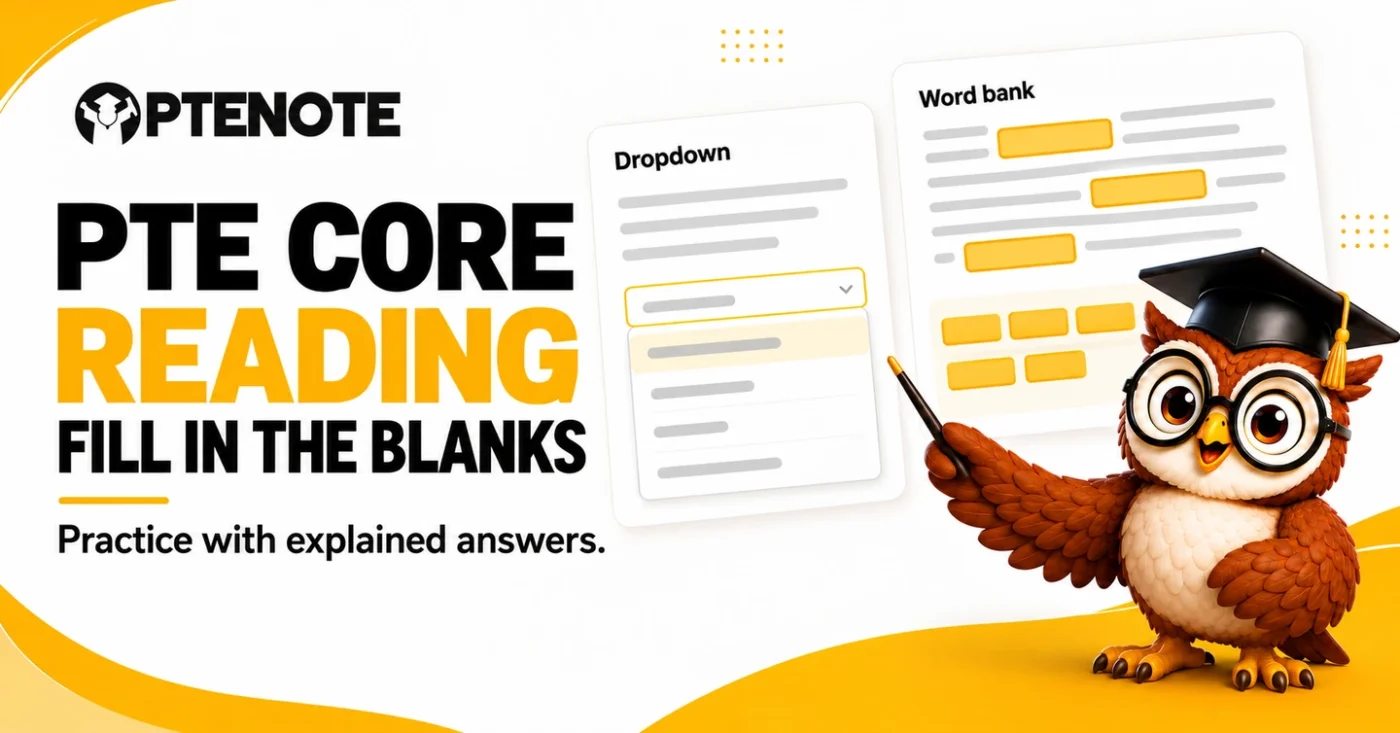
- Choose each dropdown answer from the menu beside its gap.
- For the word-bank task, drag words from the shared list into the gaps.
- Read the full sentence before choosing a word.
- Check the word form, the phrase and the passage’s meaning.
- Try our four original exercises, then explain each choice.
“Two words look right. How do I choose the one that fits?”
That is the question behind this guide. Let’s look at the clues around each gap before checking the answer key.
We will compare the two PTE Core blanks tasks first. Then you can try four short passages with clear answers. We explain why each answer fits and why the other choices fail.
We wrote these short tasks for this guide. The people and rules in them are made up. They are not Pearson questions or copies of real test items. Write your answers before you read our reasons.
How do the two PTE Core blanks tasks differ?

The dropdown task is called Reading & Writing: Fill in the Blanks. The word-bank task is called Fill in the Blanks. The table gives the current Core details from Pearson’s Reading format and Score Guide.
| Feature | Dropdown task | Word-bank task |
|---|---|---|
| How you answer | Select from a menu beside each gap. | Drag words from one shared box into gaps. |
| Maximum text length | Up to 200 words | Up to 80 words |
| Skills scored | Reading and Writing | Reading only |
| Questions in the Score Guide | 5–6 | 4–5 |
| Credit | 1 point for each correct blank | 1 point for each correct blank |
In the word-bank task, there are more words than gaps. You do not have to fit every option into the text.
Treat the point for a correct gap as task credit. Do not turn a small exercise result into a predicted official PTE score.
This lesson covers only the two blanks tasks. Our PTE Core exam format guide explains the wider test order.
Pearson can change test guidance. Check its live task page and current Score Guide before your test.
What checks can you use before choosing a word?

Try this checking order. It is our practice approach, rather than an extra Pearson rule.
- Read for the situation. Who is doing what? Notice any change, reason or condition.
- Read both sides of the gap. Include the whole sentence. Look beyond the nearest word.
- Check the word form. Ask what the sentence needs: an action, a name or a description.
- Check the word partnership. Put the choice beside its nearby words. Does the phrase fit?
- Reread the complete text. Check that your choices keep the original message clear.
Look at whole phrases such as “ready for collection” and “give permission” in the tasks below. Keep each full phrase in your notes.
Avoid choosing a word only because you know its meaning. Test its form and its place in this sentence too. For example, compare “the careful driver” with “the driver checked carefully”. Keep those small phrases together in your notes.
For a shared word bank, try the clearest gap first. Then check the remaining choices. Before finishing, read every filled sentence again rather than judging each gap on its own.
Can you solve these dropdown practice questions?

Choose one option for each numbered gap. Hide the answers until you finish the passage. These short tasks are for learning the method. They are not full Reading tests.
Exercise 1: Joining a workshop
Before using the workshop’s shared tools, each new member must (1) ______ a short induction. The tutor explains how the equipment works and asks learners to follow each instruction (2) ______. People who have (3) ______ the session receive an access card. A card is issued (4) ______ the tutor has checked that the member can use the tools safely.
An induction is an introductory session. Here, the tutor shows a new member how to use the tools.
- Gap 1: attend / attendance / attended / attending
- Gap 2: carefully / careful / care / caring
- Gap 3: completed / complete / completion / completing
- Gap 4: after / during / despite / without
Show Exercise 1 answers and reasons
Answers: 1 attend; 2 carefully; 3 completed; 4 after.
1. Attend: “Must attend” fits this sentence. “Attendance” names the act of being present; it cannot replace the action after “must”. “Attended” and “attending” are the wrong forms here.
2. Carefully: How do learners need to follow each step? “Carefully” tells us how to do it. “Careful” and “caring” tell us about a person or thing. “Care” does not fit this phrase.
3. Completed: “Have completed” shows that the session is finished. “Complete” and “completing” do not fit directly after “have” here. “Completion” is a name for the result; it cannot describe the completed action here.
4. After: The tutor checks first; the card follows. “During” and “despite” do not fit directly before “the tutor has checked”. “Without” does not fit that structure either. It would also remove the check that the passage requires.
Your review: Underline “must”, “follow each instruction”, “have” and “the tutor has checked”. Explain how each clue supports the answer.
Exercise 2: Collecting a parcel
A delivery company has moved its collection desk to a larger room. Customers receive a message when their parcel is (1) ______ for collection. They must bring the reference number (2) ______ in that message. Staff can then (3) ______ the parcel before handing it over. Parcels remain at the desk for seven days; (4) ______, uncollected items are returned to the sender.
- Gap 1: ready / readily / readiness / readies
- Gap 2: included / including / inclusion / includes
- Gap 3: identify / identification / identity / identifiable
- Gap 4: afterwards / meanwhile / beforehand / instead
Show Exercise 2 answers and reasons
Answers: 1 ready; 2 included; 3 identify; 4 afterwards.
1. Ready: “Is ready for collection” describes the parcel’s state. “Readily” describes an action. “Readiness” would need a different sentence structure. “Readies” is a verb form that does not fit after “is” here.
2. Included: Read the phrase as “the reference number that is included in that message”. “Including” would make the reference number do the including. “Inclusion” names an act or result. “Includes” cannot complete this phrase without changing the structure.
3. Identify: The staff use the number to find the right parcel. “Can identify” fits. “Identification” and “identity” name a thing, so neither fits after “can”. “Identifiable” means that a person can tell what something is. It does not fit after “can then” here.
4. Afterwards: The return happens when the seven days end. “Afterwards” fits that order. “Meanwhile” means “at the same time”. “Beforehand” means “before that point”. “Instead” signals a change of plan. Here, the text gives two steps in time.
Your review: Did you use the whole last sentence for Gap 4? Note which step comes first. Keep that clue beside your answer.
Before moving to the next exercise, try one correction sentence of your own. For example, use “is ready for” with a different subject. Keep it short enough to explain.
Can you solve these word-bank practice questions?

Use four words from each bank. In these exercises, use each selected word once. Keep the unused words beside your answer. Explain why they do not fit.
Exercise 3: A Sunday walking group
The walking group leaves from outside the museum at 9 a.m. New members are (1) ______ to join, even without experience. The leader chooses a (2) ______ route with few steep hills. Please arrive five minutes (3) ______ to sign in before departure. If heavy rain is forecast, the organiser sends a (4) ______ message and the walk does not go ahead.
Word bank: welcome / gentle / early / cancellation / gently / welcoming / later / cancel
Show Exercise 3 answers and reasons
Answers: 1 welcome; 2 gentle; 3 early; 4 cancellation.
1. Welcome: “Are welcome to join” invites the new members. “Welcoming” would describe people who greet others warmly. That is not the message here.
2. Gentle: The route has few steep hills. “Gentle” describes that route. “Gently” describes how an action happens; it cannot describe “route” in this phrase.
3. Early: Five minutes before the 9 a.m. departure gives time to sign in. “Later” would place arrival after the departure time. Check the event order instead of choosing by word form alone.
4. Cancellation: The walk will not go ahead. The message tells members that it is off. “Cancellation message” names this kind of notice. “Cancel” is the action word. It does not name the type of message here.
Unused words: gently / welcoming / later / cancel.
Now test the unused words against all four gaps. None fits the required grammar and message. If you used one, compare your completed sentence with the passage’s timing or invitation.
Exercise 4: A repair café
At the repair café, volunteers help visitors mend small household items. Visitors first describe the (1) ______ on a form. A volunteer then checks whether the item can be repaired with the tools (2) ______. Some repairs need a replacement part, so visitors must give (3) ______ before any part is ordered. Completed items are tested (4) ______ before they are returned.
Word bank: fault / available / permission / thoroughly / faulty / availability / permit / thorough
Show Exercise 4 answers and reasons
Answers: 1 fault; 2 available; 3 permission; 4 thoroughly.
1. Fault: Visitors describe the problem with the item. “The fault” names that problem. “Faulty” describes an item with a problem; it needs something to describe and cannot name the problem here.
2. Available: Read “the tools available” as “the tools that are available”. It tells us which tools the café has. “Availability” names that state. The gap needs a word to describe the tools, so use “available”.
3. Permission: “Give permission” means allow the part to be ordered. “Permit” can name an official document, but no such document is involved in this passage. As one document, it would need “a” before it. Its action use does not fit after “give” here.
4. Thoroughly: The gap describes how the items are tested. “Thoroughly” means with careful attention to the details. “Thorough” describes a person, action or thing; it does not fit directly after “are tested” here.
Unused words: faulty / availability / permit / thorough.
Your review: Write these full phrases: “describe the fault”, “tools available”, “give permission” and “tested thoroughly”. Circle the clue that supports each choice.
Did the same word form cause trouble twice? Work on that form in your next short session. Try a new sentence with the same kind of gap.
How can you review mistakes without memorising answers?

Use a small review log. For each mistake, write five things:
- Your first answer.
- The correct word.
- The full phrase around the gap.
- The clue you missed.
- One sentence to try next.
For Exercise 3, a useful note is: “I chose ‘gently route’. I needed a description of the route. Next: ‘a gentle slope’.” That is more specific than “study vocabulary”.
Keep three simple labels in your log: form, phrase and meaning. Use “form” for a choice such as “thorough” instead of “thoroughly”. Use “phrase” for “give permission”. Use “meaning” for a time word that reverses the event order.
Try this short practice round: answer one passage, check every gap, explain one error and write one new sentence. On the next day, cover the correction and try the new sentence again.
Keep your first answers on one line and your fixes on the next. If you got three gaps right and fixed the fourth after checking, record both steps. Do not count the corrected response as a new test attempt.
When you begin timed practice, record accuracy alongside time. If a decision took too long, note exactly where you got stuck. Was it a word you did not know, a phrase you had not met, or repeated checking without a new clue?
Choose the next exercise from that note. Do not use this small set to promise yourself a score or a date for reaching it.
Frequently asked questions
Must every blank be correct to earn credit?
No. The dropdown task gives one point for each correctly completed blank. The word-bank task also gives one point for each correctly completed blank.
Do both blanks tasks contribute to Writing?
The dropdown task contributes to Reading and Writing. The word-bank task contributes to Reading only. Check the test name when using a guide: this article covers PTE Core.
Can I make a choice when I am unsure about a dropdown gap?
Yes. Pearson does not deduct points for an incorrect dropdown answer. Choose an answer rather than leaving the gap empty. Use the sentence clues to narrow the choices first.
Are these official questions or a complete Reading test?
No. We wrote these short tasks and the answer notes. Use them to choose a word and explain why it fits. For official practice, use Pearson’s current Core tasks.
What can you practise next?
Choose one gap you missed. Cover the explanation and point to the clue in the sentence. Then write a fresh sentence using the same phrase or word form.
Return to the other exercise type tomorrow. Keep both the individual dropdown choices and the shared word bank in your practice. Let your review notes decide which error to tackle next.