Book PTE Exam
 PTE Voucher
 PTE Mock Tests
 Pricing
 About Us
 Blog
 Practice


Key Takeaway
- Your accent itself does not lower your PTE Academic score.
- Pearson accepts regional and national varieties of English pronunciation when regular English speakers can understand them.
- Pronunciation is about clear vowels, consonants, words and stress.
- Oral fluency is about smooth rhythm, phrasing and a natural speaking rate.
- Do not copy a British or American accent. Work on unclear words, misplaced stress, long pauses, repeated starts and rushed speech.
“My English is clear, but I have an Indian accent. Will PTE reduce my score?”
That worry is common, and the answer is good news. You do not need to hide your accent or sound British, American or Australian. PTE checks if your speech is clear and smooth.
Accent, pronunciation and oral fluency are linked, but they are not the same. This guide shows you the difference and what to practise when a voice clip sounds unclear or broken.
Does Accent Affect Your PTE Academic Score?

No. Your accent itself does not lower your PTE Academic score. Pearson says its scoring engine does not discriminate against accents.
Pearson also states that PTE Academic accepts regional and national types of English pronunciation when English speakers can understand them. This means your home accent is not a scoring problem by itself.
Your words still need to be clear. A changed sound, lost word ending or stress on the wrong part can make a word hard to hear. That is a pronunciation issue. It is not about where your accent comes from; it is about clear speech.
So, does accent affect PTE score? Accent is not the target. Clear pronunciation and smooth oral fluency are the targets.
Pearson advises you not to change your accent. Focus on clear speech and smooth flow instead.
What Is the Difference Between Accent, Pronunciation and Oral Fluency?
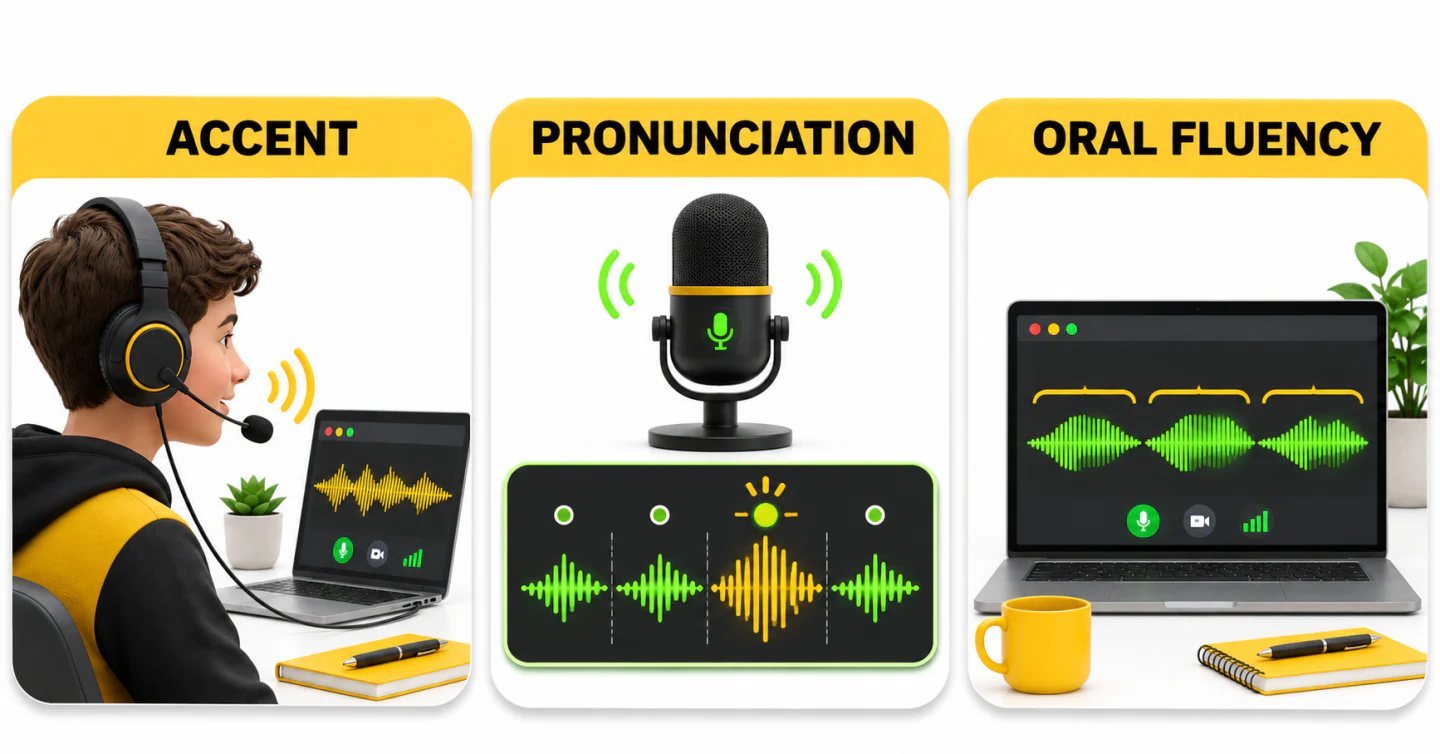
An accent is how people from a place, country or social group say words. It is part of how your voice sounds.
Pronunciation and oral fluency are scoring traits in some PTE speaking tasks, and Pearson scores them as two traits. Check them one at a time.
| Term | Simple meaning | What to notice in a recording | Do you need to change it? |
|---|---|---|---|
| Accent | Your overall way of sounding | The sound pattern linked to your language or community | No. Keep it when your speech is clear. |
| Pronunciation | How clearly you produce sounds, words and stress | Unclear vowels or consonants, missing endings and stress on the wrong syllable | Fix a sound or stress pattern that hides a word. |
| Oral fluency | How smoothly your speech moves | Long pauses, repeated starts, word-by-word speech, rushing and uneven phrasing | Use a steady rate and speak in short phrase groups. |
Here is an example: a student says, “The research results were surprising.” The accent is the sound of the full sentence, while pronunciation tells us if “research” and “results” are clear. Oral fluency tells us if the words flow as a phrase or come out in six parts.
Now picture two students from the same city reading that line. The first makes each key word clear and keeps the phrase together. The second drops word endings, pauses after each word and starts again twice. In this example, their accent is the same, but their practice needs are not. One student needs clearer endings; the other needs smoother flow. “Strong accent” is too broad to tell either student what to fix.
What Should You Improve for a Stronger Pronunciation Score?
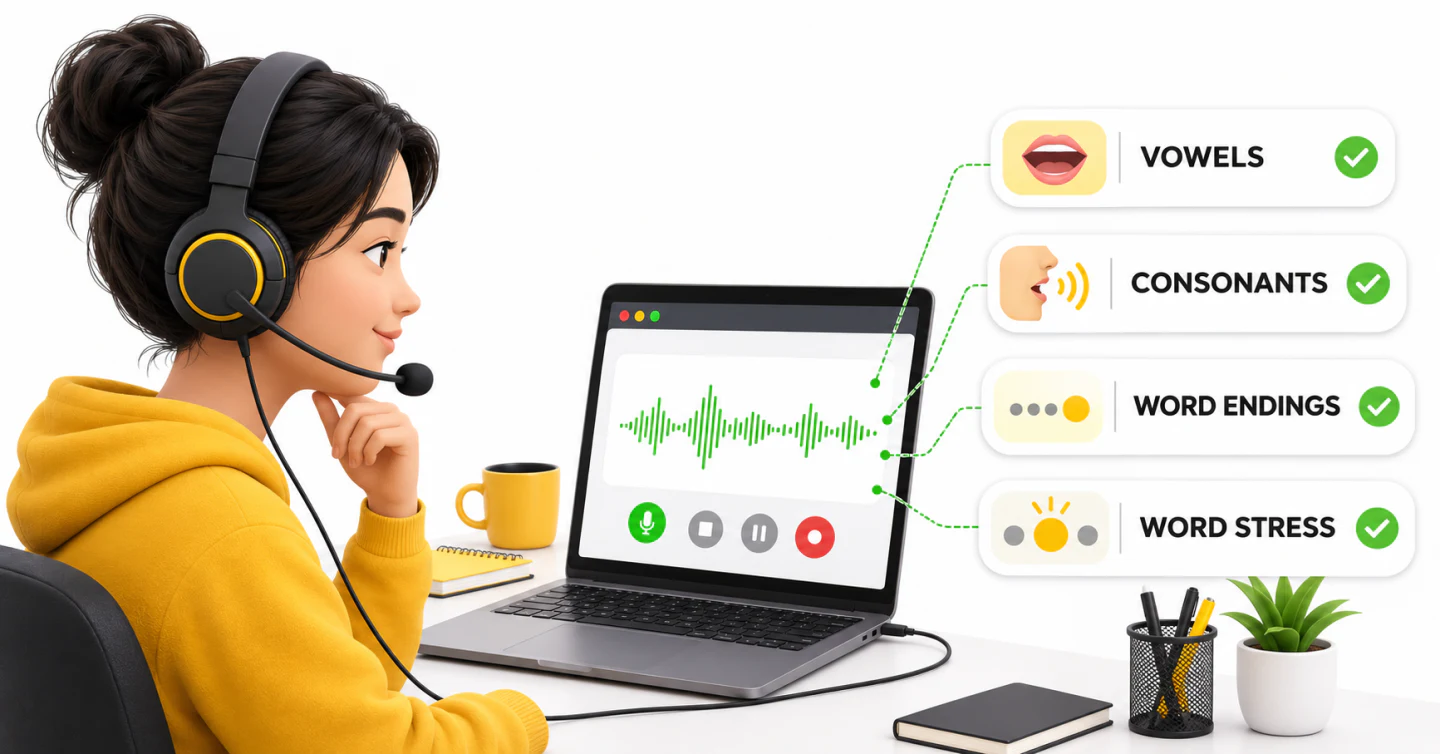
Pearson scores pronunciation by checking if English speakers can understand you with ease. Its guide focuses on vowels, consonants, words and stress.
That is a better goal than “sound more British,” so record a short PTE answer and check these points:
- Can you hear the start and end of each key word? Listen for endings such as -s, -ed and -ing. Do not make them too strong; just make them clear.
- Do two different words sound too similar? Choose the exact pair that causes trouble and practise it in short sentences.
- Is the strong syllable in the right place? Use a good online dictionary to check word stress.
- Does your volume fall at the end of a phrase? Keep the final words clear instead of letting them disappear.
- Can an English speaker write the word they heard? Ask which word was unclear, not for a judgement of your accent.
Work on one repeated problem at a time. For example, if “worked” sounds like “work,” practise the final sound inside three short sentences. Keep your natural voice and normal accent.
Do not try to copy an accent. Pearson’s top score guide focuses on speech that is easy to understand. Clear sounds and word stress matter more than a national accent.
How Can You Improve Oral Fluency Without Changing Your Accent?
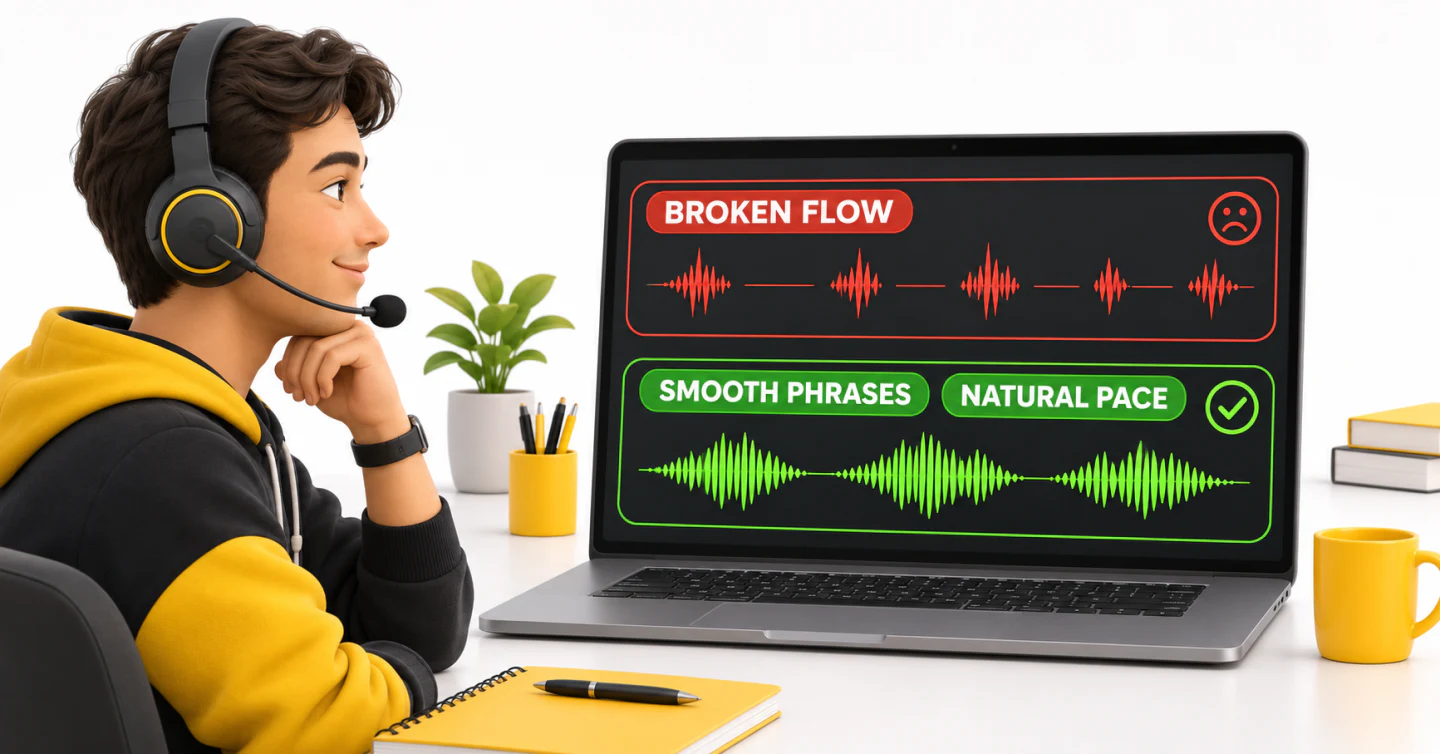
Pearson links oral fluency to smooth rhythm, phrasing and stress. The best answers use a steady, natural speaking rate and good phrasing. Hesitation, repeated words and false starts lower the score.
Fast speech is not always fluent. When you rush, words can join in the wrong places and key endings can fade. Use a pace that lets you finish short groups of meaning.
Try this short routine:
- Choose one response of about 30 to 40 seconds.
- Mark short phrase groups with a slash. For example: “The chart compares four age groups / and shows a steady fall in weekly visits.”
- Record the response once at your normal pace.
- Listen for one long pause, restart or rushed phrase.
- Record one more attempt and fix only that break.
Keep short pauses between ideas because they help people follow you. Avoid a pause inside a phrase, a long silence or several restarts.
You can find a broader task routine in our PTE speaking practice guide. Use it after you identify whether pronunciation or oral fluency needs more attention.
How Do You Find the Real Problem in Your Own Recording?

Do not listen to a voice clip and write, “My accent is bad.” That note is too broad and does not tell you what to do next.
Use three passes instead:
- Pass 1 — words: Write down each word you cannot hear at once. This is your pronunciation list.
- Pass 2 — flow: Mark long pauses, repeated starts and places where every word sounds separate. This is your oral-fluency list.
- Pass 3 — message: Check that the answer fits the prompt.
Now choose one fix. If three word endings are unclear, practise those endings; if you stop after a few words, mark phrase groups. If you restart after small mistakes, practise speaking to the end.
A PTENOTE mock-test score is preparation feedback, not an official Pearson result. Our PTE mock tests can help you record and review timed answers. To learn how the wider score works, read our guide to the PTE scoring system.
Frequently Asked Questions
Do I need a British or American accent for PTE Academic?
No. Pearson accepts clear types of English from many regions and nations. Keep your own accent, and focus on clear words, correct stress and smooth speech.
Does an Indian accent affect the PTE score?
An Indian accent does not lower the score by itself. The same rule applies to other accents. The issue starts only when English speakers cannot understand your words with ease.
Is pronunciation the same as accent?
No. Accent is your way of sounding, while pronunciation is how clearly you say sounds, words and stress. You can keep a strong accent and still speak with clear pronunciation.
Is oral fluency the same as speaking fast?
No. Oral fluency means smooth rhythm, phrasing and a natural rate. Rushed speech can become unclear and uneven.
Can I pause during a PTE speaking response?
Use short pauses between complete ideas. Avoid long silences, repeated starts and pauses that break a phrase in the middle.
What should I practise first: pronunciation or oral fluency?
Listen to one recording before choosing. If words are hard to recognise, begin with pronunciation. If the words are clear but the response stops, restarts or rushes, begin with oral fluency.
Keep Your Accent and Improve the Part PTE Scores
Your accent is not a mistake to remove. Keep the voice that feels natural to you.
Focus on the traits PTE scores: clear pronunciation and smooth oral fluency. Record one answer, name one exact problem and try again. That is a better goal than trying to sound like someone from another country.