Book PTE Exam
 PTE Voucher
 PTE Mock Tests
 Pricing
 About Us
 Blog
 Practice



Key Takeaway
- You get 20 seconds to prepare after the audio ends.
- You then have 40 seconds to speak.
- Speak to the person in the situation.
- Plan the listener, goal, key details and next step.
- Use our examples to learn a method, then choose your own words.
You understand the situation. Then the microphone opens, and you cannot decide how to begin.
Start by choosing what you need from the other person. Are you asking for a change, explaining a problem or suggesting a new plan? Build your response around that purpose.
In this guide, we explain PTE Core Respond to a Situation and work through three original examples. You will see the prompt, a short plan, a sample response and the reason for each choice.
What happens in PTE Core Respond to a Situation?
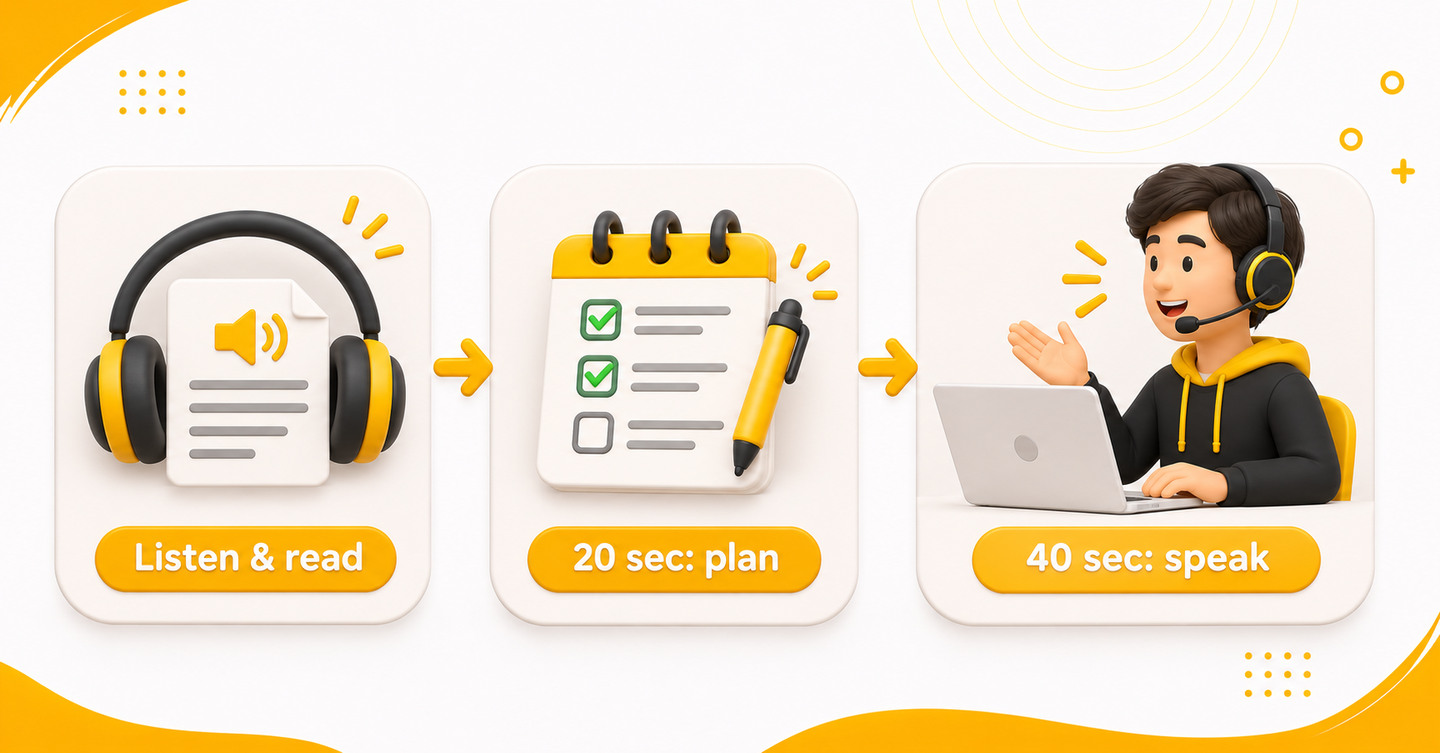
The official task description says: You read and hear an everyday situation, then say what you would say in that situation.
| Task detail | PTE Core rule |
|---|---|
| Prompt | The prompt contains up to 60 words. |
| Preparation | You get 20 seconds to prepare after the audio ends. |
| Response | You then have 40 seconds to speak. |
| Questions | The Score Guide lists 2–4 Respond to a Situation questions. |
| Skill | This task contributes to Speaking. |
The audio plays once. You can record your answer only once. Start after the tone; speech before the microphone opens is not recorded.
You can take notes on the provided erasable whiteboard while the audio plays. Keep your notes short. A few words such as “supervisor — training time — counter duty” are enough for our method.
Pearson scores Appropriacy, Pronunciation and Fluency. Here is what those terms mean:
- Appropriacy checks whether your language and level of formality suit the situation and the person you address.
- Pronunciation checks how easily regular English speakers can understand your speech.
- Fluency checks the flow, rhythm and phrasing of your speech.
The task uses partial credit rather than a simple right-or-wrong mark. You get no credit for silence or an answer that is not about the situation.
For the complete test order, use our PTE Core exam format guide. Check Pearson’s live Core task guidance and current Score Guide before your test.
How can you plan and deliver a clear response?
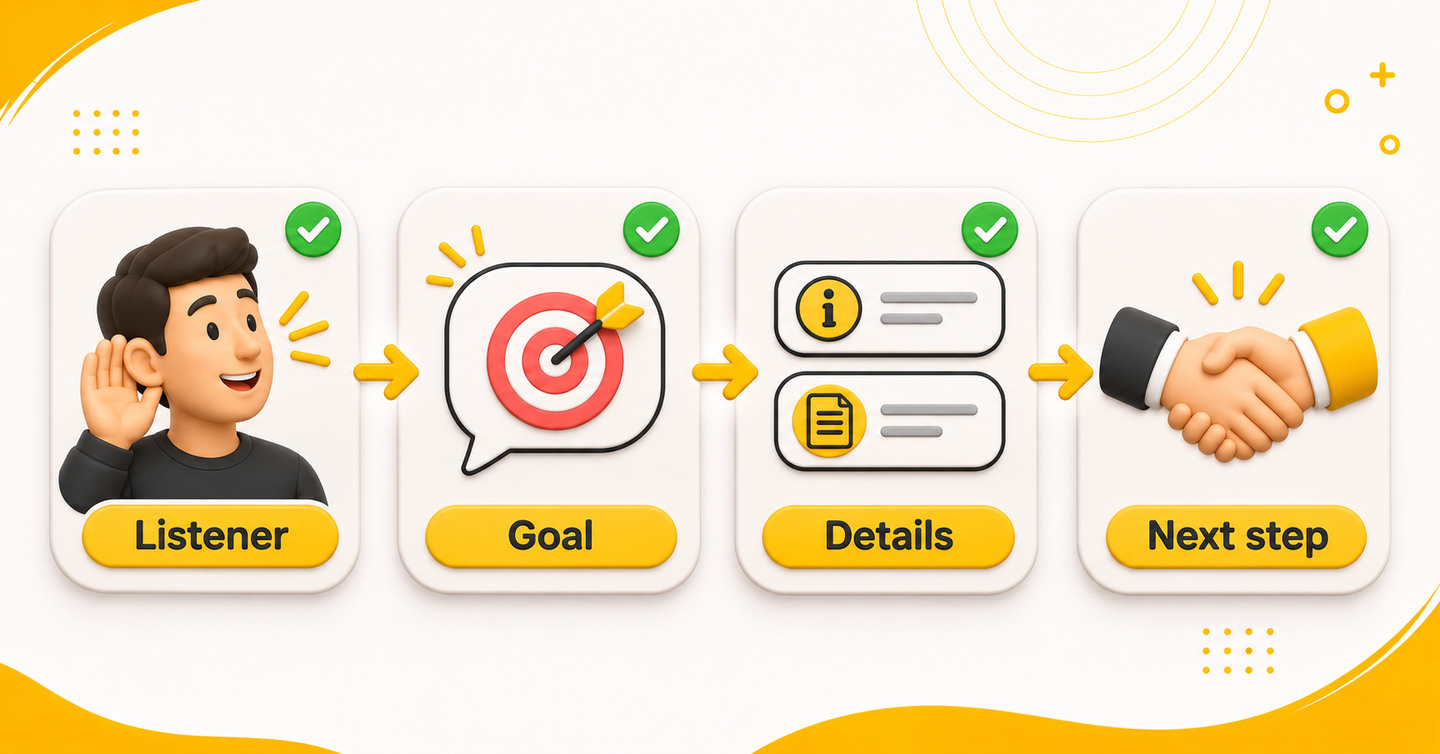
We recommend the following method. It is a planning tool, not a fixed answer to memorise. Read the whole prompt before choosing your message.
- Find the listener. Decide who you are speaking to. Is it a supervisor, a shop worker or a friend? Choose an opening that fits. “Hello, could I ask about…” suits a work request. “Hi, can we change…” suits a friend.
- Name your goal. Put the purpose into a few words: change the time, find the right item or move a meeting. Begin the response with that purpose instead of retelling the whole prompt.
- Keep the details that matter. Notice the reason, time, place or problem the listener needs. Check numbers carefully. Keep the facts from the prompt unchanged, and avoid adding a new emergency or promise.
- Choose a next step. Ask for a clear action or offer an option that fits the situation. End with something the listener can respond to: a new time, a receipt check or a choice between two plans.
During preparation, try planning ideas rather than full sentences. For a work request, your plan can be as short as: “supervisor / move training / counter duty / later session.”
When you speak, turn those notes into a connected message. Give the request, explain the reason and offer the next step. You do not need to say the planning labels aloud.
For tone, compare these two openings:
- To a supervisor: “Could I discuss tomorrow’s training time with you?”
- To a friend: “Hi, can we meet a little later tomorrow?”
Both are polite. The first sounds more formal; the second sounds relaxed. Practise changing the opening when the listener changes, while keeping the purpose clear.
Pearson advises trying to speak for the whole 40 seconds. Use relevant detail to develop your message. Avoid repeating the same request just to fill time. Rehearse the examples with a timer, then shorten any sentence you cannot say comfortably.
What do the worked examples look like?
We wrote the following fictional situations for teaching. They are not official Pearson questions or predictions. Read a prompt and try your own response before reading our sample. The written models show possible wording; they are not scored recordings.
Example 1: Ask a supervisor to change a training time
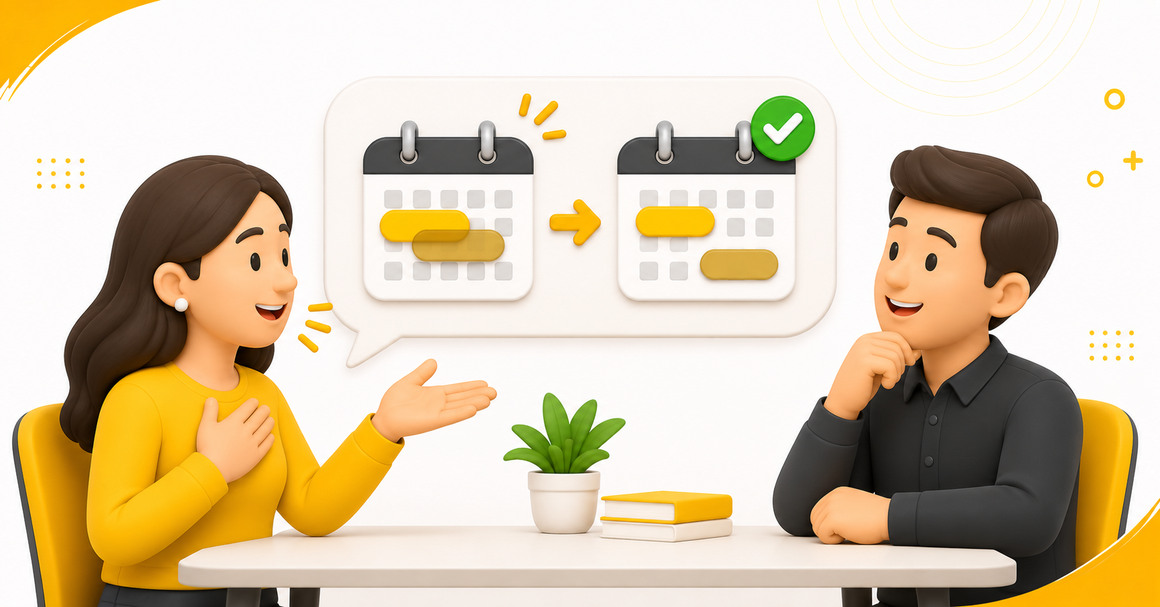
Prompt: Your supervisor has arranged training for tomorrow at 2 p.m. You must serve customers at the front counter until 3 p.m., and no one is available to cover you. Ask whether you can attend a later session. Explain why you cannot join at 2 p.m.
Short plan: Supervisor; request later training; counter duty until three; ask about another session.
Sample response:
Hello, could I ask about tomorrow’s training? I would like to attend, but I am on the front counter until three, and there is no one to cover me. Could I join a later session instead of the one at two? I want to complete the training without leaving customers waiting at the counter. Please let me know whether there is a later session I can attend. Thank you for helping me arrange this.
The request comes near the start. The reason is specific: counter duty ends at three, and no one can cover. The speaker asks for a later session without claiming that a new session already exists.
Notice the difference between asking and announcing. “I will come at four” decides a time the prompt never offered. “Is there a later session I can attend?” asks what is possible.
Check your version: Did you include the two o’clock training, the three o’clock finish and the lack of cover? If one detail is missing, add it to your plan before your next attempt.
Example 2: Resolve a mix-up at a repair shop

Prompt: You arrive at a repair shop to collect your desk lamp. The staff member brings out a black lamp, but yours has a blue shade. You have the collection receipt. Explain the mix-up politely and ask the staff member to find your lamp.
What needs to change? The staff member needs to check the item against the receipt. Your goal is to collect the right lamp.
A weak opening would be: “You gave me the wrong thing. This is bad.” It names a problem but leaves out the blue shade and the receipt. It also starts by blaming the listener.
A fuller response:
Excuse me, I think there has been a mix-up with my collection. The lamp you brought out is black, but mine has a blue shade. I have my collection receipt here. Could you please check the details and help me find my lamp? I would like to collect the correct one. Thank you for checking it for me; I appreciate your help with sorting this out.
The speaker uses the colour difference to identify the problem. “I have my collection receipt here” offers something the worker can check. The final request is clear and polite.
No refund, repair charge or damaged item appears in this prompt. Keep those matters out of your response. They would change the problem you were asked to solve.
Try the opening again: Put the item and the colour difference into your own first two sentences. Then ask for the receipt check without copying our full model.
Example 3: Change a plan with a friend

Prompt: You planned to cook dinner with a friend at 6 p.m. tomorrow. Your grocery collection has moved to 6 p.m., so you cannot start cooking until 7 p.m. Apologise and ask whether your friend prefers to start at seven or cook together another day.
Plan the choice: Friend; apologise; grocery collection at six; cooking at seven or another day.
Hi, I am sorry, but can we change our cooking plan for tomorrow? My grocery collection has moved to six, so I cannot start cooking until seven. Would you be happy to start at seven instead? If that is too late, we can choose another day to cook together. I am sorry for changing the plan. Let me know which option suits you, and we can arrange it from there.
The opening sounds like a message to a friend. The speaker explains the delay briefly, then gives the two choices requested in the prompt. The friend gets a clear question to answer.
Compare “I cannot come tomorrow” with the sample. That short statement loses the option of starting at seven. In your response, keep both choices instead of turning a delay into a cancellation.
Review the tone: A phrase such as “I request your permission to amend our arrangement” sounds much stiffer here. Use words you would comfortably say to a friend.
How can you review an answer and practise again?

Start with one example. Set a preparation timer, then record a response within the task’s speaking limit. Keep the model hidden during your attempt.
Replay your answer and use these questions. This is our practice checklist, not Pearson’s scoring scale.
| Review area | Ask yourself | Next practice action |
|---|---|---|
| Fit | Did I address the person and complete the request? | Underline each required detail in the prompt. Find it in your answer. |
| Clarity | Can I understand the important words, names and times? | Practise the unclear phrase, then record the whole message again. |
| Flow | Where did I stop, restart or rush? | Shorten one difficult sentence. Try the response again at a steady pace. |
Choose one change for the next attempt. For example, move a hidden request to the opening, add a missed time or replace a long sentence with two short ones. Listen again to check whether you made that change.
Then use a fresh situation. Repeating the same model word for word is not the goal. Try a new listener or purpose and build the message again.
For a short study session, we suggest one prompt, one recording, one careful review and one retry. On another day, mix this task with your other speaking work. Our 30-day PTE Core study plan can help you organise the wider practice.
When you review a full mock, use the result as preparation feedback. Our guide to using PTE mock tests explains that review process. A mock result does not guarantee your official Pearson result.
Frequently asked questions
How much time do I have?
You get 20 seconds to prepare after the audio ends. You then have 40 seconds to speak.
How many questions are there?
The Score Guide lists 2–4 Respond to a Situation questions.
Can I take notes?
You can take notes on the provided erasable whiteboard while the audio plays. For our method, note the listener, goal and essential details.
Can I record a second answer in the exam?
You can record your answer only once. Keep the retries in this guide for practice.
Do I need to memorise these sample responses?
No. Use them to study the choices behind a response. Cover the sample, read the prompt and explain the same message in your own words.
Is this the PTE Academic guide?
This page covers PTE Core. For Academic preparation, use our separate PTE Academic Respond to a Situation guide.
What can you try next?
Choose the repair-shop example and cover the sample. Plan the receipt check, then record your own polite request. Replay it once and check whether the listener has enough detail to help. Use that one finding to decide what to change.