Book PTE Exam
 PTE Voucher
 PTE Mock Tests
 Pricing
 About Us
 Blog
 Practice


Key Takeaway
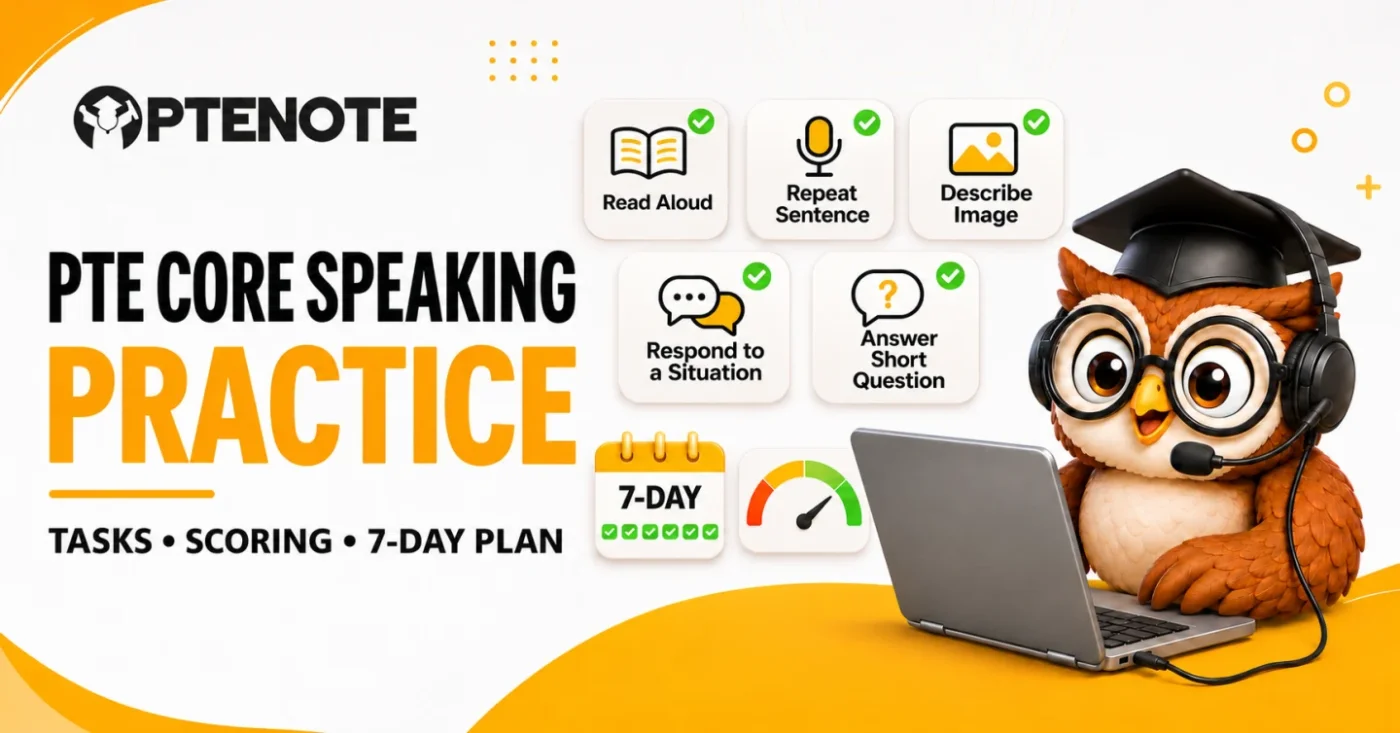
- PTE Core has five scored speaking task types: Read Aloud, Repeat Sentence, Describe Image, Respond to a Situation and Answer Short Question.
- Read Aloud, Repeat Sentence and Describe Image check Content, Pronunciation and Oral fluency. Respond to a Situation checks Appropriacy, Pronunciation and Oral fluency.
- Answer Short Question is different. Pearson marks it correct or incorrect for Vocabulary, and it affects both Listening and Speaking.
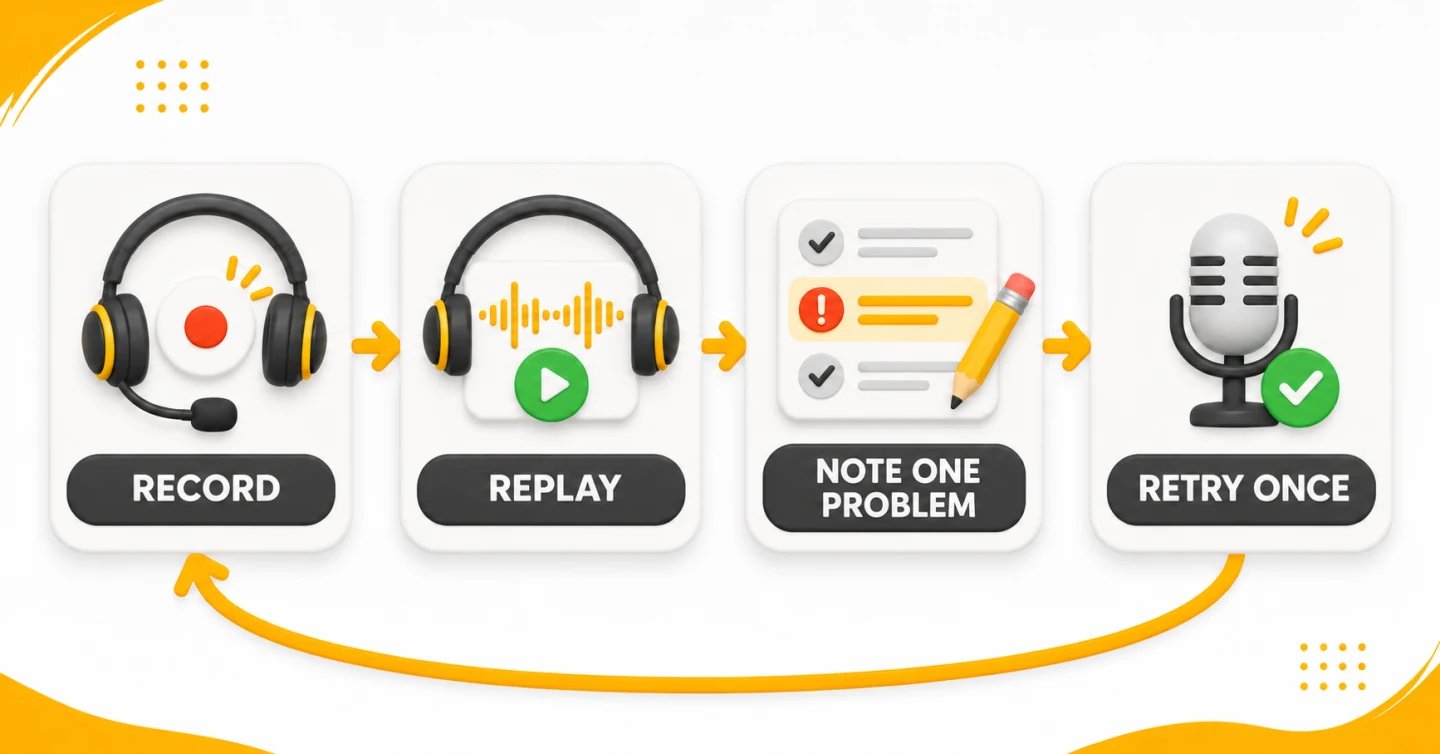
- Use one practice loop: record a timed answer, replay it, find one clear problem and retry once.
- The seven-day plan below covers all five tasks, scoring checks, mixed practice and a final weekly review.
“I practise speaking every day, but I do not know whether I am practising the right things.”
Many PTE Core students have this problem. Speaking for a long time is not enough. Each task asks you to do something different. Pearson does not use the same scoring traits for every answer.
This guide gives you a simple way to practise. First, learn the five Core speaking tasks. Next, check the scoring trait that matters for each one. Then use the seven-day plan to record, review and correct your answers.
Use PTE Core material for the plan below. For the full test order, use our PTE Core exam format guide.
Pearson can change test information. The task details in this guide were checked against Pearson’s live PTE Core pages and 2026 Score Guide on 16 November 2026. Check the live sources again before your test.
What Are the Five PTE Core Speaking Tasks?
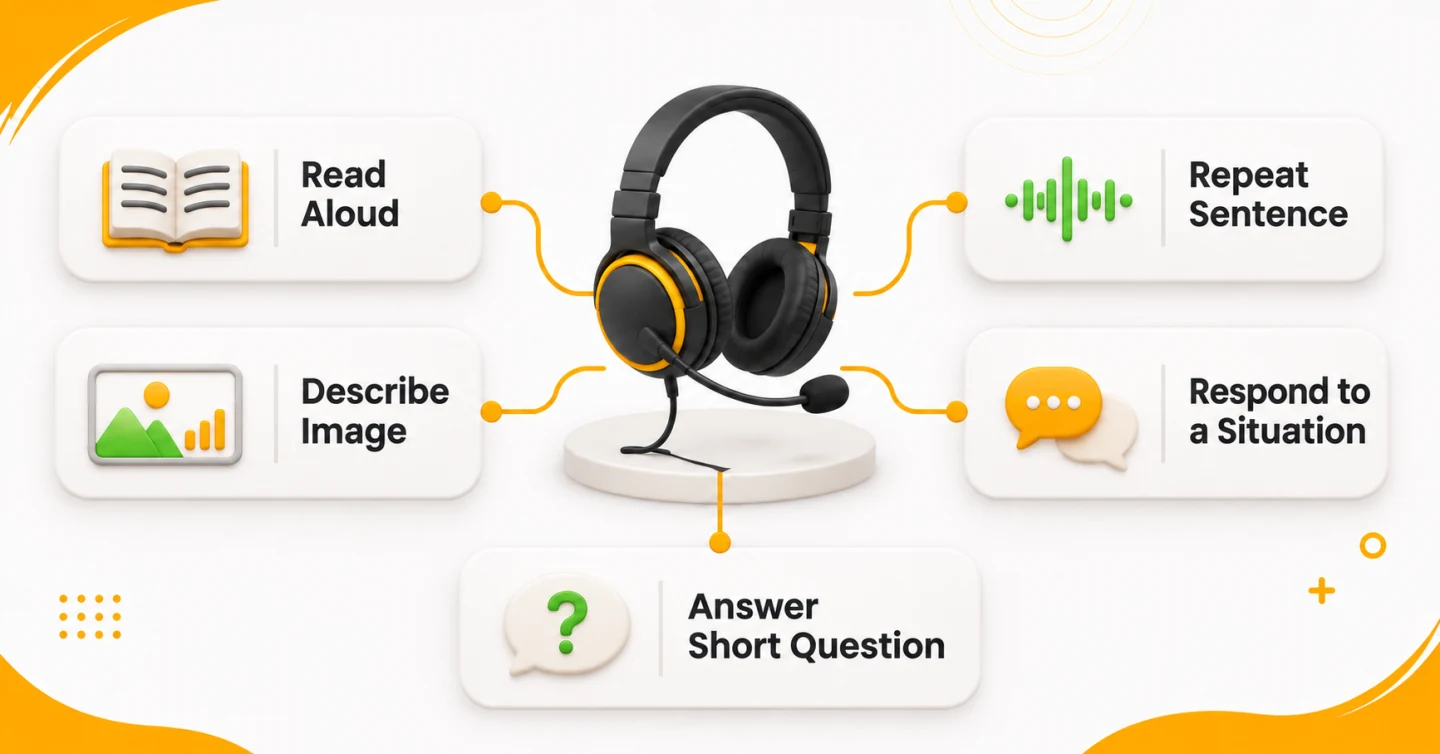
Speaking and Writing share Part 1 of PTE Core. Pearson lists this part at 50–65 minutes with seven question types. Five are speaking tasks and two are writing tasks.
The Personal Introduction gives you 25 seconds to prepare and 30 seconds to record, but it does not affect your score.
The table below focuses on the five scored speaking tasks.
| Task | Questions | What you do | Time | Skills scored |
|---|---|---|---|---|
| Read Aloud | 6–7 | Read an on-screen text of up to 60 words | 30–40 seconds to prepare; answer time varies | Reading and Speaking |
| Repeat Sentence | 10–12 | Hear one sentence and repeat it | A 3–9 second prompt and a 40-second recording window | Listening and Speaking |
| Describe Image | 3–4 | Explain the main information in an image | 25 seconds to prepare; 40 seconds to speak | Speaking |
| Respond to a Situation | 2–4 | Say what you would tell someone in an everyday situation | 20 seconds to prepare; 40 seconds to speak | Speaking |
| Answer Short Question | 5–6 | Answer a spoken question in one word or a few words | A 3–9 second prompt; 10 seconds to answer | Listening and Speaking |
Keep this Core plan focused on the five speaking tasks above.
How Is PTE Core Speaking Scored?
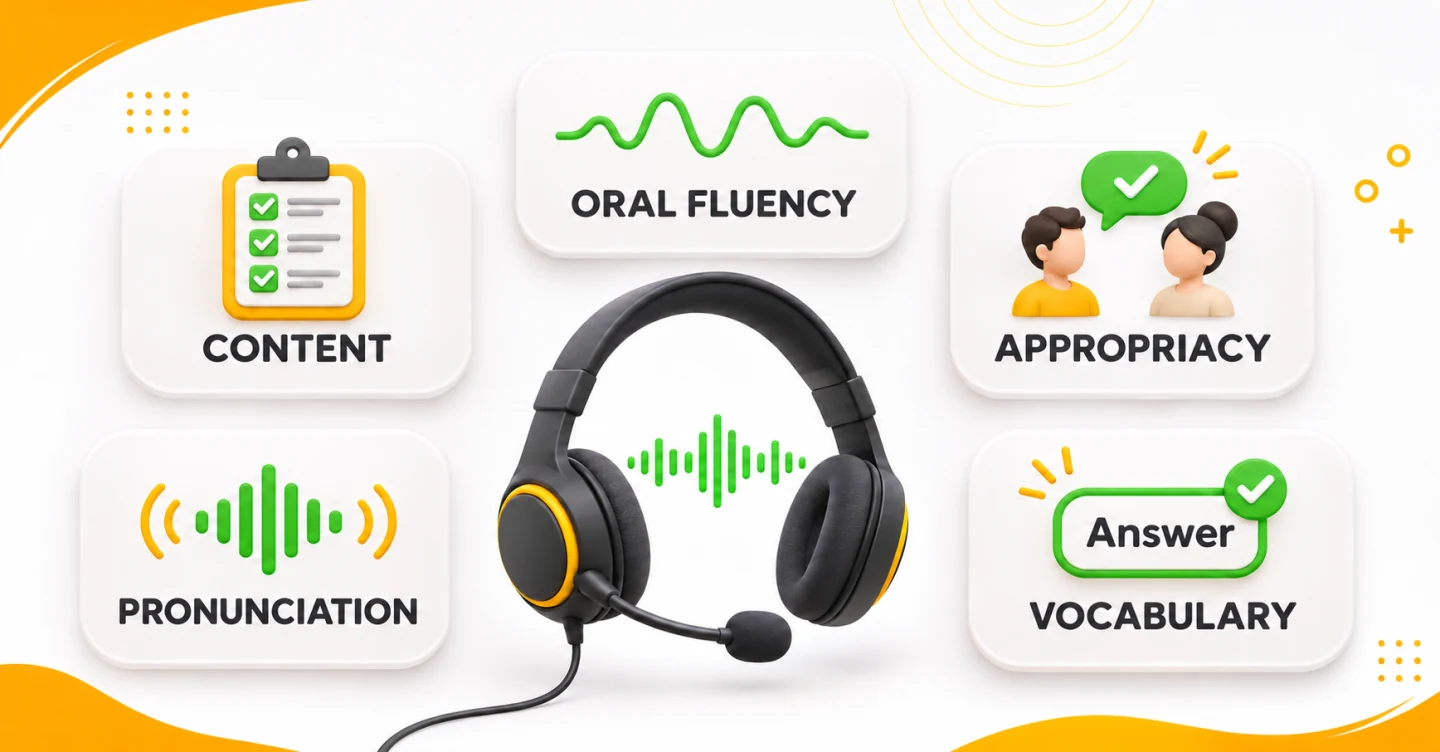
Pearson reports PTE Core scores on a scale from 10 to 90. Use item counts to plan practice. Do not try to convert them into a fixed number of Speaking points.
Most speaking answers receive partial credit. Answer Short Question is the exception because Pearson marks it correct or incorrect.
Use these simple checks when you review an answer:
| Trait | What to check | Tasks |
|---|---|---|
| Content | Check the correct words or the important information from the prompt. | Read Aloud, Repeat Sentence, Describe Image |
| Pronunciation | Check whether regular English speakers can understand your sounds, words and stress. | Read Aloud, Repeat Sentence, Describe Image, Respond to a Situation |
| Oral fluency | Check for a smooth, natural rate and useful phrasing. | Read Aloud, Repeat Sentence, Describe Image, Respond to a Situation |
| Appropriacy | Check whether your words, tone and level of formality fit the person and situation. | Respond to a Situation |
| Vocabulary | Check for an appropriate word or short phrase. | Answer Short Question |
Pearson uses a 0–5 scale for Pronunciation and Oral fluency in the four longer speaking tasks. Describe Image Content also uses a 0–5 scale. Repeat Sentence Content uses a 0–3 scale, and Respond to a Situation Appropriacy uses a 0–3 scale.
You do not need to copy a British, American or Australian accent. Pearson recognises regional and national forms of English when regular English speakers can understand them. In practice, listen for unclear sounds, missing word endings, uneven volume and rushed phrases.
How Should You Practise Each PTE Core Speaking Task?
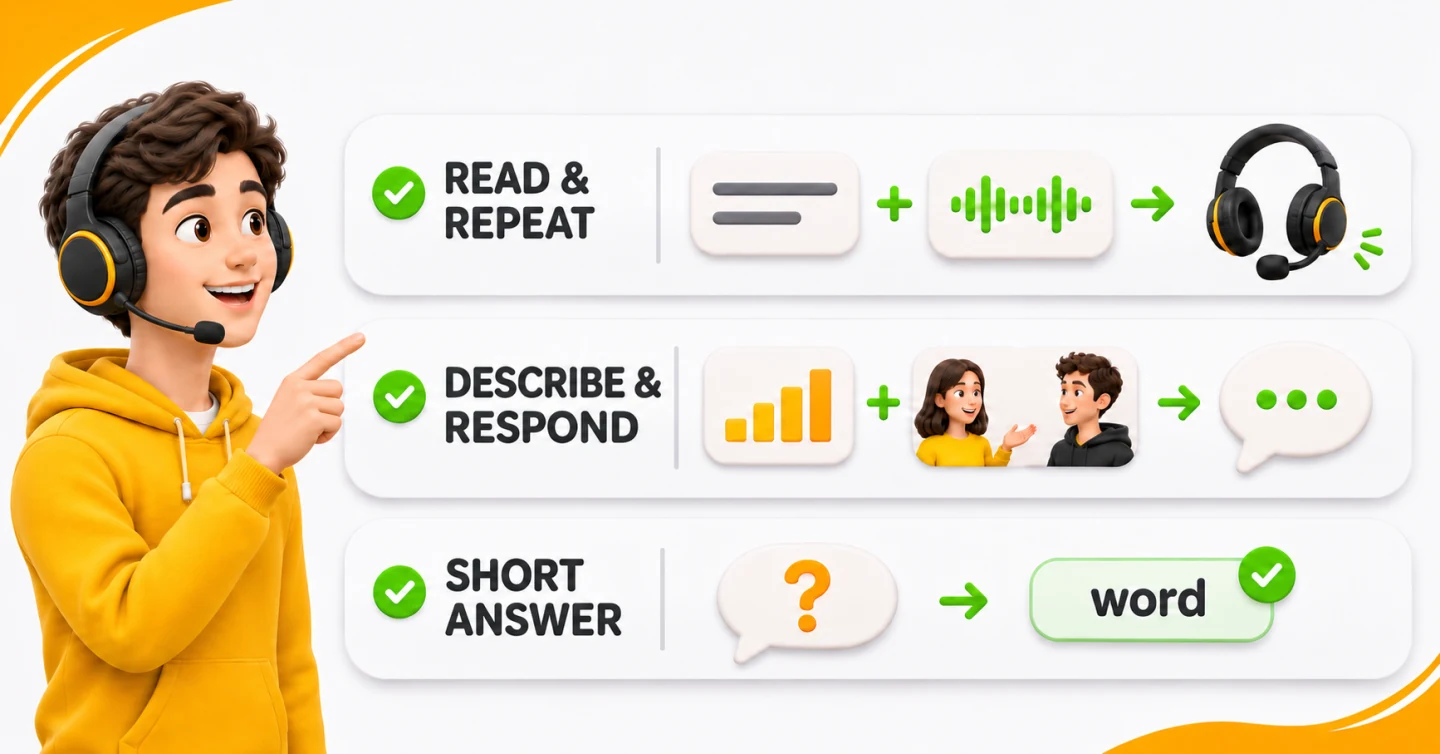
Start every session with the same four-step loop:
- Read the task instruction and set the correct timer.
- Record one answer without restarting.
- Replay the answer and check the task’s scoring traits.
- Choose one problem, then record one corrected retry.
That loop stays the same. The practice method changes with the task.
Read Aloud
Use the preparation time to divide the text into short meaning groups. Mark the words that carry the main idea. Read once at a steady speed.
Check three things when you replay it. Did you miss, add or replace a word? Were any words hard to understand? Did you pause in the middle of a phrase?
Do not repeat the passage until it sounds memorised. One careful retry is enough. Use a new passage in the next session.
Repeat Sentence
Listen for two or three short phrase groups instead of chasing every word one by one. Repeat the groups in the same order. If the last part is lost, say the accurate words you remember instead of inventing a new ending.
For a short drill, use six sentences. Record every first attempt. Replay only the two weakest answers, note where the correct sequence broke, then try those two once more.
Describe Image
Use the 25 seconds to choose four things: the subject, the main pattern, two useful details and a clear final point. The words must fit the image in front of you.
Avoid a full memorised script. Pearson’s lowest Content level includes responses with a large amount of prepared material that does not deal with the image.
For a deeper method and original examples, use our PTE Core Describe Image guide.
Respond to a Situation
Before speaking, identify the person, your purpose and the right tone. Then answer as if you are speaking directly to that person.
For example, a message to a manager needs a polite request and enough detail to understand the problem. A message to a close friend can sound more relaxed. Do not retell the prompt as an outside narrator.
During review, ask: Did I complete the real purpose? Did my tone fit the listener? Did I include the important detail? Those questions check Appropriacy before you focus on delivery.
Answer Short Question
Give one accurate word or a few words. A long explanation earns no extra marks.
Practise in quick groups of ten. Listen once, answer immediately, and mark each answer correct or incorrect. Put unknown words into a small vocabulary list, but keep the spoken answer short.
How Do You Review a Speaking Recording?
Do not judge a recording with one vague question such as “Did I sound good?” Use a short checklist.
- Task answer: Did I do what the prompt asked?
- Content or Appropriacy: Did I keep the correct words, key information or suitable tone?
- Pronunciation: Which exact word was hard to understand?
- Oral fluency: Where did I pause, repeat, restart or rush?
- Recording: Was my voice clear and steady?
Write only the main repeated problem in your error log. “Speaking was weak” is not useful. “I paused after every two words in Read Aloud” gives you a clear action.
Use five columns:
| Date | Task | Main problem | One correction | Retry result |
|---|---|---|---|---|
| ___ | ___ | ___ | ___ | ___ |
One correction keeps the retry focused. Save the other problems for later sessions.
What Is the 7-Day PTE Core Speaking Plan?
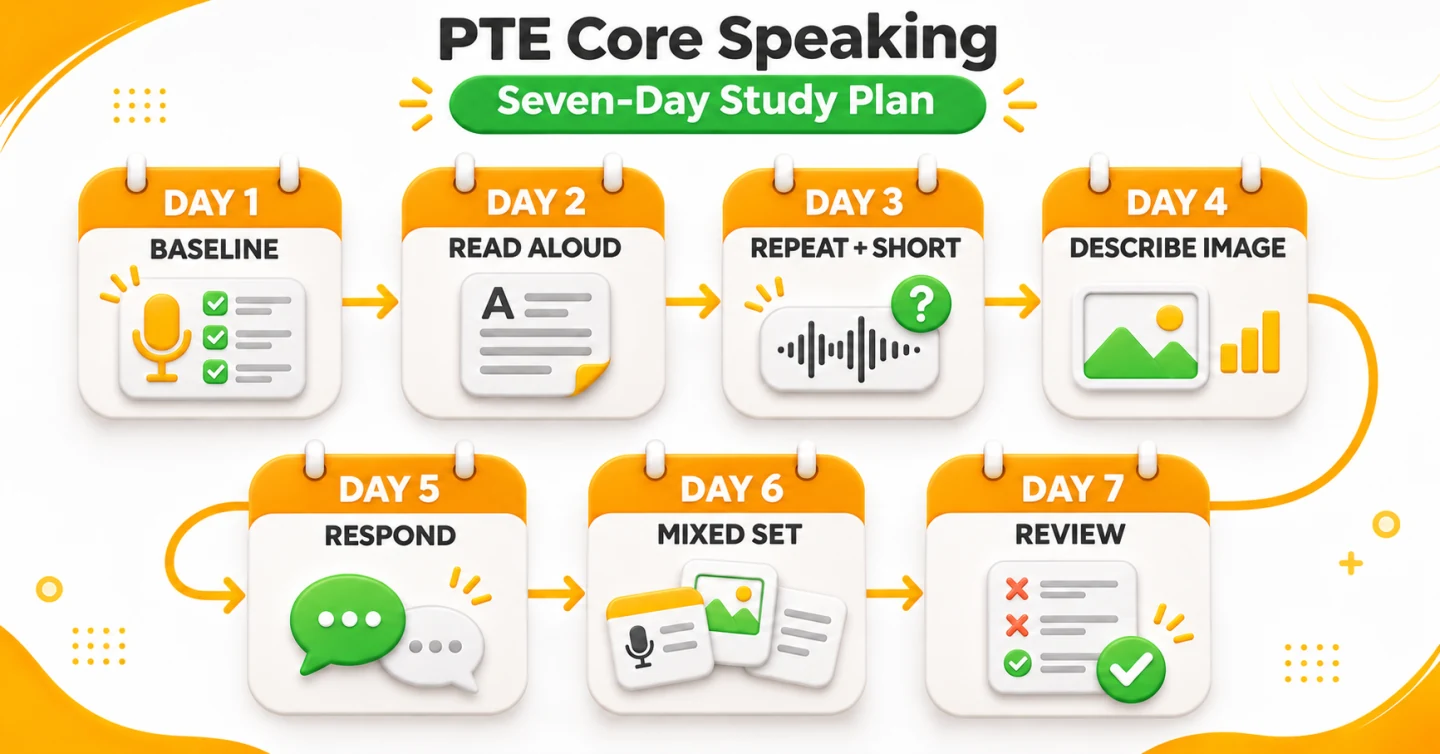
Use 35–45 minutes for each normal day. If you have less time, reduce the number of answers but keep the review and one retry.
| Day | Main work | Review focus |
|---|---|---|
| Day 1 | Record a short baseline set: two Read Aloud, four Repeat Sentence, one Describe Image, one Respond to a Situation and five Answer Short Question items. | Find the two clearest repeated problems. Do not try to fix everything. |
| Day 2 | Practise Read Aloud with phrase marks and accurate words. Finish with four Repeat Sentence items. | Word errors, phrase breaks, stress and clear endings. |
| Day 3 | Practise Repeat Sentence in short phrase groups. Add ten Answer Short Question items. | Correct word order, immediate starts and short accurate answers. |
| Day 4 | Practise three Describe Image items with the full 25-second plan and 40-second response. | Main idea, connected details, clear speech and smooth phrasing. |
| Day 5 | Practise four Respond to a Situation items with different listeners and purposes. | Purpose, register, politeness, key detail and a direct close. |
| Day 6 | Complete a mixed timed speaking set in the same task order shown above. Do not pause between task groups. | Check whether your method still works when the task changes. |
| Day 7 | Review the error log. Retry one item from each weak task, or complete a fresh full mock when you need whole-test practice. | Choose the next week’s two priorities from repeated evidence. |
The plan is a starting routine, not a score promise. Repeat the week with new prompts. Give a short daily block to the task that keeps producing the same error. Keep the other tasks in mixed practice.
Our PTE mock tests can support longer timed practice. Treat a mock-test score as preparation feedback, not an official Pearson result. Use the score and recordings to choose the next task drill. Do not take another full mock before reviewing the first one.
If you have a full month, connect this speaking week to our 30-day PTE Core study plan.
Frequently Asked Questions
How many speaking task types are in PTE Core?
PTE Core has five scored speaking task types: Read Aloud, Repeat Sentence, Describe Image, Respond to a Situation and Answer Short Question. The Personal Introduction uses the microphone but does not affect your score.
Does Answer Short Question affect the Speaking score?
Yes. In PTE Core, Answer Short Question affects Listening and Speaking. Pearson marks the answer correct or incorrect for Vocabulary.
Do I need a native accent for PTE Core Speaking?
No. Pearson accepts understandable regional and national forms of English. Focus on clear sounds, word stress, steady volume and smooth phrasing.
How many Repeat Sentence questions are in PTE Core?
Pearson lists 10–12 Repeat Sentence questions. Use the count to plan regular practice, but do not use it to calculate a score.
Can I use one template for every Describe Image or Respond to a Situation prompt?
Use a flexible order for your ideas, not a memorised answer. Describe the real image and respond to the real person, purpose and tone in the situation.
Can seven days guarantee a higher PTE Core Speaking score?
No. The plan helps you organise practice and find repeated problems. It cannot guarantee a score change. Your starting English level, task knowledge and review quality all matter.
How long do I need to practise each day?
This plan uses 35–45 minutes on most days. A shorter session can still follow the same loop: one timed set, one careful review and one corrected retry.
Conclusion
Start with the scoring trait, not with a random pile of speaking questions. Read Aloud and Repeat Sentence need accurate language. Describe Image needs relevant, connected information. Respond to a Situation needs the right purpose and tone. Answer Short Question needs one short, accurate reply.
Use the seven-day plan once, then read your error log. Keep the two task problems that repeat most often as the next week’s priorities. That gives every new recording a clear purpose.