



Key Takeaway
- PTE Core is a computer-based English test that takes about two hours.
- The test order is Speaking & Writing, Reading, then Listening.
- It has 19 scored question types: 7 in Speaking & Writing, 5 in Reading and 7 in Listening.
- The Personal Introduction comes first, but it does not affect your score.
- Pearson lists section ranges of 50–65 minutes, 27–37 minutes and 22–37 minutes. Your full test will not exceed two hours.
- Nineteen question types does not mean nineteen questions. Most task types appear more than once.
- Some tasks have their own response timer. Others share the remaining time for the whole section.
- You cannot return to an earlier question after moving on.
“I know PTE Core is about two hours, but what actually happens during those two hours?”
That is the right question to ask before you begin serious practice.
The PTE Core exam format is not random. It follows a fixed three-part order. Each part has its own time range. The question types also appear in a set sequence.
Knowing that sequence helps you practise the correct tasks. It also stops a common mistake: preparing with PTE Academic material that contains tasks you will not receive in PTE Core.
This guide walks you through all 19 PTE Core question types in order. You will see the current question ranges, fixed response times, skills scored and key rules for test day.
Pearson can update test content and timing guidance. Check Pearson’s live PTE Core format pages and current Score Guide before your test.
What Is the PTE Core Exam Format at a Glance?
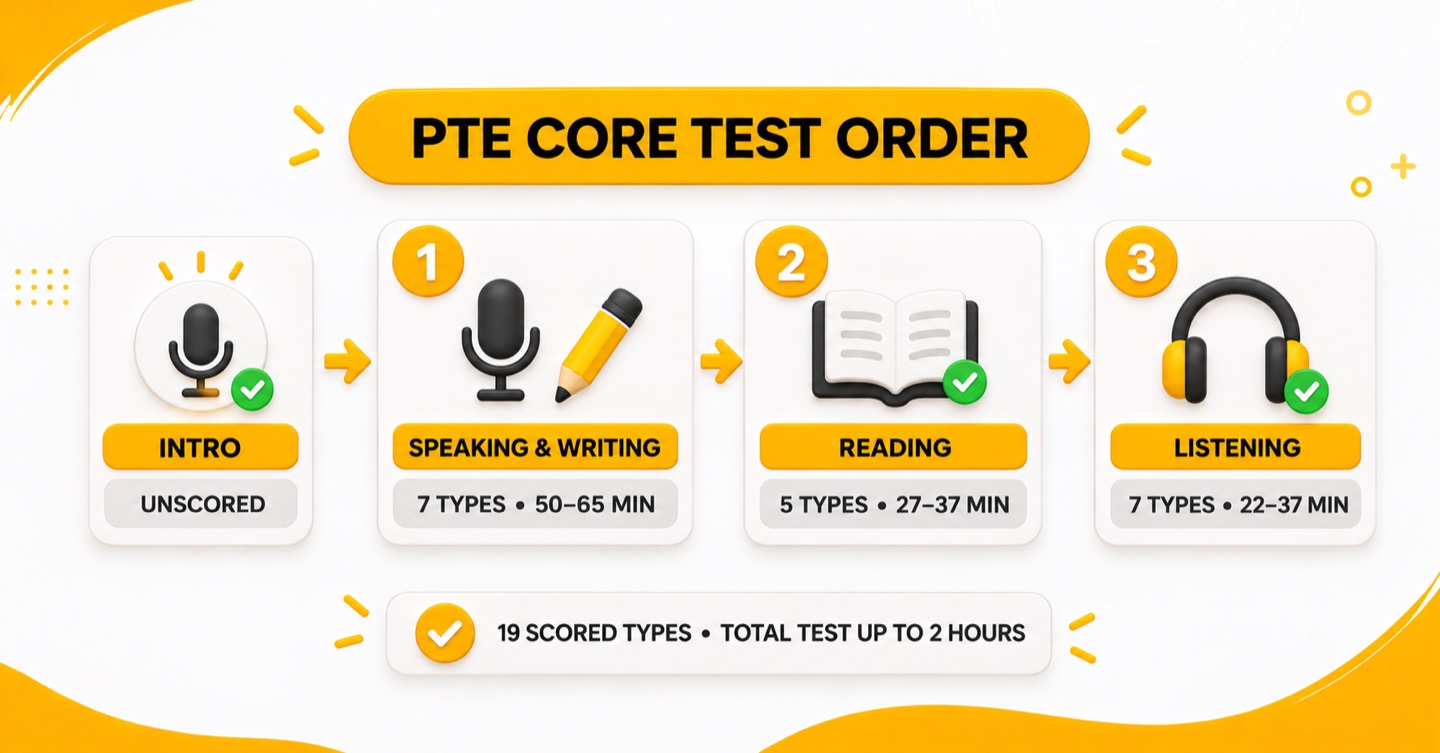
PTE Core tests four English skills in three parts. Speaking and Writing share the first part. Reading is second. Listening is third.
| Test stage | Time | Question types | Main skills |
|---|---|---|---|
| Personal Introduction | 25 seconds to prepare and 30 seconds to record | Unscored | Familiarisation only |
| Part 1: Speaking & Writing | 50–65 minutes | 7 | Speaking, Writing and integrated skills |
| Part 2: Reading | 27–37 minutes | 5 | Reading and one integrated Reading-and-Writing task |
| Part 3: Listening | 22–37 minutes | 7 | Listening and integrated skills |
Pearson says the full test will not exceed two hours. Do not add the lowest or highest section times and treat that total as your exact test length. Pearson builds each test version to balance the complete time.
The phrase 19 question types means 19 different task formats. It does not mean you answer only 19 questions. For example, Pearson lists 10–12 Repeat Sentence questions and 6–7 Read Aloud questions in one test. The exact mix varies within the official ranges.
What Happens Before the Scored Questions Begin?

The Personal Introduction appears before Part 1.
You receive 25 seconds to read the prompt and prepare. You then have 30 seconds to record one response. You cannot record it again.
Pearson says this introduction is for familiarisation and does not contribute to your score. Use it to settle into the microphone and screen. Do not treat it as an eighth scored Speaking & Writing task.
After the introduction, the scored questions begin with Read Aloud.
What Are the 7 Speaking & Writing Question Types?
Part 1 is the longest part of PTE Core. It lasts 50–65 minutes and contains seven scored question types.
| Order | Question type | Questions | What you do | Time to answer | Skills scored |
|---|---|---|---|---|---|
| 1 | Read Aloud | 6–7 | Read a text of up to 60 words aloud | Varies; 30–40 seconds to prepare | Reading and Speaking |
| 2 | Repeat Sentence | 10–12 | Listen once and repeat the sentence | 40-second recording window | Listening and Speaking |
| 3 | Describe Image | 3–4 | Describe the important information in an image | 25 seconds to prepare; 40 seconds to speak | Speaking |
| 4 | Respond to a Situation | 2–4 | Say what you would tell someone in an everyday situation | 20 seconds to prepare; 40 seconds to speak | Speaking |
| 5 | Answer Short Question | 5–6 | Answer in one word or a few words | 10 seconds | Listening and Speaking |
| 6 | Summarize Written Text | 1–2 | Write a 25–50 word summary | 10 minutes | Reading and Writing |
| 7 | Write Email | 2–3 | Write an email that answers the prompt | 9 minutes | Writing |
1. What do you do in Read Aloud?

You see a text of up to 60 words and read it aloud. Pearson gives you 30–40 seconds to prepare before the microphone opens. The answer time changes with the length of the text.
This task affects Reading and Speaking. Pearson checks whether you say the correct words, how clearly you pronounce them and how smoothly you speak.
Do not begin before the tone. Your voice is not recorded until the microphone opens.
2. What do you do in Repeat Sentence?

You hear one sentence that lasts about 3–9 seconds. You listen once, then repeat it in the same order. You can record only one response.
Repeat Sentence affects Listening and Speaking. Content, pronunciation and oral fluency receive partial credit. If you forget part of the sentence, say the accurate words you remember instead of inventing a different ending.
3. What do you do in Describe Image?

You see an image and get 25 seconds to study it. You then have 40 seconds to describe it.
This task affects Speaking. Pearson looks at relevant content, pronunciation and oral fluency. Identify the main message first, then give useful details and relationships. A memorised response that does not fit the image will not answer the task.
4. What do you do in Respond to a Situation?

You read and hear a description of an everyday situation. You get 20 seconds to prepare and 40 seconds to say what you would tell the person in that situation.
This task affects Speaking. Your language must fit the person, purpose and level of formality. A polite request to a manager needs a different tone from a casual message to a close friend.
5. What do you do in Answer Short Question?

You hear a short question and reply with one word or a few words. The recording opens after the question and gives you 10 seconds.
This task is marked correct or incorrect. A short accurate answer is enough. Extra words do not earn extra credit.
6. What do you do in Summarize Written Text?

You read a text of up to 200 words and write a 25–50 word summary. You have 10 minutes.
The response must explain the main idea and important supporting points without changing the meaning. Pearson scores content, form, grammar and vocabulary. Stay inside the 25–50 word range shown in the task instruction.
7. What do you do in Write Email?

You read a prompt of up to 100 words and write an email. You have 9 minutes.
Pearson’s live task instruction tells candidates to write 80–120 words. Follow that on-screen range. Address all parts of the prompt, use a suitable greeting and sign-off, and keep the level of formality appropriate for the reader.
Write Email affects Writing. Pearson scores content, email conventions, form, organisation, grammar, vocabulary and spelling.
What Are the 5 Reading Question Types?
Part 2 lasts 27–37 minutes. The five Reading tasks share the section clock. Pearson does not give a separate fixed answer time for each item.
| Order | Question type | Questions | What you do | Skills scored |
|---|---|---|---|---|
| 1 | Reading & Writing: Fill in the Blanks | 5–6 | Choose a word from each drop-down list | Reading and Writing |
| 2 | Multiple Choice, Multiple Answers | 1–2 | Select every correct answer | Reading |
| 3 | Reorder Paragraph | 2–3 | Put text boxes into the correct order | Reading |
| 4 | Fill in the Blanks | 4–5 | Drag words into gaps in a text | Reading |
| 5 | Multiple Choice, Single Answer | 1–2 | Select one correct answer | Reading |
1. How does Reading & Writing: Fill in the Blanks work?

You read a text of up to 200 words with gaps. Each gap has a drop-down list. Choose the word that fits the meaning and grammar.
You receive one point for each correct blank. This is the only task in the Reading part that affects both Reading and Writing.
2. How does Multiple Choice, Multiple Answers work?

You read a text of up to 275 words and choose more than one answer.
This task uses partial credit. Pearson adds one point for a correct choice and deducts one point for a wrong choice, with a minimum of zero for the item. Do not select every option as a guess.
3. How does Reorder Paragraph work?

You receive text boxes in the wrong order and arrange them into a logical paragraph. Pearson awards credit for each correct adjacent pair.
Look for the opening sentence first. Then track pronouns, repeated ideas, time order and linking words between boxes.
4. How does Reading: Fill in the Blanks work?

You read a short text of up to 80 words. A word bank appears below it. Drag the correct words into the gaps. There are more options than gaps.
This task affects Reading. You receive one point for each correct blank.
5. How does Multiple Choice, Single Answer work?

You read a text of up to 110 words and select one answer about its content or tone.
The item is marked correct or incorrect. If you are unsure, remove options that conflict with the text and choose the strongest remaining answer before moving on.
What Are the 7 Listening Question Types?
Part 3 lasts 22–37 minutes. Every recording plays once. Summarize Spoken Text has its own eight-minute timer. The other Listening tasks do not have a separate fixed answer time on Pearson’s live format page, so manage the remaining section clock carefully.
| Order | Question type | Questions | What you do | Skills scored |
|---|---|---|---|---|
| 1 | Summarize Spoken Text | 1–2 | Write a 20–30 word summary | Listening and Writing |
| 2 | Multiple Choice, Multiple Answers | 1–2 | Select every correct answer | Listening |
| 3 | Fill in the Blanks | 2–3 | Type missing words into a transcript | Listening and Writing |
| 4 | Multiple Choice, Single Answer | 1–2 | Select the best summary | Listening |
| 5 | Select Missing Word | 1–2 | Choose the missing final word or phrase | Listening |
| 6 | Highlight Incorrect Words | 1–2 | Mark words that differ from the recording | Listening and Reading |
| 7 | Write from Dictation | 3–4 | Type the sentence you hear | Listening and Writing |
1. What do you do in Summarize Spoken Text?

You hear a recording of about 45–75 seconds and write a 20–30 word summary. You have eight minutes for the complete item, including listening and writing.
Pearson scores content, form, grammar, vocabulary and spelling. Note the topic and main points while listening. Then write complete sentences inside the required word range.
2. How does Listening Multiple Choice, Multiple Answers work?

You hear a recording of about 50–90 seconds and select more than one correct option.
This task uses partial credit. A correct choice adds one point and a wrong choice deducts one point, with a minimum of zero for the item. Select only the options supported by the recording.
3. How does Listening Fill in the Blanks work?

You see a transcript with gaps and hear a 30–60 second recording. Type each missing word as you listen.
This task affects Listening and Writing. Each correctly spelled word earns credit.
4. How does Listening Multiple Choice, Single Answer work?

You hear a 30–60 second recording and select the paragraph that best summarises it.
Only one option is correct. Focus on the speaker’s main message, not one small detail that appears in the audio.
5. How does Select Missing Word work?

You hear a recording of about 20–70 seconds. The final word or phrase is missing. Choose the option that best completes the recording.
This task is marked correct or incorrect and affects Listening.
6. How does Highlight Incorrect Words work?

You read a transcript while listening to a recording. Click the words on the screen that are different from the words you hear.
Pearson gives one point for each correct word and deducts one point for each incorrect word, with a minimum of zero for the item. This task affects Listening and Reading.
7. How does Write from Dictation work?

You hear a sentence that lasts about 3–5 seconds and type it into the response box. You hear it once.
This task affects Listening and Writing. Pearson awards one point for each correct word in the correct order and spelling. Use the short pause after the audio to check spelling and sentence structure before moving on.
How Do the PTE Core Timings Work?

PTE Core uses two timing systems.
First, a few tasks have their own fixed response time. These include Summarize Written Text, Write Email and Summarize Spoken Text. Speaking tasks also show preparation and recording countdowns.
Second, Reading and most Listening tasks use the remaining time for the whole part. Spending too long on one question leaves less time for the tasks that follow.
Pearson’s 2026 Score Guide lists these section ranges:
- Speaking & Writing: 50–65 minutes.
- Reading: 27–37 minutes.
- Listening: 22–37 minutes.
The lowest numbers add to 99 minutes, while the highest add to 139 minutes. That does not mean your test can last either total. Pearson explains that each test version is balanced, no candidate receives every absolute minimum or maximum, and the complete test will not exceed two hours.
There are no scheduled breaks. You can ask the Test Administrator for an unscheduled break, but the test clock will continue. Pearson also says you cannot return to an earlier question after moving on.
How Is PTE Core Different from PTE Academic?

Both tests assess Speaking, Writing, Reading and Listening on a computer, but they are built for different purposes and use a different task mix.
PTE Core uses everyday and workplace English. PTE Academic uses academic settings. If you are still choosing your test, read our PTE Academic vs PTE Core vs PTE Academic UKVI comparison and confirm the exact test accepted for your application.
The biggest format differences are simple:
- PTE Core has Write Email. It does not have Write Essay.
- PTE Core does not include Re-tell Lecture.
- PTE Core does not include Summarize Group Discussion.
- PTE Core Listening does not include Highlight Correct Summary.
Do not use an Academic-only task list as your Core study plan. Some shared task names also use different prompt lengths or answer rules, so practise with current PTE Core material.
How Can You Use the Format to Plan Your Practice?

1. Learn the order before chasing strategies
Write the three parts and all 19 task types on one page. If a practice source includes an extra task, check whether it belongs to PTE Academic.
2. Separate fixed timers from section timers
Practise fixed-time writing and speaking tasks with their real countdowns. For Reading and most Listening items, practise moving on without spending the whole section on one difficult question.
3. Practise integrated-skill tasks carefully
Several tasks affect more than one skill. Read Aloud affects Reading and Speaking. Summarize Written Text affects Reading and Writing. Write from Dictation affects Listening and Writing.
Do not treat every task as belonging to only the part where it appears.
4. Complete full-format practice
Single-task drills help you learn a method. Full-format practice shows whether you can keep that method while the test continues for about two hours.
If you review the PTENOTE PTE mock-test page, confirm that the current practice content and package details match PTE Core before paying or starting a full mock.
5. Book only after confirming the correct test
PTE Core is not the correct test for every Canadian study, work or immigration goal. Check the current requirement from the organisation or programme that will receive your score.
Once PTE Core is confirmed, you can review our PTE exam-booking service and select the exact test type in the booking process.
FAQs About the PTE Core Exam Format
How long is the PTE Core exam in 2026?
PTE Core takes about two hours. Pearson says no complete test will exceed two hours, even though the separate section ranges do not add to one fixed total.
How many question types are in PTE Core?
There are 19 scored question types: 7 in Speaking & Writing, 5 in Reading and 7 in Listening.
Does PTE Core have only 19 questions?
No. It has 19 different question types, and most types appear several times. Pearson gives an item range for every type in the 2026 Score Guide.
What is the order of the PTE Core test?
The order is Personal Introduction, Speaking & Writing, Reading, then Listening. The Personal Introduction is not scored.
Does PTE Core include an essay?
No. PTE Core includes Write Email instead of Write Essay.
Is there a break in PTE Core?
There is no scheduled break. If you request an unscheduled break, the clock keeps running.
Can you go back to a previous PTE Core question?
No. Pearson says you cannot return to an earlier question after you move on.
Can you use PTE Academic practice material for PTE Core?
Do not use it as your main preparation source. The tests share some tasks, but their purpose, language setting, timings and task mix differ. Pearson advises candidates to use preparation material for the exact test they plan to take.
Conclusion
The PTE Core exam format becomes easier to manage when you see it as one fixed journey:
- Start with the unscored Personal Introduction.
- Complete 7 Speaking & Writing question types.
- Move through 5 Reading question types.
- Finish with 7 Listening question types.
That gives you 19 scored task formats across a test of about two hours.
Use the official order when you build your practice plan. Learn each task’s answer rule, respect its timer and prepare with PTE Core material instead of borrowing an Academic task list. Once the format feels familiar, you can spend less energy wondering what comes next and more energy answering the question in front of you.
References and Useful Resources
- Pearson: PTE Core overview — Check the test purpose, three parts and current overview.
- Pearson: PTE Core test format — Open Pearson’s live guide to the complete format.
- Pearson: Speaking & Writing format — Review the seven tasks, prompts and response rules.
- Pearson: Reading format — Review the five Reading tasks.
- Pearson: Listening format — Review the seven Listening tasks.
- Pearson: PTE Core Score Guide 2026 — Check current question ranges, section timings and scoring.
- Pearson: PTE Core Test Taker Handbook — Read the official test-day and break rules.
- PTENOTE: PTE Academic vs PTE Core vs PTE Academic UKVI — Confirm which PTE test matches your goal.