Book PTE Exam
 PTE Voucher
 PTE Mock Tests
 Pricing
 About Us
 Blog
 Practice



Key Takeaway
- Treat your mock score as the start of your review, not the final answer.
- Check your skill results, task patterns and test conditions before choosing what to practise.
- Use an error log. Record what went wrong, why it happened and what you will do next.
- Use four short stages over 30 minutes. Save the result, find patterns, complete the error log and make a short practice plan.
- Work on one or two clear problems. Then take another full mock.
“I finished my PTE Academic mock test. What should I do with the score now?”
Start by slowing down. A high score can hide repeated mistakes. A low score can come from one weak task or poor time control. Your test setup can also cause it. Taking another full mock straight away will not tell you which reason applies.
A careful review turns one result into a useful study plan. You do not need several hours. The routine below takes 30 minutes. It gives you a simple PTE mock test error log that you can keep using.
If you need help with the test itself, read our complete PTE mock-test guide first. This article starts after you have submitted the mock and opened your result.
What Should You Review Before Looking at Individual Mistakes?

Begin with a quick snapshot of the whole attempt. Record the date and mock provider. Add the test version and the main score view. Then write one sentence about how the attempt felt.
For example:
I lost focus near the end of Listening, and my room became noisy during the final tasks.
This note helps you separate an English problem from a test-condition problem. Check the answers, your notes and the room conditions. Then decide if your Listening skill is weak.
Next, review information in this order:
- Overall result: Use it as a checkpoint for this attempt.
- Skill results: Compare Speaking, Writing, Reading and Listening when your report shows them.
- Task patterns: Find task types where the same problem appears more than once.
- Test conditions: Check time pressure, focus, noise, microphone audio and tech problems.
- Individual answers: Open the detailed review or feedback your provider makes available.
Start with the report your provider gives you. Pearson says its Scored Practice Test report shows an Overall Score and four Communicative Skills scores: Listening, Reading, Speaking and Writing. It does not include a Skills Profile or a sub-skill breakdown. Use the details that your provider shows. Check each available result screen. Do not search for a field that is not part of your report.
Pearson also says its Scored Practice Test cannot reproduce all conditions of the full test. Pearson describes the practice report as an indicator, not a guaranteed result. Pearson says your real score can be the same, lower or higher. Focus on patterns and next steps. Do not treat one practice number as a promise.
What Should a PTE Mock Test Error Log Include?
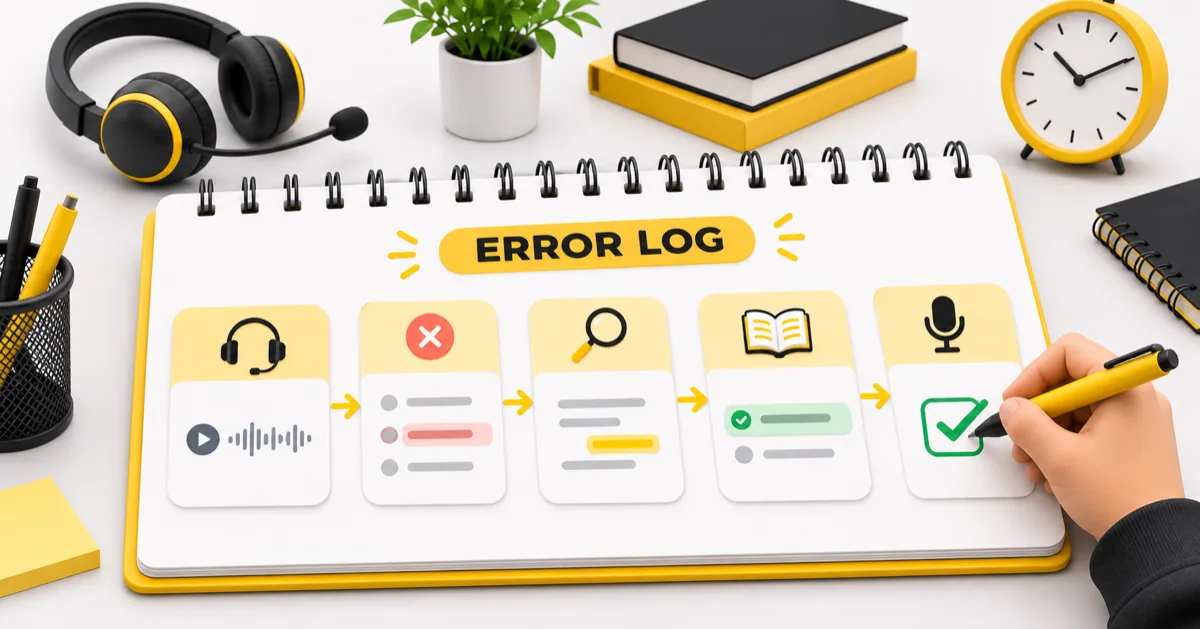
An error log is a small table. It turns a mistake into a next step. One row should answer five questions:
- Where did the problem happen?
- What exactly went wrong?
- Why do you think it happened?
- What is the correct method or answer?
- What will you practise next?
Use this copyable template:
| Date and mock | Skill and task | What happened? | Likely cause | Correction | Next practice | Check again |
|---|---|---|---|---|---|---|
| Add the date and test name | Name the exact task | Describe the visible mistake | Choose one reason | Write the correct approach | Set one small drill | Add a date or session |
Choose one cause for each row. We recommend using five simple labels:
- English: vocabulary, grammar, spelling, pronunciation or understanding.
- Task method: you misunderstood the instruction or used an unsuitable method.
- Time: you rushed, got stuck or left too little time for later tasks.
- Focus: you missed a keyword, forgot your plan or stopped listening carefully.
- Setup: noise, microphone position, internet or another technical issue affected the attempt.
Do not write “careless mistake” as the cause. That label does not tell you what to change. Write the action that caused the mistake. For example: “I matched one word, chose an option and did not check the full meaning.”
Here is a fictional example:
| Skill and task | What happened? | Cause | Correction and next practice |
|---|---|---|---|
| Listening: Write from Dictation | Missed plural endings in three answers. | English and focus | Check the sentence for number and grammar. Practise five short dictations and mark every missing ending. |
| Speaking: Read Aloud | Paused in the middle of phrases. | Task method | Mark phrase groups before speaking. Record three passages and listen for broken phrases. |
| Reading: timed section | Spent too long on one question and rushed the last items. | Time | Set a stopping point during the next timed drill and move on when it is reached. |
The example is a review method, not a model score report. Replace it with evidence from your own answers and feedback.
How Does the 30-Minute PTE Mock Review Routine Work?
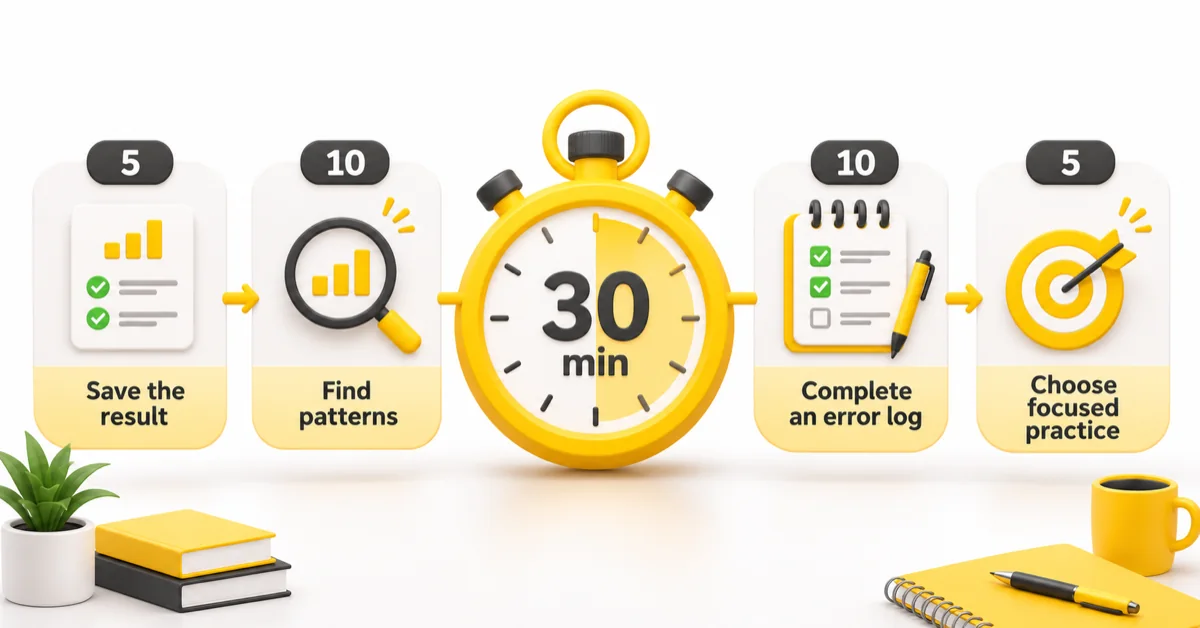
Set a 30-minute timer. Work in four stages. Keep the scorecard, answer review and a blank error log open.
| Time | Review stage | What to do | What you should have at the end |
|---|---|---|---|
| 0–5 minutes | Save the result | Record the score view, date, mock name and one note about the test conditions. | One clear snapshot of the attempt. |
| 5–15 minutes | Find patterns | Compare skills and task types. Mark repeated mistakes and unusual technical problems. | A short list of possible causes. |
| 15–25 minutes | Complete the error log | Add useful errors. State the cause, correction and next drill for each one. | Three to five usable error-log rows. |
| 25–30 minutes | Choose the next practice | Select one main weakness and one supporting problem. Schedule the drills and a review date. | A small plan you can start in your next study session. |
Stop when the timer ends. You can return to a hard answer later. Your first review should give you a plan. You do not need a perfect record of every click.
How Do You Turn the Error Log Into Your Next Practice Plan?

Read your completed rows. Circle problems that repeat and are clear enough to work on. Then choose one main weakness and one supporting problem.
For example:
- Main weakness: missing small words and endings in Write from Dictation.
- Supporting problem: losing focus during longer Listening tasks.
- Next sessions: complete short dictation drills and check every ending. Then practise notes from one short audio clip.
- Review point: open the error log after the third practice session and mark what changed.
Avoid a plan such as “improve Listening.” It is too broad. Name the action you will repeat and the evidence you will check.
Use this one-sentence planning frame:
Before my next full mock, I will practise [task or skill] by doing [specific drill] in [number of sessions], and I will check [one visible sign of progress].
Do focused practice before another full mock. First, make a clear change that you can test. Try a better note method, clean up your microphone setup or fix repeated spelling errors.
Keep the next review fair. Use similar test conditions. Compare the pattern, not just the overall number. If the same error returns, keep it in the log and change the drill. If the error stays away, mark it as controlled. Then move to the next priority.
Our PTE Academic study-plan guide can help you place these drills into a longer routine. Does the result look odd because of your microphone or computer? Check our PTE mock-test setup guide before you use that attempt as your study baseline.
Frequently Asked Questions
Can I review only the overall PTE mock score?
Use the overall result as a starting point. Then check the skill, task, answer and condition details that your provider gives you. One number cannot show the cause. Check whether the main problem is English, time, focus, method or equipment.
Should I add every wrong answer to my error log?
No. Add errors that show a pattern or a misunderstood task. Also add a mistake when the fix is useful or the problem affected several answers. Skip rows that give you no clear next action.
What if two mock tests give me very different scores?
Compare the provider, question set, room, equipment, timing and your own focus. Then look for problems that appear in both attempts. Do not use two different scores to promise what will happen in the real exam.
Can I retake a Pearson Scored Practice Test?
Pearson states that its Scored Practice Tests are single-use. Check the rules of your own mock provider before starting another attempt.
Is a mock-test score a guaranteed PTE result?
No. Use a mock score as preparation feedback. Pearson describes its Scored Practice Test result as an indicator, not a guaranteed result.
How many errors should I choose for my next study plan?
Start with one main weakness and one supporting problem. This keeps the plan clear. Complete the planned drills and review the log again. Then choose the next problem.
Use Every Mock to Choose One Clear Next Step
Do more with a PTE Academic mock than read the overall score. Save the result. Find patterns, record useful errors and choose one small practice goal.
Keep your error log beside you during your next few study sessions. Update it when you find better evidence. When you are ready, explore our current PTE mock-test options. Review the next score with the same 30-minute routine.