Book PTE Exam
 PTE Voucher
 PTE Mock Tests
 Pricing
 About Us
 Blog
 Practice



Key Takeaway
- Countable nouns have a form for one item and a form for more than one.
- An uncountable noun does not take a plural ending in its uncountable meaning.
- Use many with plural countable nouns and much with uncountable nouns.
- Count a unit when you need a number: two pieces of advice.
- Try the exercises before opening the answers.
“I know the word, but do I need to add an s?” That small choice can stop you in the middle of a sentence. You write a noun, change it, then wonder whether the first version was right.
We’ll work through countable and uncountable nouns for PTE Academic using short rules and original exercises. Start with the meaning of the noun. Then check the words around it. Keep a notebook nearby so you can try the questions before reading our answers.
What is the difference between countable and uncountable nouns?
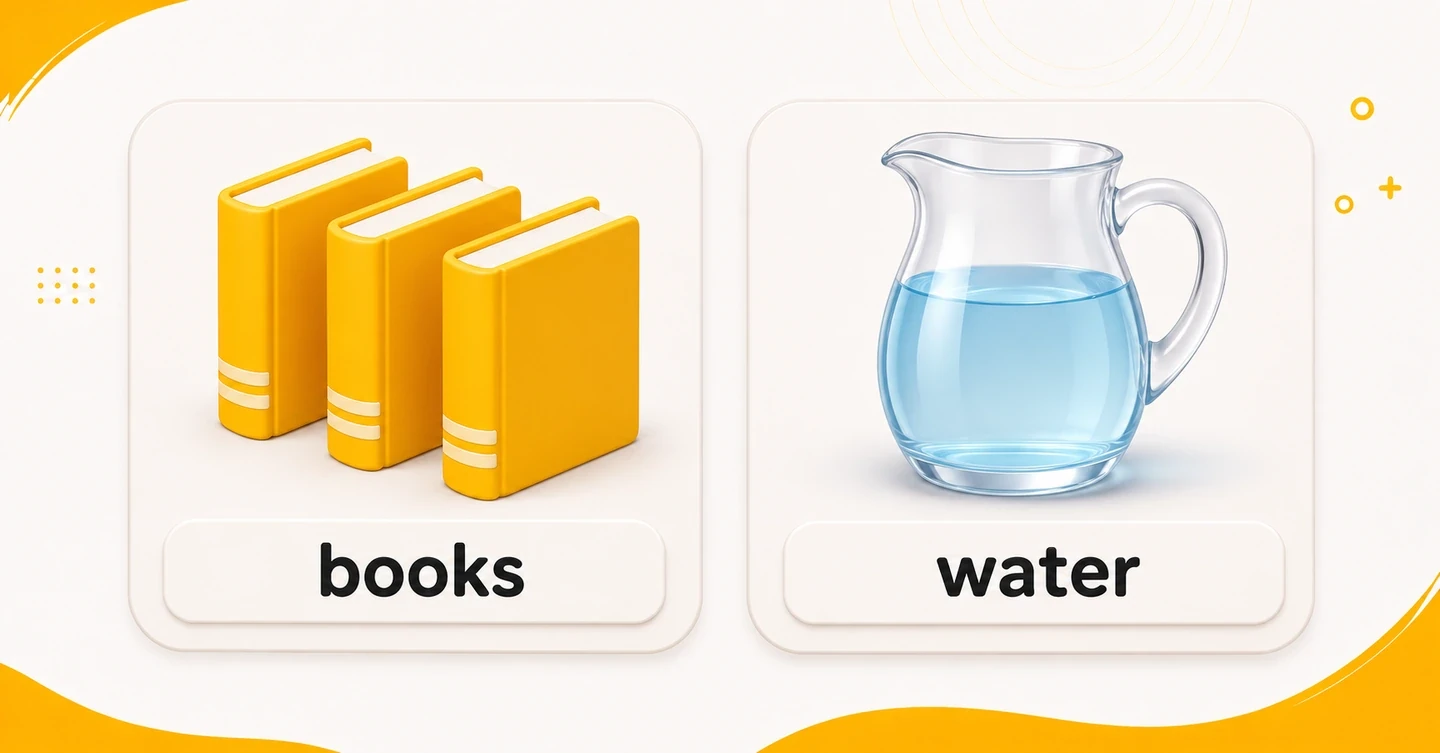
A countable noun names something that English treats as a separate item you can count.
Countable nouns have singular and plural forms: singular means one; plural means more than one.
For example, write “one book” or “three books”. The number tells you how many separate books there are. Here, use book for one item and books for several.
An uncountable noun is a noun you do not count directly with a number in that meaning.
Compare “three books” with “some water”. You can count the books. For water, the sentence refers to an amount. We’ll look at how to count bottles or other units below.
In an uncountable meaning, the noun takes neither a plural ending nor a/an directly before it.
That last phrase matters: in an uncountable meaning. Some words have a countable meaning too. Do not decide that a word must follow one pattern in every sentence.
Pearson’s Fill in the Blanks (Dropdown) guidance asks you to use grammar and context to choose missing words.
This lesson focuses on one part of that work: noun choice. For the other Reading tasks, use our PTE Reading practice guide.
Which words and noun forms fit together?

Read the whole sentence before changing the noun. Is the writer talking about one item, several items or an amount? Use the patterns below as a starting point.
A singular countable noun needs a word such as a, an, the, my or this before it.
For a simple example, compare “I borrowed a book” with “I borrowed books”. In the first sentence, a introduces one book. The second sentence uses the plural form.
Choose a or an by the next sound: a before a consonant sound, an before a vowel sound.
So “a useful book” is correct. The first sound in useful is the sound at the start of “you”. Listen to the word instead of checking only its first written letter.
| Pattern | Original learning example | What to notice |
|---|---|---|
| many + plural countable noun | How many books did you borrow? | The word books names separate items. |
| much + uncountable noun | How much water is left? | Water names an amount here. |
| some + plural countable or uncountable noun | I brought some books and some water. | Some works with both types. |
| a lot of + plural countable or uncountable noun | We need a lot of desks and a lot of space. | Check the noun after the phrase. |
| uncountable noun + singular verb | The water is cold. | Use is in this sentence. |
| plural noun + plural verb | The books are heavy. | Use are in this sentence. |
Try reading a whole phrase aloud: “some useful information”. Keep useful in the phrase when you check the noun. Adding a describing word does not turn information into a separate countable item.
Information, advice, equipment and furniture are uncountable in their ordinary uses shown below.
| Noun | Use this phrase | Avoid this form in that meaning |
|---|---|---|
| information | some information about the course | three informations |
| advice | some advice about revision | an advice |
| equipment | some equipment for the lab | new equipments |
| furniture | some furniture for the study room | two furnitures |
Do you need to say an exact number? Name a unit.
Use a countable unit with an uncountable noun: one piece of advice, two pieces of advice, or one bottle of water.
In “two pieces of advice”, pieces carries the plural ending. Advice stays unchanged. Choose a unit that makes sense for the thing you mean. A bottle suits water; it does not suit advice.
When checking your own writing, mark the noun first. Then read its quantity word and verb together. Ask yourself what each word refers to before changing anything.
Can a noun be countable and uncountable?

Some nouns have both countable and uncountable uses with different meanings.
A glass can mean a drinking container; glass can also mean the material.
Compare these original sentences: “Please put two glasses beside the sink.” “The new door is made of glass.” The first sentence counts containers. The second names a material. Read beyond the noun to see which meaning fits.
A paper can mean a newspaper; paper can also mean the material used for writing or printing.
For example, “I bought a paper at the station” refers to a newspaper. “The printer needs paper” refers to the material. Do not add an s simply because the printer needs more than one sheet.
Learner’s dictionaries use C for countable and U for uncountable.
Check the entry for the meaning in your sentence, rather than stopping at the first definition. Read its example. Then write your own short sentence using the same meaning. If an entry shows both labels, look at how the examples differ.
For more examples of meaning changes, read the British Council’s guide to nouns with countable and uncountable uses.
How can you practise noun choice for PTE Academic?
We wrote these exercises for this lesson. They are grammar practice, not real Pearson exam questions or a full PTE practice test. Write down each answer before opening its explanation. No timer is required for this lesson.
Set 1: choose the correct option. Read each sentence in full. Choose only from the two options provided.
- The course page gives useful information / informations.
- How much / many chairs do we need for the workshop?
- The new lab equipment is / equipments are ready.
- Could you give me an advice / some advice about this course?
- The tutor suggested two pieces of advice / advices.
- We do not have much / many water left in the jug.
- The reading room has a / an useful desk lamp.
- The library ordered three book / books for the display.
Show Set 1 answers and explanations
- information. The noun is uncountable here. Informations adds an incorrect plural ending.
- many. “Chairs” is a plural countable noun, so many fits. Much does not fit this noun.
- equipment is. Equipment is uncountable in this use and takes a singular verb. The phrase “equipments are” makes both choices wrong.
- some advice. Advice is uncountable here. Some fits; an cannot directly introduce this uncountable use.
- pieces of advice. Count the pieces. Advices does not express separate suggestions in this use.
- much. Water refers to an amount. Many is for plural countable nouns.
- a. Useful starts with a consonant sound, like the start of “you”. The written u does not make an correct.
- books. Three requires the plural form here. “Book” names one item.
Set 2: complete a connected passage. Choose the correct option for each numbered gap.
A college opened a room for group study. It bought new (1) ___ and placed four (2) ___ near the window. A notice gave students (3) ___ about using the room. At the entrance, a tutor offered a (4) ___ of advice: leave the desks clear after each session.
- furniture / furnitures
- desk / desks
- information / informations
- piece / pieces
Show Set 2 answers and explanations
- furniture. New describes the furniture. It does not change this uncountable noun into a plural.
- desks. The number four calls for the plural form of desk.
- information. The notice provides details. Use the uncountable form without a plural ending.
- piece. A introduces one piece. The complete phrase is “a piece of advice”.
Read the completed passage once more. Notice the difference between furniture and desks: the passage names the room’s furnishings as a whole, then counts particular desks.
Set 3: fix one noun error in each sentence. Keep the intended meaning. Write a complete corrected sentence.
- The college bought two new equipments.
- The guide contains three useful informations.
- The table is made of a glass.
- How much books can fit on this shelf?
Show Set 3 corrections and explanations
- The college bought two new pieces of equipment. Pieces supplies a countable unit. Equipment stays unchanged.
- The guide contains three useful pieces of information. Count the pieces of information, rather than adding s to information.
- The table is made of glass. The sentence names the material. A glass would name a drinking container.
- How many books can fit on this shelf? Books is plural and countable, so choose many.
Other rewrites are possible, but keep the number or meaning given in each question. For example, deleting “two” from the first sentence loses information about the number of items.
After checking, choose one error to record. Note your first answer, the correction and your reason. Then make a fresh sentence. Try the same pattern tomorrow with a different noun, rather than copying the corrected sentence again.
Frequently asked questions
Is information countable?
Information is uncountable in the ordinary uses taught in this lesson.
Use a phrase such as “some information about the library”. To state a number, use “three pieces of information”.
Can I use some with both noun types?
Yes. Some works with plural countable nouns and uncountable nouns.
Compare “some books” and “some water”. Check the noun form after some rather than treating some as a signal to add s.
Does an uncountable noun always refer to a liquid?
No. Advice and information are also uncountable in their ordinary meanings.
Do not sort nouns only by whether you can hold or see the thing. Check the word’s use in a learner’s dictionary.
What if a dictionary shows both C and U?
C means countable; U means uncountable.
Find the definition that matches your sentence and compare its examples. For your study notes, record the whole phrase and its meaning.
What can you try next?
Take one sentence you wrote today. Underline its nouns and check any word you are unsure about. Write one correction and explain it in plain English. Then try a fresh question from our Reading practice guide.