Key Takeaway
- Choose practice for the PTE test you plan to take.
- Take the mock on a desktop or laptop in a quiet place.
- Keep the timer running and complete the full test.
- After the test, check the scorecard and your mistakes.
- Choose one weak skill or question type to practise.
- Practise that weak area before taking another full mock.
- Use a fresh mock that you have not completed before.
- Do not take several full mocks one after another without practice.
- Treat every mock score as practice feedback, not an official PTE result.

Have you ever finished a PTE mock test, seen your score and asked, “What should I practise now?” You are not alone. A score can make you feel happy or disappointed. But the score alone does not tell you what to study next.
You can take a PTE mock test online to practise from home. It becomes useful when it is part of a simple study routine. It can show problems with your English, time control, focus or equipment. You can then work on those problems before taking another mock.
This guide explains that study routine. Do you only need help opening your account or starting a test? Read our separate PTENOTE mock-test login guide. This guide stays focused on practice, checking your results and improving your skills.
Want to see the available tests before reading the complete guide? Visit our online PTE mock-test service. You can check the current free trial, supported test types, features and package options there.
What Is a Full PTE Mock Test?

A full-length PTE mock test is a practice version of the complete test. A PTE practice test can be short and focused, but a full mock puts different PTE tasks into one timed session. You answer on a computer. You record speaking answers, type writing answers and complete reading and listening tasks.
Choose practice for the exam you will take. Our current platform supports the PTE Academic mock test, PTE Academic UKVI practice and the PTE Core mock test. PTE Academic and PTE Academic UKVI use the same academic test format. PTE Core has a different purpose and test content. Always confirm which test your university, visa authority or other organisation requires before you practise.
This is different from practising one question at a time. During short practice, you can pause or repeat a question. You may also check how to answer it. During a full mock, the test keeps moving. You must manage your time and focus until the end.
You may ask, “My English is already good. Do I still need a mock?” Yes, a mock can still help. PTE does not check only your everyday English. You also need to understand each task, use the microphone correctly, organise answers quickly and move through the test within the available time.
A student can speak English well and still lose marks by misunderstanding a task, speaking too softly or using too much time. Another student may have weaker English but improve because they check their mistakes and practise the right problem. A mock replaces “I think I am ready” with a result you can review.
A full mock can help you:
- get a starting result before making your study plan;
- find skills and question types that need more practice;
- check whether you can manage the timer;
- build focus for a complete test session;
- get used to answering on a computer; and
- test whether your microphone and study setup work properly.
A useful online mock should give you more than a final number. It should have clear instructions, timed tasks, practice across Speaking, Writing, Reading and Listening, and a scorecard that helps you find weak areas. It should also explain that a practice score is not an official result.
A full mock can show problems that may not appear during single-question practice. For example, you may:
- speak clearly at the beginning but rush later;
- lose focus during a long session;
- spend too much time on one task;
- make typing or grammar mistakes under pressure;
- use a microphone that does not record your voice clearly; or
- know a method but forget to use it each time.
Our mock score is only for practice. It is not an official Pearson result. It also cannot promise the score you will receive in the real exam. Use it to plan your study, not to predict your final result.
When Should You Take Your First Mock?

Take your first full mock after you understand the basic test order and main question types. You do not need to be good at every task first. This first mock gives you a starting result. This is also called a baseline.
Your starting result answers three useful questions:
- How well can I do now?
- Which skill or question type should I practise first?
- Can I stay focused during the complete timed test?
Are you completely new to PTE? Learn the basic test format before taking your first mock. Otherwise, you may get a low result only because you did not understand the instructions. If you already know the question types, do not wait until you feel fully ready. Some weak areas only appear when the timer is running.
How Should You Prepare Your Test Setup?

Use a desktop or laptop for our mock tests. Do not take the test on a mobile phone. A computer gives you a larger screen and a physical keyboard. It also gives you a setup that is closer to the real computer-based exam.
Before starting, prepare:
- a desktop or laptop connected to power;
- a working microphone and headphones—a wired headset is better;
- a stable internet connection;
- a quiet room where people will not disturb you;
- a comfortable chair and clear desk; and
- enough free time to finish the complete test.
Test the microphone before you begin. Speak at your normal volume. Keep the microphone in the same position near your mouth. Close apps that you do not need and turn off notifications. A computer or microphone problem can lower the value of your practice result.
For a detailed device checklist, read our laptop, microphone and headphones setup guide.
How Does AI Mock-Test Scoring Help You?

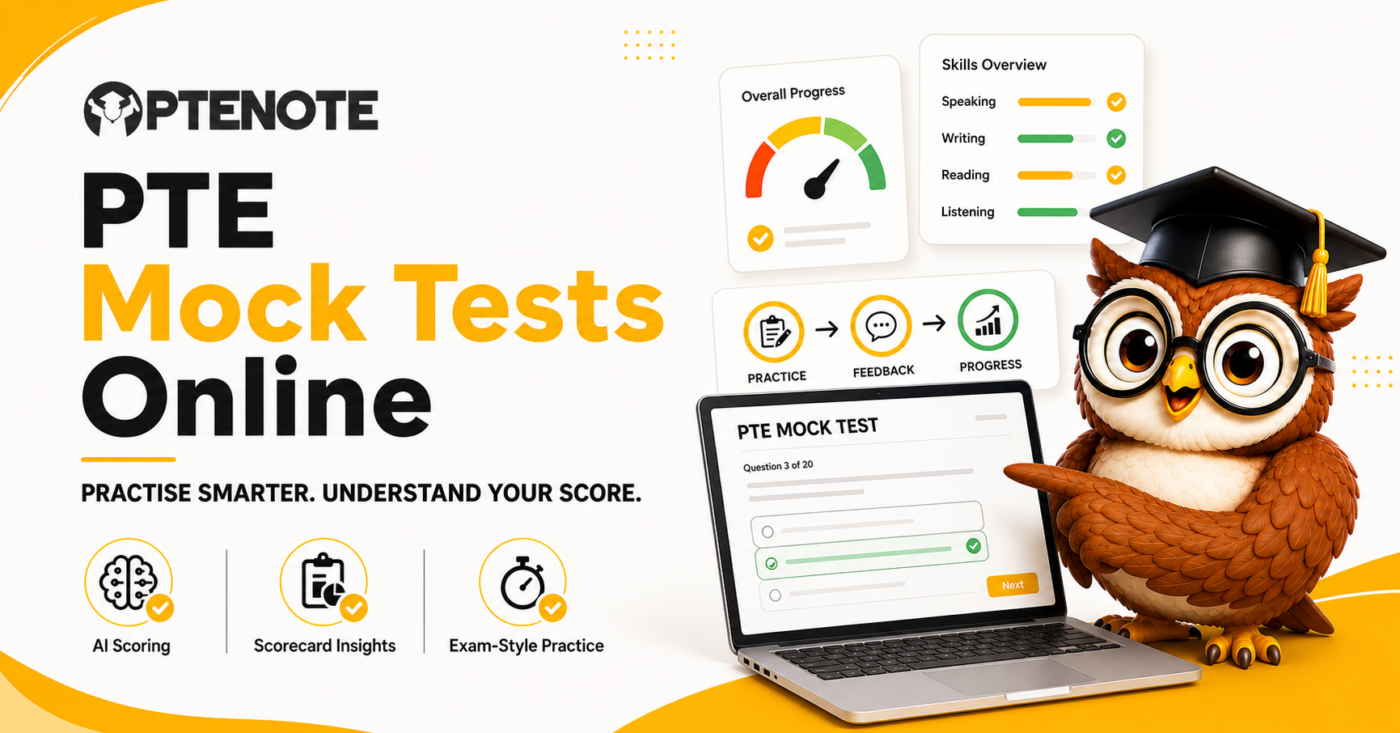
Our mock-test system uses AI scoring. This means a computer system checks your answers and prepares practice results. It can help you see patterns across speaking, writing, reading and listening.
An AI-scored PTE mock test gives you practice feedback without waiting for an official exam result. Use that feedback to decide what to practise next.
For example, the feedback can help you notice:
- whether speaking speed or long pauses need attention;
- whether grammar, spelling or sentence structure causes repeated problems;
- whether reading or listening answers are often incorrect; and
- whether one skill stays lower across several fresh mocks.
Do not use only one number to make a study decision. Check the skill results, your answers and your own notes. A low speaking score, for example, can be connected to your answer, fluency, microphone position or background noise. You need to look at the complete attempt.
AI scoring also has limits. Our mock score is preparation feedback. It is not an official Pearson score, and it cannot guarantee the result you will receive in the real exam. The real test has different questions and a different test environment. Your focus, stress, microphone and timing can also change.
Official PTE Academic, PTE Academic UKVI and PTE Core scores use a scale from 10 to 90. A mock result shown as a PTE-style score is still only an estimate for practice. Only Pearson can issue your official test result.
Use mock scores to compare patterns across several attempts. Do not use one mock score as a promise of your final result.
How Can You Use the Five-Step Mock-Test Improvement Cycle?

- Take one full mock like a real test. Do not pause the test to search for answers or watch a help video. Use the same desk, headset and browser setup that you plan to use for later mocks. This helps you see how well you can do now.
- Check more than the overall score. The overall score is only a summary. It is not a study plan. Check your speaking, writing, reading and listening results. Look for a skill that stays weaker than the others.
- Choose one main problem. Choose a problem that you can practise. “Improve my English” is too broad. A clearer goal is “speak smoothly without long pauses” or “make fewer spelling mistakes in listening answers.”
- Practise the weak area on its own. Spend a few study sessions on this problem. Practise the related question types and check your mistakes. Write repeated mistakes in a small notebook so you remember to fix them.
- Use a fresh mock to check your improvement. After your practice, take a mock that you have not used before. Use the same test setup. Compare the new result with the earlier result. You cannot retake a completed mock on our platform, so always choose a fresh unused mock.
How Should You Read a PTE Mock-Test Scorecard?

The scorecard is the page that shows your test results. Start with the overall result. Then check speaking, writing, reading and listening. Ask why one skill is lower. Also check whether the same problem appears in several question types.
A PTE mock test with a scorecard is more useful than a test that shows only one final number. The skill results and feedback give you a clearer starting point for your next practice session.
For example, a low listening result can come from spelling mistakes, poor notes or losing focus during long audio. A low speaking result can come from your answer, pronunciation, speaking speed or microphone position. The score alone cannot show the exact reason. Check your answers and mistake notes to find it.
Use this review order:
- Overall result: Are your results moving closer to your target?
- Weak skill: Which skill is often lower than the others?
- Question type: Which questions or answer habits cause this problem?
- Reason: Is the problem your English, test method, time, focus or equipment?
- Next step: What will you practise before the next mock?
Our system uses AI, which means a computer system checks your answers. This can help you find weak areas. However, the result is only for practice. Do not give a mock result to a university, visa office or employer as an official Pearson score.
Want to understand the layout before taking a test? View our sample PTE scorecard. Use it to learn where the overall and skill results appear. Your own mock scorecard will contain the results from your attempt.
Should You Take a Full Mock or Do Focused Practice?

The answer depends on what you need to do today. A full mock measures how your skills, timing and focus work together. Focused practice helps you work on one skill or question type.
Take a full mock when you want to:
- get a starting result;
- practise the complete timed test flow;
- check your focus and stamina;
- measure whether recent practice works under time pressure; or
- compare your current result with an earlier fresh mock.
Choose focused practice when you already know the main problem. For example, spend time on speaking fluency when long pauses keep affecting your answers. Practise spelling when the same listening errors appear again. Work on reading time control when one task regularly takes too long.
Our current mock-test service includes section-wise practice. Use it to work on a weak section before you measure your full performance again. Features can change, so check the live service page before choosing a package.
Do not take another full mock only to confirm the same weakness. First work on the problem. Then use a fresh mock to see whether the change also works in a complete test.
Why Did Your PTE Mock-Test Score Go Down?

Improvement does not always move upward after every mock. One lower score is information. It does not automatically mean that your English became worse.
Your result can change because:
- you were tired, worried or distracted;
- the questions felt more difficult to you;
- your microphone position or room noise changed;
- you rushed one section or spent too long on a task;
- you tried a new method that still needs practice;
- one weak skill affected several answers; or
- your earlier result was higher than your normal level.
Before changing your complete study plan, compare the lower result with several earlier attempts. Check which skill changed. Also check your equipment, test time, sleep and mistake notes.
If the same skill stays lower across several fresh mocks, treat it as a real practice priority. If only one attempt was lower and the next results return to your normal range, it may have been one difficult day.
How Many PTE Mock Tests Should You Take?

There is no correct number for every student. The right number depends on your current level, target score and exam date. It also depends on how much practice you need between mocks.
Taking more mocks does not always create more improvement. You may repeat the same mistake in five tests. In that case, you have found the problem five times, but you have not fixed it.
A better rule is:
- take your first mock to get a starting result;
- practise the most important weak area;
- take another fresh mock when you have made a real change;
- compare the results under similar conditions; and
- repeat only when the next test can answer a useful question.
Near your exam date, full mocks can help you check two things. Can you keep a steady result? Can you stay focused until the end? Earlier in your study plan, spend more time practising weak question types.
What Is a Practical Four-Week PTE Mock-Test Plan?
This example is for a student who already knows the basic PTE format. You can change the plan to match your level and exam date.
| Week | Main goal | Suggested work |
|---|---|---|
| Week 1 | Get your starting result | Take one full mock, check the scorecard and choose the first weak area to practise. |
| Week 2 | Work on the biggest weakness | Practise the related questions. Write down your mistakes and work on the English or test method you need. |
| Week 3 | Check the change | Take a fresh mock, compare the results and choose the next weak area. |
| Week 4 | Get a steady result | Practise the weak areas that remain. Then complete one final timed mock with the equipment you already tested. |
If your exam is far away, give each practice cycle more time. If the exam is very close, do not make yourself tired with several full mocks in the final days. Checking mistakes, sleeping well and following a simple test-day routine are also important.
Which PTE Mock-Test Mistakes Should You Avoid?

- Taking mocks only to get a higher score. A higher score can feel good, but you also need to know why it changed. Write down your test setup, the weak area you practised and the mistakes you still made.
- Changing too many things at the same time. Do not change your study method, microphone, room and time plan together. If you change everything, you may not know what caused the new result. Keep the test setup similar and change one study goal at a time.
- Ignoring equipment problems. Poor recordings, weak internet and background noise can make the result less useful. Fix these problems before taking another full mock.
- Memorising answers instead of building your skill. A memorised answer may not match a new question. Learn a simple method, improve your English and practise using the method with different questions.
- Comparing every score with another student. Another student may have a different target, exam date and starting level. Compare your new results with your own earlier results. Also compare them with the score required for your own application.
- Using a phone for a full mock. Complete our mock tests on a desktop or laptop. A mobile screen does not give you the intended setup for typing, listening and speaking practice.
How Do You Know When You Are Becoming Exam Ready?

One high mock score can make you feel confident. However, similar results across several fresh mocks are more useful. You are getting ready when:
- your recent mock results are similar;
- your results are close to the score required for your application;
- you can finish the full test within the available time;
- your equipment works correctly each time;
- you understand your mistakes and know how to fix them; and
- you can also do well on fresh questions.
Always ask the university, visa office or other organisation which PTE test and score you need. A mock-test provider cannot decide this requirement.
What Do You Get and Which Mock-Test Package Should You Choose?

Our current standalone packages provide scored full-length mocks, AI practice results and access to your mock-test account for the package period. You can use the scorecards to compare attempts and decide what to practise next.
Want to try a free PTE mock test before buying a package? Open our pricing page and select Try one Free Scored Test! to access your free scored test. You can use it to understand the interface, check your setup and see how the practice feedback is presented.
Choose a package by checking your exam date, current preparation level and study plan:
| Your situation | What you should check before choosing |
|---|---|
| Your exam is close | Choose a package that remains active until your exam and gives you enough time to review each mock. |
| Your exam is several weeks or months away | Choose a package that gives you enough access time to take a baseline mock, practise weak areas and complete fresh comparison mocks. |
| You are new to PTE | Choose enough access time to learn the test format before taking several full mocks. |
| Mock tests are included with your booking or voucher | Check the included mock-test validity shown in that package before paying. |
Do not choose a package only because it has a longer validity period. First check your exam date and make a simple practice plan. Your access should remain active until you finish that plan.
A package gives you access to the platform. Choosing a more expensive package or a package with longer validity does not automatically improve your score. Your progress depends on how you take the mocks, review your scorecards and practise your weak areas.
Package names, prices, test counts, free-trial terms, features and validity can change. Check our live pricing page. The package details shown before payment are the final reference.
How Can You Get PTENOTE Mock-Test Access?

You can buy a standalone mock-test package. You can also use the free mock access included with an eligible exam-booking or voucher package.
For standalone access, use this process:
- Open our PTENOTE pricing page.
- Find the mock-test packages and read the current price, test count, features and validity.
- Select the package that fits your study time.
- If you have not submitted your details before, enter your name, email address and mobile number in the popup form.
- Select Continue to payment. If you submitted your details earlier, selecting a package takes you directly to payment without showing the popup.
- Complete the payment through our website.
- Check WhatsApp for your access link, username and password.
We send mock-test access details through WhatsApp only. Use an active mobile number and check it carefully before continuing to payment.
Package names, prices, features and access time can change. Check the live package before buying. The details shown for the package you choose are the final details.
Our PTE exam-booking and PTE voucher packages include 50 free scored mock tests. You do not need to buy a separate mock package for the access included with your selected package. Check the live package before you pay and confirm the mock-test validity.
Before paying any mock-test provider, check what you will receive. Look for a clear test count, access period, scoring limits, device requirements, payment record and support method. The payment, GST invoice and access should remain connected to the same verified business. Be careful when someone asks you to pay through an unrelated personal QR code or promises a guaranteed PTE score.
For the exact login and troubleshooting steps, read our PTENOTE mock-test login guide.
Frequently Asked Questions
Can I take a PTENOTE mock test on my phone?
No. Use a desktop or laptop for the mock test.
Can I retake a completed mock test?
No. Once a mock is completed, use a fresh unused mock for your next attempt.
Does a mock score guarantee my official PTE result?
No. A mock score is only a practice result. Pearson gives you the official result after the real test.
Should I take a full mock every day?
Usually, no. Leave enough time to review the result and practise the weak area before using another complete test.
Are 50 free mock tests included with every PTENOTE purchase?
Our exam-booking and voucher packages include 50 free scored mock tests. Check the selected live package before buying because the validity and other package details can change.
Do all standalone mock-test packages contain the same tests?
Check the live pricing page before paying. The package shown there gives you the current test count, features and access period. These details can change.
Can I try a PTE mock test before buying a package?
Yes. Open our pricing page and select Try one Free Scored Test! You can use the free scored test to understand the interface, check your setup and view the practice feedback before choosing a paid package.
Can I practise for PTE Academic, PTE Academic UKVI and PTE Core?
Our current platform supports all three. Choose practice that matches the test required for your study, work or visa goal.
Why can my mock score be different from my official PTE score?
The questions, test environment, microphone, focus and stress can be different. AI systems can also check practice responses differently. Use your mock score to find patterns, not to predict an exact official result.
Should I use a full mock or focused practice today?
Use a full mock when you need to measure your complete timed performance. Use focused practice when you already know which skill or question type needs work.
Where will I receive my mock-test login details?
Check WhatsApp on the mobile number you entered for the order. Our message contains your access link, username and password.
Conclusion
A PTE mock test is most useful when it helps you choose what to practise next. Start with your first mock result. Check the scorecard, choose one weak area and practise it. Then use a fresh mock to check your improvement.
This routine takes more time than simply collecting scores, but it gives every full mock a clear purpose. Similar results across several fresh mocks are a better sign of progress than one high result.
Ready to begin? Review our current PTE mock tests online or compare the available options on our pricing page. Check every live package detail before paying.
References and Useful Resources
- Pearson PTE: official PTE Academic AI practice
- Pearson PTE: PTE Academic, PTE Academic UKVI and PTE Core test information
- Pearson PTE: understand the official 10–90 score scale
- Pearson PTE: PTE Core scoring
- PTENOTE PTE Mock Tests
- PTENOTE pricing
- PTENOTE sample scorecard
- PTENOTE mock-test login guide
- PTE mock-test laptop, microphone and headphones setup