




Key Takeaway
- Keep short notes for each of the three speakers.
- Explain their main ideas and how their views connect.
- Use the three practice discussions below to build your own summary.
- Check your recording for missing points, mixed-up speakers and unclear speech.
“I understand the discussion, but what should I say first?”
That can be the hardest part of this task. You hear several views, then need to give one clear spoken answer.
Our PTE Summarize Group Discussion practice starts with short, original discussions. We show which notes to keep and how those notes become a summary.
You will also try an example without a final group decision. This helps you practise reporting what happened without adding your own ending.
These are text-based learning exercises, not official Pearson questions. They are shorter than a full practice recording. Use them to learn the method, then practise with task audio.
What do you need to do in this task?
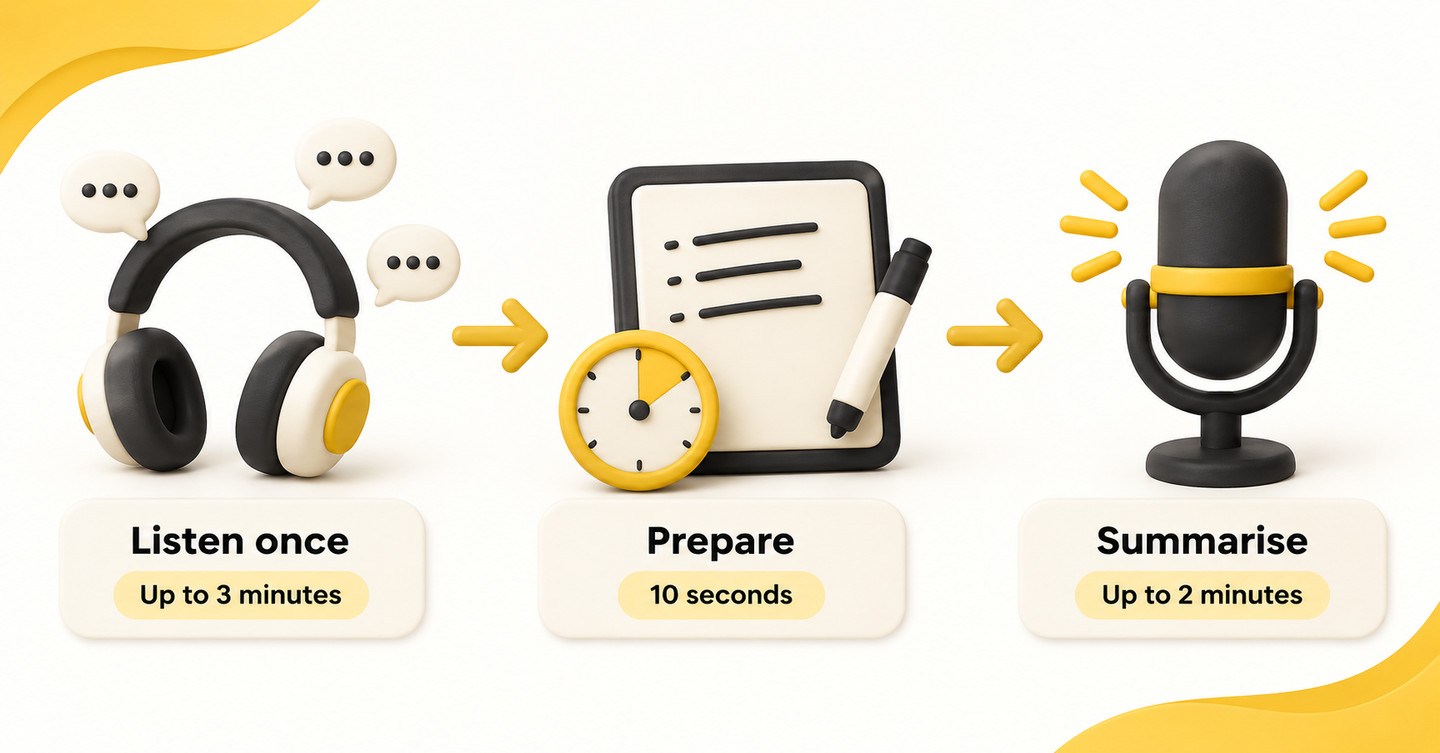
In PTE Summarize Group Discussion, you listen to three people. The recording can last up to three minutes and plays once.
You then have ten seconds to prepare and two minutes to speak. Start after the tone, when the microphone opens. You can record your answer only once.
The task tests listening and speaking. Pearson, the company that runs the PTE exam, assesses three areas.
These are content, pronunciation and oral fluency. Content means the meaning you report; pronunciation means how clearly you say words. Oral fluency means the flow of your speech.
Check Pearson’s official task format for the full instructions and scoring details.
In these exercises, we focus first on meaning. A smooth answer can still miss a key point or give it to the wrong speaker.
For the wider test structure, use our PTE Academic exam pattern guide. Here, we will work through this one task in detail.
How can you take notes without losing the discussion?
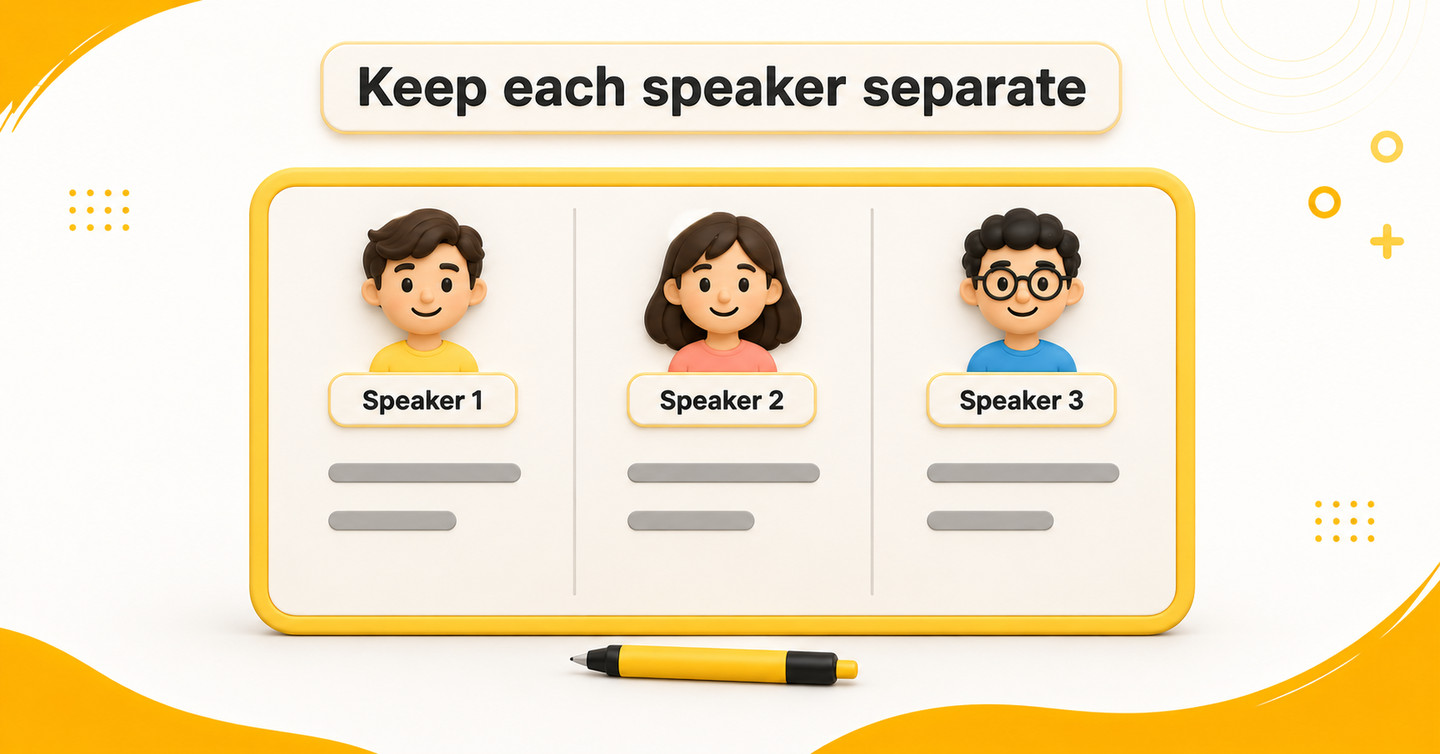
For PTE group discussion note taking, try three columns: S1, S2 and S3. These labels mean the first, second and third speaker.
Write the shared topic above the columns. Under each speaker, keep their main view and the reason behind it.
Leave room for later comments. A person may speak again and change part of their plan.
For example, “open the lab on Sunday” may later become “try one Sunday each month.” Your notes need to show that change.
This approach follows Pearson’s advice on speaker notes and changing views. The speakers may return to earlier points, so keep adding notes under the right person.
Keep meaning, not whole sentences
Suppose someone says, “The hall would be useful, but we cannot afford the weekend hire fee.”
A useful note is hall useful / weekend fee too high. It keeps both the benefit and the concern.
Writing only hall good loses the cost problem. Copying the whole sentence may leave you behind when the next person speaks.
Use words you can read at a glance. An arrow can show a change, while a question mark can show an unresolved point.
Choose symbols you already know. A new set of complex signs can become another thing to remember.
Use the preparation time to choose your route
Once the discussion ends, find the topic in your notes. Next, locate each person’s main point and any important change.
Choose a clear starting sentence, but avoid writing a whole answer. You need your notes to guide speech, not become a script.
If a small detail is missing, keep the parts you understood. Do not fill the gap with a reason the speaker never gave.
How do you turn your notes into a connected summary?
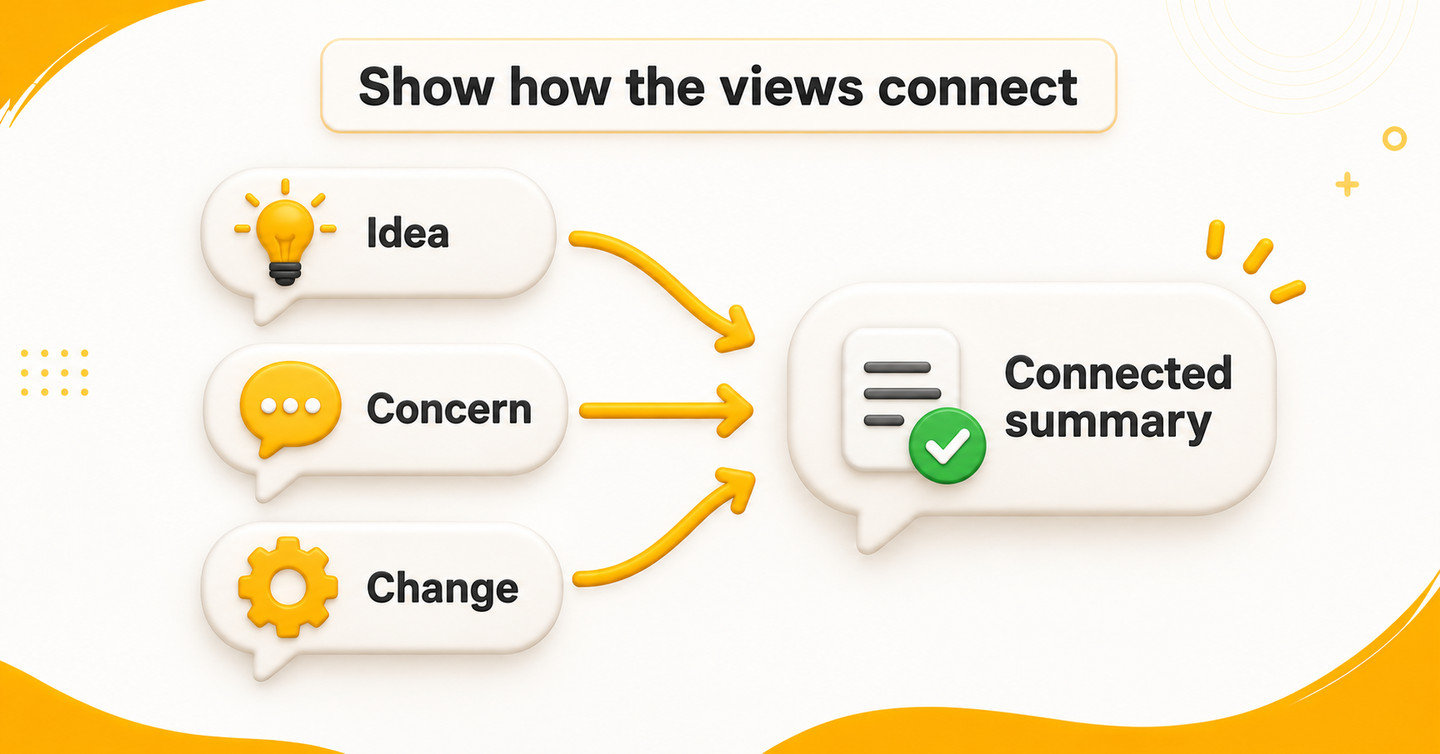
A list tells us what each person said. A connected summary also tells us how their points fit together.
Consider these notes: S1: hall / more space; S2: fee too high; S3: use classroom first.
A loose list might sound like this: “They discussed a hall, money and a classroom.” We know the topics, but not the speakers’ views.
A clearer version is: “The first speaker wanted a larger hall. The second raised the cost, so the third suggested using a classroom first.”
The words so, but and while can link ideas. Use them only when the discussion supports that link.
For example, so suggests that one point led to another. It would be misleading if the classroom idea came from a separate concern.
Try this speaking route as a practice aid:
- State the shared topic in one clear sentence.
- Explain the main views, with the reasons that matter.
- Show any agreement, concern or change between those views.
- Report the final position, if the speakers reached one.
This is a planning aid, not a fixed answer to memorise. The order and detail should change with the recording.
You also do not need a formal opening such as “This audio was very informative.” Start with the topic and use the time for meaning.
What do useful PTE Summarize Group Discussion examples look like?
The next three exercises build different skills. First, follow an agreement with conditions. Then track a changed plan. Finally, practise a discussion that ends without agreement.
Read each original discussion once, then hide it. Give yourself ten seconds to review your notes before recording a summary.
This first round is a reading-to-speaking drill. It does not test your listening in the same way as unseen audio.
The sample answers are possible summaries, not scripts or scored answers. Your wording can differ if the meaning stays accurate.
Example 1: A water refill point with conditions
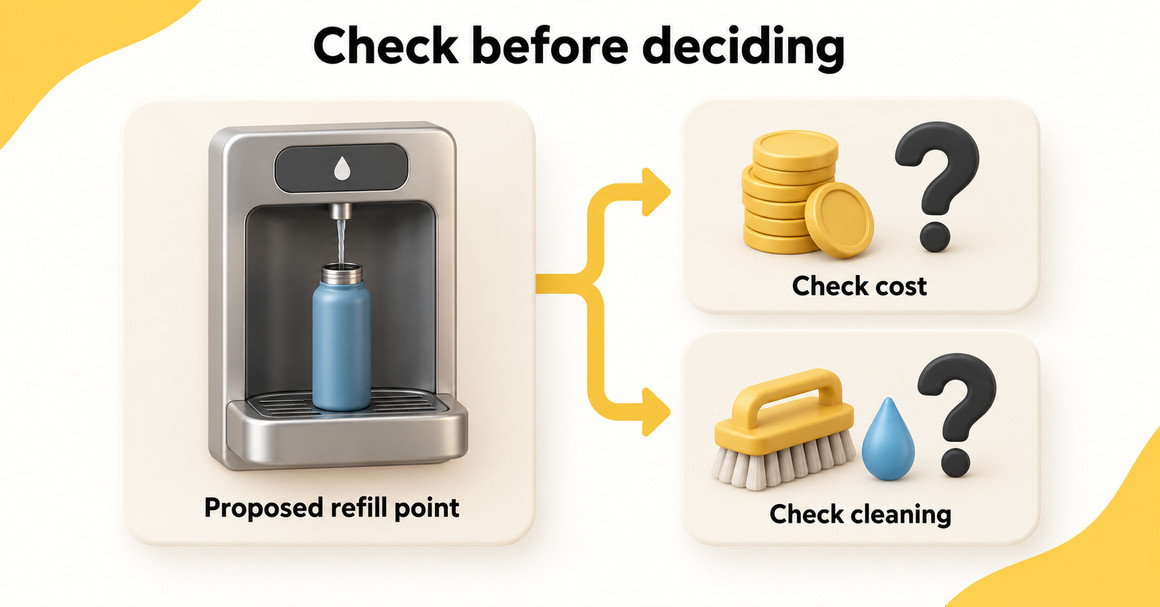
Your goal: Keep the shared plan and the conditions attached to it.
Original practice discussion
Speaker 1: “Our club could ask for a water refill point near the sports hall. People buy bottles there after training. A refill point would help students who bring their own bottles.”
Speaker 2: “I like the idea, but who would look after it? A refill point needs cleaning. We should check whether the sports team can take that on before we ask for money.”
Speaker 3: “There is already one inside the main building. Could we put up clearer signs instead? That would cost less, though the building closes before evening training ends.”
Speaker 1: “That closing time is the problem. Better signs would help during the day, but evening users still need water. We could ask for a point outside the sports hall.”
Speaker 2: “I would support that if the staff agree to maintain it. We also need to know the cost. We cannot promise that the club will pay without checking our budget.”
Speaker 3: “Then let’s ask about the cost and cleaning first. We can compare that with keeping the main building open later. I agree that signs alone would not help the evening group.”
Useful notes
| Speaker | Main point | Detail to keep |
|---|---|---|
| S1 | Refill point near sports hall | Evening users cannot reach the existing point after closing |
| S2 | Supports it with conditions | Check cleaning responsibility and cost |
| S3 | First suggests signs | Accepts signs alone will not help; compare later opening |
One possible summary
The group discussed a water refill point near the sports hall. The first speaker said evening users could not use the existing point after the building closed. The second supported a new point if staff could maintain it and the cost was checked. The third first suggested clearer signs to the existing point. However, they accepted that signs would not solve the evening access problem. They suggested comparing a new point with keeping the main building open later. The next step was to check costs and cleaning, rather than confirm a purchase.
Why this works
The answer keeps the access problem, the cleaning condition and the changed view about signs. It does not claim the club has approved or paid for anything.
Notice that “everyone wanted a new refill point” would be too strong. The group still needs information before choosing a final option.
Try it again: Cover the sample answer and use only the table. Can you keep the conditions while using different words?
Example 2: A field visit changes from morning to afternoon
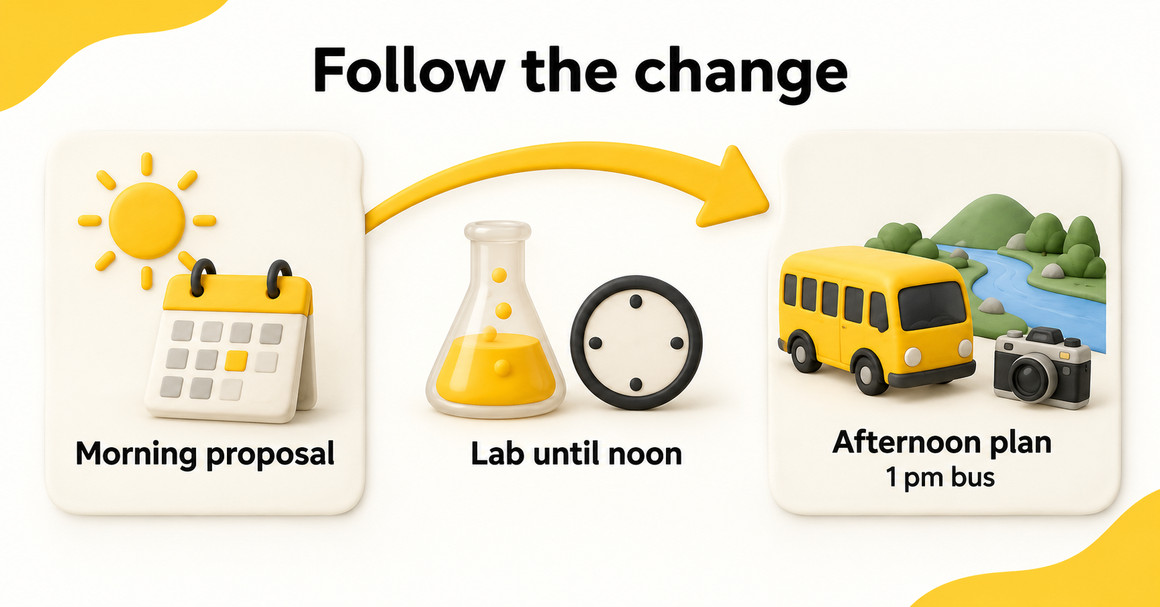
Your goal: Separate the first proposal from the later plan.
Original practice discussion
Speaker 1: “For our river project, I suggest visiting the site on Tuesday morning. We could take photos and count how many people use the path. Morning would leave us time to sort the notes afterwards.”
Speaker 2: “Tuesday is fine, but I have a lab until noon. I could join in the afternoon. We also need photos from both ends of the path, which will be easier with all three of us.”
Speaker 3: “I checked the bus times. There is a bus at one, and the trip takes about half an hour. We could meet at the stop after lunch. Would that leave enough time?”
Speaker 1: “Yes, if we plan our jobs before we leave. I can count path users. You two could take the photos and write down any damaged signs. We can sort the notes the next morning.”
Speaker 2: “That works for me. I will take photos at the north end. Could we agree on what to count first? Otherwise, our notes might cover different things.”
Speaker 3: “Good point. Let’s make one shared checklist tonight. I will cover the south end and check the return bus. Then we can all meet for the one o’clock bus on Tuesday.”
Useful notes
| Speaker | Starting point | Later detail |
|---|---|---|
| S1 | Tuesday morning visit | Accepts afternoon; counts path users; sorts notes next morning |
| S2 | Lab until noon | Joins afternoon; north-end photos; asks for shared counting rules |
| S3 | One o’clock bus | South-end photos; shared checklist; check return bus |
One possible summary
Three students planned a river project visit. The first suggested Tuesday morning, but the second had a lab until noon. The third found a one o’clock bus, so they agreed to travel after lunch. The first student would count path users, while the others would take photos at opposite ends. They also planned to note damaged signs. To keep their work consistent, they agreed to prepare a shared checklist. They would sort the notes the next morning, and the third student would check the return bus.
Why this works
The summary follows the change from morning to afternoon and gives the reason. It also separates the visit from the later work on the notes.
A mistake to repair: “They will visit on Tuesday morning and make a checklist on the bus.”
Both parts change the discussion. The visit moved to the afternoon. They planned to make the checklist that evening, before the visit.
Try it again: State the agreed plan without repeating every turn. Keep the reason for the time change and the shared checklist.
Example 3: An exhibition room with no final choice
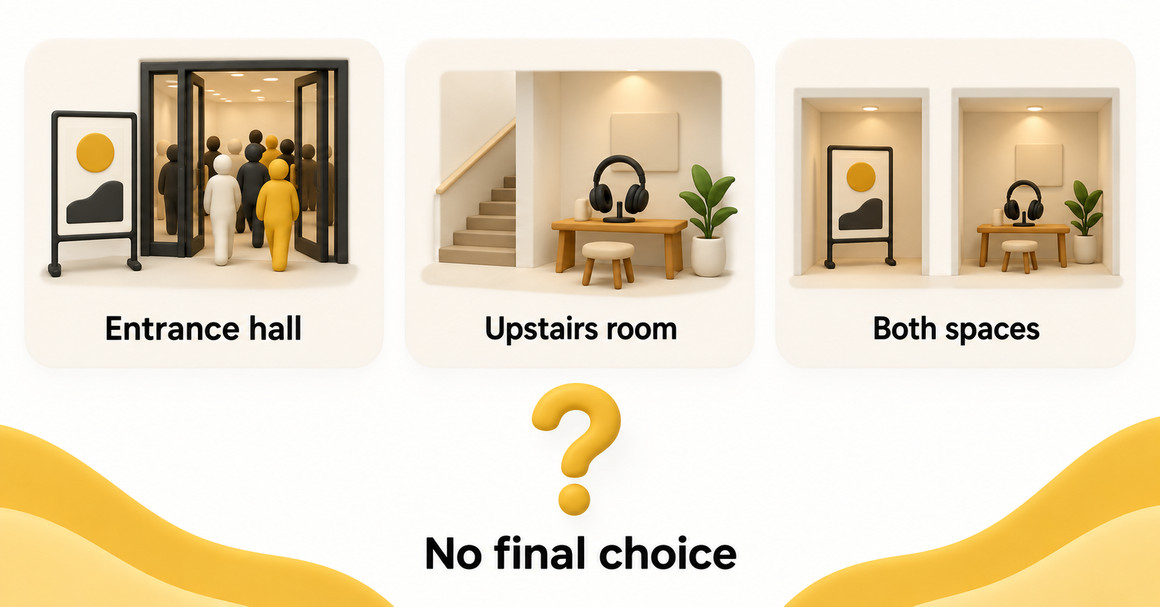
Your goal: Report different views without inventing agreement.
Try this one before opening the answer below. Make your own notes, hide the discussion and record your summary.
Original practice discussion
Speaker 1: “I think we should hold our class exhibition in the entrance hall. People pass through it all day. More students might stop to see our work, even if they had not planned to come.”
Speaker 2: “I would choose the upstairs room. The hall gets noisy, and some of our work includes short audio clips. Visitors would find those hard to hear near the main doors.”
Speaker 3: “Could we display the posters in the hall and play the clips upstairs? We would keep the busy location for the visual work. Signs could lead people to the quieter room.”
Speaker 2: “I still prefer one quiet room. We could advertise it around campus before the event. That may bring people upstairs, though we cannot know how many will come.”
Speaker 1: “Using both spaces could work, but visitors might miss half the exhibition. We would also need students in two places to answer questions. We have not checked who can help yet.”
Speaker 3: “Let’s check the rooms and ask our classmates about helping before we choose. We should also test the clips in the hall. Then we will know how much the noise matters.”
Show the notes, sample summary and answer check
Useful notes
| Speaker | Preferred option | Reason or concern |
|---|---|---|
| S1 | Entrance hall | Passing visitors; split display may be missed and needs more helpers |
| S2 | Quiet upstairs room | Audio hard to hear in hall; advertise to attract visitors |
| S3 | Split the display | Check rooms and helpers; test audio before choosing |
One possible summary
The students discussed where to hold their class exhibition. The first preferred the entrance hall because passing students might stop to look. The second wanted a quieter upstairs room so visitors could hear the audio clips. The third suggested using both spaces. However, the first worried that visitors might miss part of the display and that more helpers would be needed. The second still preferred one quiet room. The third proposed checking the rooms and available helpers, then testing the sound in the hall. They had not chosen a final location.
Check your answer
Did you include the hall’s main benefit and its noise problem? Did you explain the concern about using two spaces?
Most of all, did you leave the final choice open? Saying “they agreed to use both rooms” would add a decision they never made.
These PTE Summarize Group Discussion examples train different habits. The first keeps conditions, the second tracks changes, and the third avoids a false ending.
How should you review your recording?
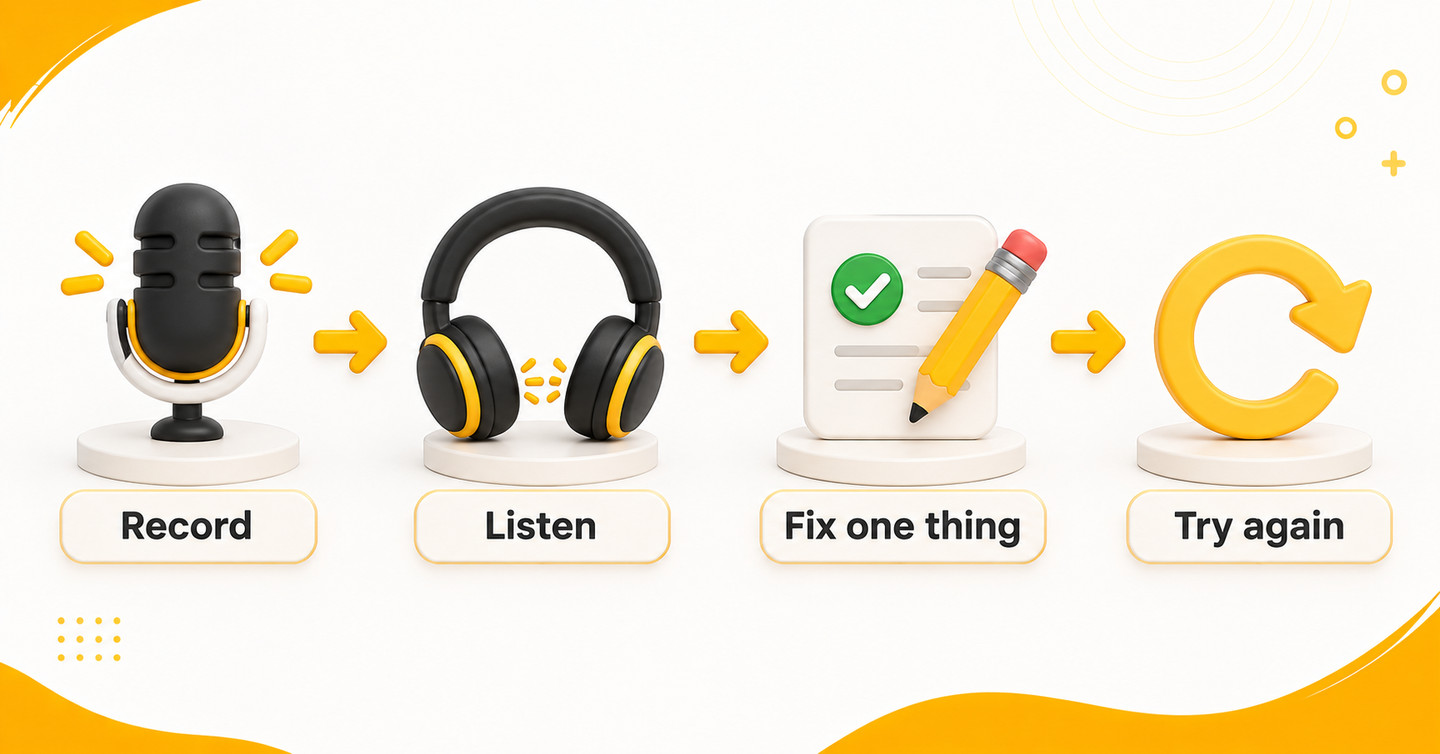
Listen to your answer before looking at the sample again. Ask whether someone who missed the discussion could follow your summary.
Then compare your recording with the original text. Mark the points you kept, missed or changed.
Use these checks to choose your next practice step. They are a learning checklist, not Pearson’s scoring scale.
| Check | What to listen for | A useful next step |
|---|---|---|
| Topic | Is the main issue clear near the start? | Replace a vague opening with the actual topic |
| Speakers | Did you mix up who supported or questioned an idea? | Trace each point back to the speaker’s notes |
| Meaning | Did you drop a reason, condition or change? | Add that missing link in your next attempt |
| Accuracy | Did you invent a fact or a group decision? | Remove it and report only what the discussion supports |
| Speech | Can a listener follow your words and pauses? | Say the difficult phrase slowly, then record it in context |
If you hear a long pause, find its cause. You may be searching for a word, reading unclear notes or trying to recall a lost detail.
Choose one issue for the next recording. For example, fix speaker attribution first: this means giving each point to the right person.
After that, work on speech flow. Short, complete sentences can be easier to manage than one long sentence with several ideas.
One better repeat does not prove that you have mastered the task. Try a new discussion to see whether the same skill carries over.
How can you add real listening practice?
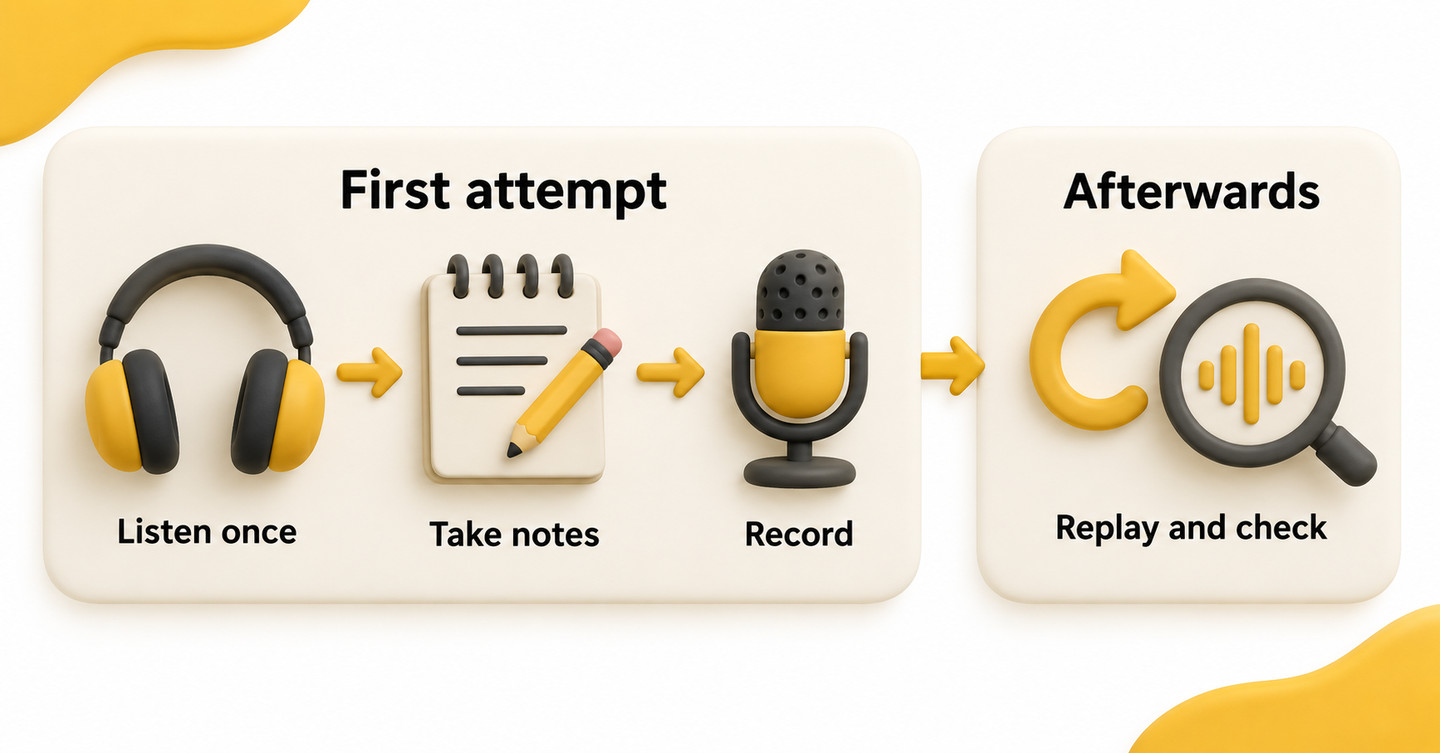
Once the written drills feel easier, move to a recording you have not heard. Pearson’s speaking practice resources include downloadable example questions with audio files.
That page is aimed at teachers, but the recordings can support your own practice. Choose a Summarize Group Discussion question and keep its sample answer hidden.
Keep the transcript hidden during your first attempt. Listen once, take notes, use the preparation time and record your own summary.
After that attempt, replay the audio for learning. Check the parts you missed and compare them with your notes.
If you understand the replay but missed it first, your note taking may need work. Try keeping fewer words so you can keep listening.
If you still cannot understand a phrase, study that short section. Say its key words aloud, then listen again within the full sentence.
This makes PTE listening practice more useful than replaying a whole clip without a goal. Keep your first attempt separate from later attempts, which benefit from knowing the content.
For a wider PTE speaking practice routine, use our speaking practice guide. Keep this drill as one part of your preparation across speaking tasks.
When should you try a full PTE practice test?
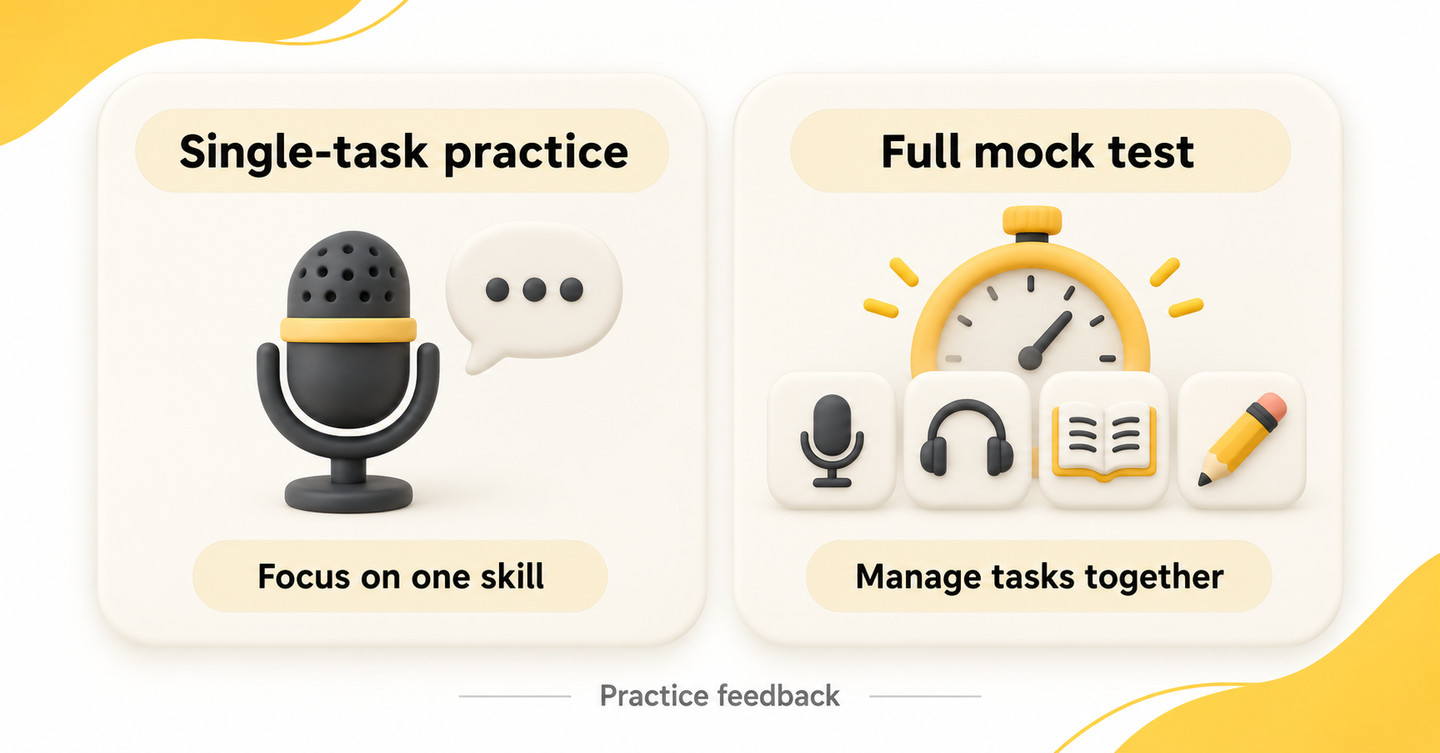
Use a full practice test when you want to check how you manage several tasks together. It can help you notice problems that single-task drills may hide.
For example, your notes may become harder to read as you get tired. Or you may speak clearly in one exercise but rush during a longer session.
Our PTE mock-test guide explains how to prepare for a full attempt. You can also view our PTE Mock Tests for current options.
A PTE mock test gives preparation feedback, not an official Pearson result. Use that feedback alongside a review of what you actually said.
Frequently asked questions
Do I need to speak for the full two minutes?
No. Pearson says you do not need to use all the speaking time. Focus on a clear, complete summary rather than adding words to fill time.
The short sample answers here match short written exercises. They do not set a target length for every exam recording.
Can I call people the first, second and third speaker?
These labels can help you keep your practice answer clear. Use them consistently, and avoid guessing a name you did not hear.
For these exercises, clear links between people and ideas matter more than creative labels.
Should I give my own opinion at the end?
Keep your answer focused on the speakers’ views. Your task is to summarise their discussion, as Pearson’s guidance explains.
If they disagree, report that disagreement. You do not need to choose a winner or solve their problem.
Should I memorise the sample summaries?
Use them to check meaning, then practise with them covered. Memorising these answers would not prepare you to handle a different conversation.
Try explaining the same notes in fresh, simple words. Then move to a new example.
Conclusion
Start with the refill-point discussion and record one answer from your notes. Check whether you kept the cleaning condition and the unresolved cost.
Then try the exhibition example without viewing its answer. That gives you a different challenge: ending clearly when the speakers have not reached a decision.
Once you can do both, move to unseen task audio. Keep a brief record of one thing to improve after each attempt.
References and Useful Resources
- Pearson: PTE Academic Speaking and Writing task format — official task instructions and scoring information.
- Pearson: Mastering the Summarize Group Discussion task — official examples and preparation guidance.
- Pearson: Speaking practice resources — downloadable examples and audio for listening practice.
- Our PTE speaking practice guide — a wider routine for speaking preparation.