


Key Takeaway
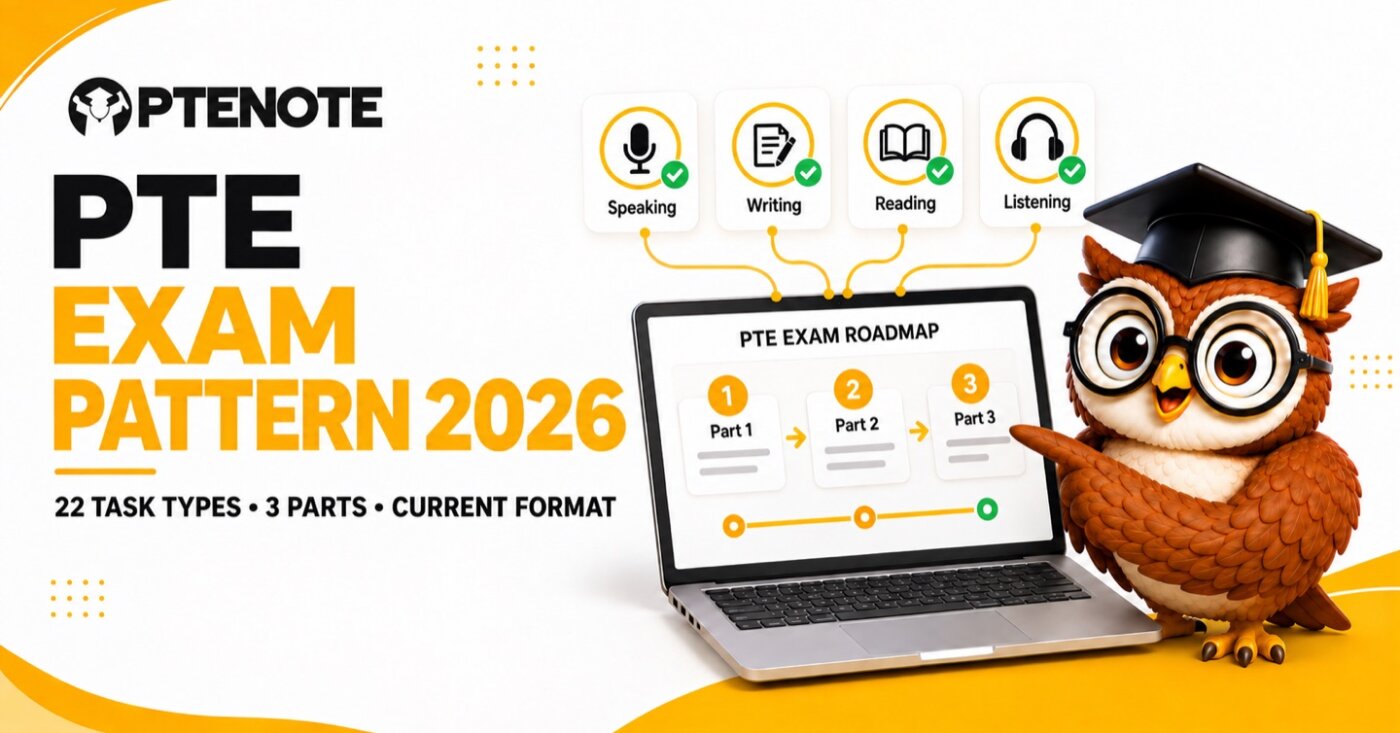
- PTE Academic has 3 parts, 22 scored question types and 65–75 questions.
- The test takes approximately 2 hours, although the exact mix varies by test version.
- Speaking & Writing takes about 76–84 minutes, Reading 23–30 minutes, and Listening 31–39 minutes.
- Two tasks added on 7 August 2025—Summarize Group Discussion and Respond to a Situation—remain part of the current 2026 format.
- Some questions score one skill, while others contribute to two of the four skill scores: Listening, Reading, Speaking and Writing.

Looking at an old PTE pattern and wondering whether it still matches the exam you will take? You are not alone. Many pages still show 20 task types, older timings or outdated skill mappings. Those details can change how you practise, so this guide uses Pearson’s current PTE Academic format and score guide.
This article covers the exam pattern only: the order of the three parts, every current question type, the usual number of questions, the skills scored and the scoring method.
What is the PTE exam pattern in 2026?

PTE Academic is a computer-based English test completed in three parts. You use a headset and microphone for speaking and listening tasks, and a keyboard and mouse for reading and writing tasks. Pearson’s current score guide states that a test contains 65–75 questions across 22 different question types.
You may also see this structure called the PTE test pattern, PTE exam format or PTE test format. In this guide, all of those terms refer to the same current order, task list, timing and scoring structure for PTE Academic.
| Order | Test part | Approximate time | Question types | Questions | Main activity |
|---|---|---|---|---|---|
| 1 | Speaking & Writing | 76–84 minutes | 9 | 35–43 | Speak into a microphone and type written responses |
| 2 | Reading | 23–30 minutes | 5 | 15–20 | Read, select, arrange and complete text |
| 3 | Listening | 31–39 minutes | 8 | 15–22 | Listen once, then select, type or summarize |
Do not add the lowest or highest section times to predict your exact test length. Pearson explains that different test versions are balanced for total length, so one candidate will not receive every minimum or every maximum. The full test remains approximately two hours.
The same warning applies to the question ranges. The section ranges show what is possible inside each part, but their three maximums are not given together. Pearson balances the complete test to 65–75 questions. Use the ranges to understand frequency, not to predict one exact paper.
There is also an important difference between a question type and a question. The format contains 22 types, but you will see several questions from many of those types. That is how one test can contain 65–75 questions without containing 65–75 different formats. The table gives a planning range, not a promise that every candidate will receive the same count.
The order is fixed: Speaking & Writing comes first, Reading comes second and Listening comes last. This matters when you build stamina. A student who practises only short task sets may understand every format but still find it difficult to concentrate through a full sitting. Your later mock tests should therefore follow the real section order instead of letting you choose your strongest section first.
The test is completed on a computer at an authorised test centre. Spoken answers are recorded through a headset microphone. Typed answers use a keyboard, while selection and drag-and-drop tasks use the mouse. You do not need specialist computer knowledge, but you should be comfortable typing, selecting text, moving answer options and watching an on-screen timer.
Before the scored tasks, you complete a Personal Introduction. It helps you become familiar with speaking into the microphone, but it does not add points to your result. Treat it as a calm equipment and voice check, then focus on the scored tasks that follow.
What does “PTE syllabus” mean? PTE Academic does not have a subject syllabus that asks you to memorise history, science or current affairs. Its syllabus is the set of English skills and task types used in the test. The topics are academic or everyday, but Pearson scores how well you understand and use English—not how much specialist knowledge you have about the topic.
The four main skills are Speaking, Writing, Reading and Listening. Tasks can also look at features inside those skills, such as content, pronunciation, oral fluency, grammar, vocabulary, spelling and whether you followed the required answer form. A beginner should therefore learn the task instruction first, then build the English ability needed to complete it.
What does “PTE exam pattern with marks” mean? PTE does not publish a simple fixed table such as “Speaking = 25 marks” or “Write from Dictation = 10 marks.” Your score report shows an overall score and four skill scores from 10 to 90. Questions contribute evidence to one or two skills, and different tasks use different scoring rules. Treat websites that publish exact permanent percentage weights with caution unless Pearson publishes the same figures in its current score guide.
Here are six simple terms used throughout this guide:
- Part: one of the three large sections of the test.
- Question type: the format of a task, such as Read Aloud or Write from Dictation.
- Prompt: the text, image, audio or situation you receive.
- Response: the answer you speak, type, select or arrange.
- Partial credit: a partly correct answer may receive some points.
- Integrated task: one answer contributes to two skill scores.
How does the test move? You work through the parts in order. Within a part, read the instruction shown for the current task, respond before its timer or the section timer ends, and submit the answer before moving forward. Audio starts automatically in Listening and in listening-based speaking tasks, and it is played once. You may take notes on the erasable noteboard supplied at the test centre.
Some questions have their own response limit, such as 15 seconds for Repeat Sentence or 20 minutes for Write Essay. Reading and most Listening tasks instead share the time available for their part. “No separate answer time” in the tables below means the section clock is running; it does not mean you have unlimited time.
What changed in the PTE pattern, and is it still current in 2026?

Pearson introduced an enhanced PTE Academic format for tests taken from 7 August 2025. The number of scored question types increased from 20 to 22, but the same three-part structure and approximate two-hour duration remained.
The two added Speaking & Writing tasks are:
- Summarize Group Discussion: listen to a discussion involving several speakers, then give a spoken summary of their main ideas and viewpoints.
- Respond to a Situation: read a short everyday or academic situation, then give an appropriate spoken response.
The enhanced format also changed a few skill mappings. In the current score guide, Read Aloud scores Speaking only, Fill in the Blanks (Dropdown) scores Reading only, and Answer Short Question scores Listening only. This is why older task-weight or skill-contribution charts can now be misleading.
For 2026 preparation, the practical lesson is simple: check the date and source of any task list before using it. A list with 20 task types is describing the earlier pattern. A chart that says Read Aloud directly adds to Reading is also using the older skill map. Neither should control how you divide your present study time.
The two added tasks are not optional trial questions in the published format. They sit in Part 1 and should appear in your speaking practice. Summarize Group Discussion requires you to follow more than one speaker and connect their main points. Respond to a Situation tests whether your reply is relevant, clear and suitable for the situation. These are different skills from simply reading prepared sentences aloud.
This guide describes PTE Academic. PTE Core and the PTE Home tests have different purposes and formats. PTE Academic UKVI uses the same Academic test content and score report, with an extra reference number used for UK visa verification.
Use this quick check to spot an outdated PTE pattern: a page is old if it lists only 20 task types, omits Summarize Group Discussion or Respond to a Situation, gives the earlier 54–67-minute Speaking & Writing timing, or says that Read Aloud still directly scores Reading. You may also find pages that call the August 2025 enhancement a “new 2026 change.” The format is current in 2026, but the change itself took effect on 7 August 2025. This date matters because a learner may otherwise expect another different pattern to begin during 2026.
Be careful with exact-looking “marks distribution” charts too. Pearson publishes task counts, scored skills and scoring traits, but it does not publish one permanent percentage weight for every task that candidates can add to 100. Test versions contain different numbers of questions within the official ranges. Use the current task and skill map to plan preparation, and use an official score report to judge your own performance.
What question types are in Part 1: Speaking & Writing?

Part 1 is the longest section. It begins with an unscored Personal Introduction for familiarisation, followed by nine scored question types. The Personal Introduction does not contribute to your score.
| Question type | Usual number | Skills scored | Scoring | What you do | Prompt and answer limit |
|---|---|---|---|---|---|
| Read Aloud | 6–7 | Speaking | Partial credit | Read a displayed passage aloud | Text up to 60 words; 30–40 seconds to prepare; response time varies |
| Repeat Sentence | 10–12 | Listening + Speaking | Partial credit | Listen once and repeat the sentence | Audio 3–9 seconds; answer within 15 seconds |
| Describe Image | 5–6 | Speaking | Partial credit | Describe the important features of an image | 25 seconds to prepare; 40 seconds to answer |
| Retell Lecture | 2–3 | Listening + Speaking | Partial credit | Listen to a lecture and retell the main information | Audio up to 90 seconds; 10 seconds to prepare; 40 seconds to answer |
| Answer Short Question | 5–6 | Listening | Correct or incorrect | Give a short spoken answer to a question | Audio 3–9 seconds; answer within 10 seconds |
| Summarize Group Discussion | 2–3 | Listening + Speaking | Partial credit | Summarize the ideas and viewpoints in a discussion | Audio up to 3 minutes; 10 seconds to prepare; 2 minutes to answer |
| Respond to a Situation | 2–3 | Speaking | Partial credit | Give an appropriate response to a written situation | Text/audio up to 60 words; 10 seconds to prepare; 40 seconds to answer |
| Summarize Written Text | 2 | Reading + Writing | Partial credit | Write one sentence that summarizes a passage | Text up to 300 words; 10 minutes; one sentence of 5–75 words |
| Write Essay | 1 | Writing | Partial credit | Write a 200–300-word essay | Prompt of 2–3 sentences; 20 minutes; answer of 200–300 words |
Summarize Written Text gives you 10 minutes per item, while Write Essay gives you 20 minutes. For speaking tasks, the preparation and response timers vary by question type, so practise starting promptly after the recording tone and finishing before the microphone closes.
The prompt limits show the largest material you may receive, not the amount you must repeat. A Retell Lecture recording can run for up to 90 seconds, but your job is to explain its central message and key support in a 40-second answer. A Group Discussion can run for up to three minutes, so notes should separate the speakers’ main views rather than copy every sentence. In Respond to a Situation, identify who you are speaking to, what outcome is needed and what tone is suitable before the 40-second response begins.
The two writing tasks have strict form rules. Summarize Written Text must be one sentence and 5–75 words; a full stop that creates a second sentence can affect form. Write Essay must be 200–300 words. Writing outside these ranges can reduce the form score even when the ideas are relevant. Plan a short structure that you can complete and check within the available time.
The first seven scored task types in Part 1 use spoken responses, but they do not all measure the same thing. Read Aloud focuses on how accurately and fluently you deliver displayed text. Repeat Sentence asks you to understand and reproduce an audio sentence. Describe Image requires an organised description of visual information. Retell Lecture and Summarize Group Discussion combine listening with a spoken summary, while Respond to a Situation asks for an appropriate real-world reply.
That difference should shape your practice. One memorised response cannot fit every speaking task. You need a reliable structure, but the words must answer the actual prompt. For an image, identify the subject and the most important details. For a lecture or discussion, capture the central idea and supporting points. For a situation, speak directly to the person involved and address what the situation asks you to do.
Several speaking tasks award partial credit for more than content. Clear pronunciation and steady oral fluency matter, so a rushed answer full of hesitations can lose points even when it mentions relevant ideas. Aim for an easy-to-understand pace. Do not force an unfamiliar accent; clarity and consistent delivery are more useful than trying to imitate a particular country.
Repeat Sentence appears 10–12 times, the highest published question range in the exam. That does not mean Pearson assigns a simple percentage weight to it, but it does mean the format gives you repeated opportunities to demonstrate Listening and Speaking. Practise listening in meaningful word groups rather than trying to remember isolated words.
The two writing tasks require different responses. Summarize Written Text must be one sentence and is scored for whether it captures the passage accurately while following the required form. Write Essay requires 200–300 words and should develop a clear position with connected ideas. In both tasks, leave enough time to check grammar, spelling and punctuation instead of using every second to add new content.
Part 1 is long, so avoid using too much energy on the Personal Introduction or overthinking one early response. Once an answer is submitted, shift attention to the next prompt. A steady routine—read the instruction, identify the task, prepare briefly and respond—reduces avoidable mistakes.
What question types are in Part 2: Reading?

Reading is the shortest part of the exam and has one section timer rather than a separate fixed timer for each question. You need to manage the 23–30 minutes across all five question types.
| Question type | Usual number | Skills scored | Scoring | What you do | Prompt and answer limit |
|---|---|---|---|---|---|
| Fill in the Blanks (Dropdown) | 5–6 | Reading | Partial credit per blank | Choose the best word for each blank | Text up to 300 words; shared Reading timer |
| Multiple Choice, Multiple Answers | 2–3 | Reading | Partial credit with deductions | Select every correct option | Text up to 350 words; shared Reading timer |
| Reorder Paragraph | 2–3 | Reading | Partial credit per correct adjacent pair | Arrange text boxes in a logical order | Text up to 150 words; shared Reading timer |
| Fill in the Blanks (Drag and Drop) | 4–5 | Reading | Partial credit per blank | Drag words into the correct gaps | Text up to 80 words; shared Reading timer |
| Multiple Choice, Single Answer | 2–3 | Reading | Correct or incorrect | Select one correct option | Text up to 300 words; shared Reading timer |
The text limits explain why Reading questions need different approaches. Multiple Choice, Multiple Answers may use the longest passage, up to 350 words, while Drag-and-Drop Fill in the Blanks may use a text of up to 80 words. A longer text does not automatically deserve unlimited time: the same 23–30-minute section clock continues across every task. Read the question first in multiple choice, but read the full local context around every blank before choosing a word.
There is no separate answer countdown for each Reading item. If you leave too much time unused on easy blank questions, you cannot save it for another section; if you overspend on one difficult paragraph, the remaining Reading items receive less time. Practise with a visible section timer and learn an approximate pace that still leaves a small final buffer.
Only Reading Multiple Choice, Multiple Answers deducts points for incorrect options in this part. Pearson records +1 for each correct option and −1 for each incorrect option, with a minimum score of zero for the question. Select an option because the passage supports it—not simply because it sounds possible.
The two Fill in the Blanks formats make up a large share of the published Reading question range. Both test whether a word fits the meaning and grammar of the surrounding sentence. Look at the words before and after each gap, identify the needed part of speech and then check common word combinations. A choice can be grammatically possible but still sound wrong in context.
Reorder Paragraph gives partial credit for correct neighbouring pairs. Start by looking for a sentence that introduces the subject without depending on an earlier reference. Then connect pronouns, repeated terms, time order and cause-and-effect language. You do not need to discover the whole order in one move; building reliable pairs is a practical way to make progress.
For Multiple Choice, Single Answer, there is no deduction for an incorrect choice. Read the question before comparing options so you know whether you need the main idea, a detail, the writer’s purpose or an inference. For Multiple Answers, be more selective because an unsupported extra choice can remove a point earned by a correct one.
Reading has a shared section timer, which means spending too long on one question reduces the time available for everything that follows. During timed practice, record where your minutes go. If one format repeatedly causes a delay, set a sensible limit and move on rather than allowing a single difficult passage to control the section.
What question types are in Part 3: Listening?

Listening contains eight question types. Each recording plays once, so read the task instructions before the audio begins and take notes where they will help. Some listening questions also score Reading or Writing.
| Question type | Usual number | Skills scored | Scoring | What you do | Prompt and answer limit |
|---|---|---|---|---|---|
| Summarize Spoken Text | 1 | Listening + Writing | Partial credit | Write a 50–70-word summary of an audio recording | Audio 60–90 seconds; 10 minutes total; answer of 50–70 words |
| Multiple Choice, Multiple Answers | 2–3 | Listening | Partial credit with deductions | Select every correct option | Audio 80–120 seconds; shared Listening timer |
| Fill in the Blanks (Type In) | 2–3 | Listening | Partial credit per correctly spelled word | Type missing words into a transcript | Audio 30–60 seconds; shared Listening timer |
| Highlight Correct Summary | 2–3 | Listening + Reading | Correct or incorrect | Choose the summary that best matches the audio | Audio 30–90 seconds; shared Listening timer |
| Multiple Choice, Single Answer | 2–3 | Listening | Correct or incorrect | Select one correct option | Audio 30–90 seconds; shared Listening timer |
| Select Missing Word | 1–2 | Listening | Correct or incorrect | Choose the word or phrase missing at the end | Audio 20–70 seconds; shared Listening timer |
| Highlight Incorrect Words | 2–3 | Listening + Reading | Partial credit with deductions | Mark transcript words that differ from the audio | Audio 15–50 seconds; shared Listening timer |
| Write from Dictation | 3–4 | Listening + Writing | Partial credit per correctly spelled word | Type the sentence you hear | Audio 3–5 seconds; shared Listening timer |
The audio-length column is a planning guide. A 120-second multiple-choice recording demands sustained attention, while a 3–5-second dictation demands exact short-term recall. All clips play once. Use the preparation time before audio begins to scan the instruction and answer area, then listen for the information that the task actually requires.
Except for Summarize Spoken Text, these tasks use the shared Listening section timer after the recording. You control the time spent selecting, checking or typing after the audio. Move forward once your answer is supported; repeatedly reconsidering a single-choice item can take time away from later dictations. For typed tasks, include spelling in your time plan because a word you understood but spelled incorrectly will not earn the same credit.
Listening Multiple Choice, Multiple Answers and Highlight Incorrect Words both deduct a point for an incorrect selection, with a minimum question score of zero. Summarize Spoken Text gives you 10 minutes to write your summary after the audio.
Every Listening recording is played once. The best preparation is not trying to write every word; it is learning to recognise the purpose, main idea, supporting details and changes in the speaker’s direction. Short notes using keywords and simple symbols are faster to review than complete sentences.
In Summarize Spoken Text, use your notes to write a focused 50–70-word summary. Include the central topic and the most important supporting relationships. A list of unrelated details is less useful than a connected explanation. Save time to check the word count, sentence structure, spelling and punctuation before the 10-minute response window ends.
Fill in the Blanks and Write from Dictation depend on accurate spelling. In Fill in the Blanks, follow the transcript while listening and type the missing words. In Write from Dictation, rebuild the full sentence after hearing it once. Practising common word endings, plurals, verb forms and function words can recover points that are often lost even when the main meaning was understood.
Highlight Correct Summary combines Listening and Reading. First understand the recording; then compare which option represents the whole message rather than repeating one memorable detail. Select Missing Word requires you to follow the logic leading to the missing ending. Multiple Choice, Single Answer similarly rewards choosing the option supported by the audio, not the one that merely repeats familiar words.
Use extra care with Highlight Incorrect Words. You gain a point for identifying a transcript word that differs from the recording, but an incorrect click deducts a point. Follow the text in rhythm with the audio and click only when you hear a clear difference. The same evidence-first approach applies to Listening Multiple Choice, Multiple Answers.
The final Listening task is Write from Dictation. Because it scores both Listening and Writing and appears 3–4 times, it deserves regular practice. Listen for the sentence in chunks, type what you remember, then use grammar and meaning to check the complete version. There is no deduction for an incomplete attempt, so enter every word you can support.
How does scoring work across the PTE exam pattern?

PTE reports one overall score and four communicative-skill scores—Listening, Reading, Speaking and Writing—on a scale from 10 to 90. The overall score reflects performance across the whole test; it is not the simple average of the four skill scores.
Questions use one of these scoring approaches:
- Correct or incorrect: the response earns one point when correct and zero when incorrect.
- Partial credit: you can receive some credit for a partly correct response or for specific scored traits.
- Partial credit with deductions: incorrect selections can cancel correct selections in Reading Multiple Choice, Multiple Answers; Listening Multiple Choice, Multiple Answers; and Highlight Incorrect Words. A question cannot fall below zero.
All question types are scored by AI. Pearson’s current score guide also states that content in Describe Image, Retell Lecture, Respond to a Situation, Summarize Group Discussion, Summarize Written Text, Write Essay and Summarize Spoken Text receives human expert review before the task score is confirmed. Write Essay receives additional human review for selected writing features.
The word marks can be confusing here. In PTE, an objective response may earn a point for a correct option, blank, word or correctly ordered pair. A longer spoken or written response is judged across several traits. Those task points are then used as evidence for the relevant 10–90 skill scores; they are not printed as a simple school-style total such as 70 marks out of 100.
| Task group | Main scoring traits | Beginner meaning |
|---|---|---|
| Read Aloud and Repeat Sentence | Content, pronunciation and oral fluency | Say the correct words clearly, at a natural pace, without long or unnatural pauses. |
| Describe Image, Retell Lecture, Summarize Group Discussion and Respond to a Situation | Content, pronunciation and oral fluency | Give a relevant spoken answer with important information and understandable delivery. Content also receives human expert review. |
| Summarize Written Text | Content, form, grammar and vocabulary | Capture the passage accurately in one grammatical sentence of 5–75 words. |
| Write Essay | Content, form, development and structure, coherence, grammar, general linguistic range, vocabulary range and spelling | Answer the prompt in 200–300 words, organise ideas clearly and use accurate, varied English. |
| Summarize Spoken Text | Content, form, grammar, vocabulary and spelling | Write an accurate 50–70-word summary that is clear and correctly written. |
| Blank, dictation and reorder tasks | Correct blank or word; correct adjacent pair for Reorder Paragraph | Each correct unit can earn credit, so complete as much of the response as you can support. |
| Multiple-choice and other selection tasks | Correct option; deductions only in the three named multiple-selection tasks | Do not click extra options without evidence when an incorrect selection can cancel a correct one. |
Content asks whether your answer includes the information the prompt requires. Form asks whether you followed rules such as the number of sentences or words. Oral fluency concerns rhythm, phrasing and smooth delivery, while pronunciation concerns whether your speech is understandable. Grammar, vocabulary and spelling are judged where the task guide lists them. This is why copying one long template into every answer is risky: correct form cannot replace relevant content.
Not every trait is worth the same number of raw task points, and not every task uses every trait. For example, spelling matters directly in the written summaries, essay, listening blanks and dictation, but it is not a separate trait in a spoken answer. Always match your review checklist to the task instead of applying one scoring checklist to the whole exam.
Because integrated questions score two skills, do not judge a task only by the section where it appears. Repeat Sentence, for example, appears in Part 1 but scores both Listening and Speaking. For a deeper explanation, read our PTE scoring system guide.
The four skill scores do not come only from the section carrying the same name. Listening can receive evidence from Part 1 and Part 3. Writing can receive evidence from Speaking & Writing and Listening. Reading can receive evidence from Reading and selected Listening tasks. This is why improving a question that tests two skills can support more than one number on your score report.
Partial credit also works differently across tasks. In a blank-filling or dictation task, each correct word or blank can add credit. In Reorder Paragraph, correctly connected neighbouring text boxes receive credit. In longer spoken and written answers, Pearson evaluates task-specific features such as content and the quality of the response. “Partial credit” does not mean every partly finished answer automatically receives the same fraction of a point.
Negative marking applies only to the three selection tasks named above. It does not mean one poor question can reduce your total test score below what you had before; Pearson sets the minimum for each of those questions at zero. The practical risk is over-selecting: an incorrect option can cancel a point from a correct selection within that question.
Your overall score is calculated from performance across the exam and should not be recreated by adding the four skill scores and dividing by four. Use the overall and skill results together. The overall score gives a broad result, while the four skills show where your performance was stronger or weaker.
Pearson’s use of AI does not mean longer answers are rewarded simply because they contain more words. Responses still need to follow the instruction, stay relevant and meet the required form. Human review on selected tasks adds another quality check; it is not a separate score that you can calculate or request during the test.
Finally, remember that the number of questions is not a public weighting formula. A high-volume task deserves practice because you will meet it often, but the final score also depends on how each response is scored and which skills it measures. Build your study priorities from your own weak skills, the task frequency and the scoring method together.
How should you prepare for the current PTE test format?

Start with the format before trying to memorise templates or chase a target score. A practical preparation sequence is:
- Learn what each task asks you to do. Know the input, response method, scored skills and whether the task uses correct/incorrect or partial-credit scoring.
- Practise each interface. Get comfortable speaking after a tone, typing while listening, dragging words, choosing options and managing section time.
- Complete a full timed mock. Practise the same three-part order without pausing or checking answers after every task.
- Review patterns, not just the final number. Identify whether missed points come from comprehension, content, oral fluency, pronunciation, grammar, vocabulary, spelling, form or time management.
Our PTE mock tests online guide explains how to use a mock score carefully. If you want a broader routine, follow our PTE study plan. Mock results are preparation estimates, not official Pearson scores.
Begin by making a one-page map of the exam. Write the three parts in order, list the 22 task types under them and mark which tasks score two skills. Add a warning beside the three tasks with deductions. This small reference helps you understand why two activities that look similar may need different answer strategies.
Next, learn one task at a time using the same questions:
- What will I see or hear?
- Will I speak, type, select or move an answer?
- How many questions usually appear?
- Which skill or skills receive points?
- Is the task correct/incorrect, partially scored or scored with deductions?
- What timer or word limit must I follow?
Then practise the real action, not only the English knowledge behind it. Speaking into a microphone feels different from speaking to a tutor. Typing a sentence after one audio play feels different from writing it after reading a transcript. Dragging words under time pressure feels different from completing a printed worksheet. Familiarity with the interaction protects the language ability you already have.
Use short practice sets while you learn a format, then combine tasks from the same section. Once you can complete those without pausing, take a full-length mock in the official order. Sit at a desk, use a headset, avoid checking notes and keep the session continuous. This tests concentration and section pacing as well as individual answers.
After the mock, do not review only the total score. Sort errors into clear groups: misunderstood instructions, missed audio, weak vocabulary, inaccurate grammar, spelling, pronunciation, fluency, incomplete content or poor time use. A label such as “Reading is weak” is too broad to guide the next practice session. “I lose time on Reorder Paragraph and miss collocations in both blank tasks” gives you something specific to fix.
Your next study block should target the pattern you found. If spelling reduces both Listening and Writing, practise dictation and blank tasks together. If spoken answers contain long pauses, record short timed responses and review where the hesitation begins. If you over-select answers on deduction tasks, require yourself to point to evidence before clicking.
Retake a comparable timed set after focused practice. Improvement should appear in the targeted task and in the way you manage it—not only as a different estimated score. Keep a simple log with the date, task, error type and next action. This prevents random practice and shows whether the same weakness keeps returning.
In the final week, use current materials that include all 22 task types. Complete at least one realistic full sitting, check your microphone habits and practise staying calm after a difficult item. You do not need to feel perfect on every question. You need a repeatable process that helps you understand the prompt, respond in the correct form and move on within time.
Frequently asked questions about the PTE exam pattern
How many parts are in PTE Academic?
PTE Academic has three parts in a fixed order: Speaking & Writing, Reading, and Listening.
How many question types are in the current PTE Academic exam?
There are 22 scored question types: nine in Speaking & Writing, five in Reading and eight in Listening. Pearson says an individual test contains 65–75 questions.
How long is the PTE Academic exam in 2026?
The test takes approximately two hours. Section timing ranges are 76–84 minutes for Speaking & Writing, 23–30 minutes for Reading and 31–39 minutes for Listening. Pearson notes that the section minimums and maximums should not be added because test versions are balanced for overall length.
Is PTE Academic exactly 135 minutes long?
No fixed 135-minute promise appears in Pearson’s current format guidance. Pearson describes PTE Academic as approximately two hours and provides ranges for each part because the question mix varies. Plan for the complete test-centre appointment, including check-in and instructions, rather than assuming that every candidate’s scored test will end at exactly the same minute.
Did the PTE exam pattern change in 2026?
The current 2026 pattern continues the enhanced format introduced on 7 August 2025. It includes 22 task types, including Summarize Group Discussion and Respond to a Situation. We found no separate Pearson announcement introducing another 2026 structural change as of 17 September 2026.
Is the Personal Introduction scored?
No. Pearson describes the Personal Introduction as a familiarisation activity, and it does not contribute to your score.
Which PTE tasks have negative marking?
Three task types deduct points for incorrect selections: Reading Multiple Choice, Multiple Answers; Listening Multiple Choice, Multiple Answers; and Highlight Incorrect Words. Each question has a minimum score of zero.
Can one PTE question affect two skill scores?
Yes. Integrated-skills tasks contribute to two communicative skills. Examples include Repeat Sentence for Listening and Speaking, Summarize Written Text for Reading and Writing, and Write from Dictation for Listening and Writing.
What does “PTE exam pattern with marks” mean?
It usually means the task list, question counts, scored skills and scoring method. PTE does not use a published fixed school-style marks table for its three parts. Results show an overall score and four skill scores from 10 to 90. Some tasks earn correct/incorrect points, while others use partial credit and several scoring traits.
Is the PTE exam pattern the same as the PTE syllabus?
They overlap, but they are not exactly the same idea. The pattern explains the order, number, timing and scoring of tasks. The syllabus describes the English skills and task formats you need to prepare. There are no subject chapters to memorise; you prepare Speaking, Writing, Reading and Listening through the 22 task types.
How many questions are in each PTE part?
The published task ranges produce about 35–43 questions in Speaking & Writing, 15–20 in Reading and 15–22 in Listening. Do not add the three maximums: Pearson balances each test to a total of 65–75 questions, so one version will not contain every maximum at the same time.
Can I download an official PTE exam pattern PDF?
Pearson provides an official PTE Academic Test Taker Score Guide in PDF format. It explains the current task counts, scored skills and scoring rules. Because web pages and third-party PDFs can remain online after a change, check the document’s edition and compare it with Pearson’s current test-format pages before relying on it.
Is PTE Academic UKVI a different exam pattern?
PTE Academic UKVI uses the same test content and score report as PTE Academic. The UKVI version includes a Secure English Language Test unique reference number for UK visa verification. PTE Core and PTE Home are different tests and should not be prepared for using this Academic task table.
Conclusion
The current PTE exam pattern is easier to plan once you see it as one map: 3 parts, 22 scored question types, 65–75 questions and an approximate two-hour test. The most important update is that the two tasks added in August 2025 remain in the 2026 format, while a few older skill mappings are no longer correct.
Keep this guide beside your practice schedule, learn what every task measures and use timed mocks to make the real interface feel familiar. When you are ready to choose a date, check our PTE exam booking page before completing payment.
References and useful resources
- PTENOTE guide to the PTE scoring system
- PTENOTE guide to using online PTE mock tests
- Pearson PTE Academic test format
- Pearson Speaking & Writing format and task guidance
- Pearson Reading format and task guidance
- Pearson Listening format and task guidance
- Pearson PTE Academic scoring
- Pearson PTE Academic Test Taker Score Guide
- Pearson 2025 PTE Academic updates
- Pearson Enhanced PTE Academic research report