Key Takeaway
- Write a 25–50 word summary.
- You get 10 minutes for each summary.
- You can use one or more complete sentences in PTE Core.
- The task contributes to both Reading and Writing.
- The test checks Content, Form, Grammar and Vocabulary.
- Keep the main message and key supporting points. Leave out your own views.
- Plan, write and check your answer. Use the practice examples below to try this process.
“I understand the passage. How do I turn it into a short summary?”
Start by choosing what matters. Do not try to squeeze every line into your answer. Ask what the writer wants you to understand, then find the points that explain that message.
In this guide, we explain the PTE Core Summarize Written Text rules in simple terms. Then we work through two passages and fix a summary that changes the meaning. Try each task before reading our answer.
What are the PTE Core Summarize Written Text rules and scoring factors?
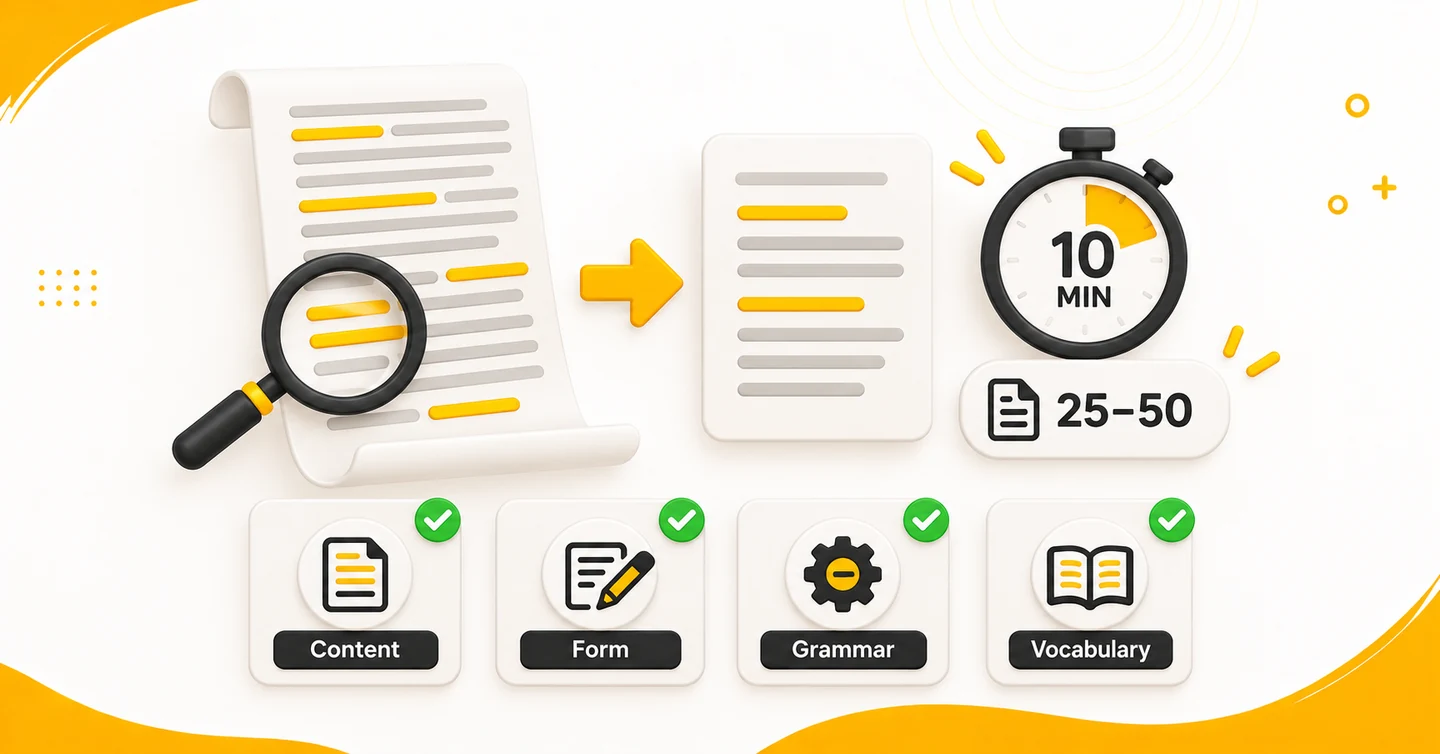
A summary gives the main message and essential supporting ideas in a shorter form. Explain the passage rather than giving your opinion about it.
Summarize Written Text appears in Part 1: Speaking & Writing of PTE Core. If the whole test is new to you, our PTE Core exam format guide explains where the task fits.
Pearson is the company behind PTE Core. Here are the task rules from its Core format page:
| Part of the task | What to expect |
|---|---|
| Reading passage | Up to 200 words |
| Your summary | 25–50 words |
| Time | 10 minutes for each task |
| Sentence format | One or more complete sentences |
| Skills scored | Reading and Writing |
| Number of questions | 1–2, according to the 2026 Core Score Guide |
Start each sentence with a capital letter and end it with a full stop. The answer box has a word counter. Check the number on the screen before moving on.
What do the four scoring factors mean?
The 2026 PTE Core Score Guide lists these factors:
- Content: Your summary needs to cover the relevant points without changing their meaning.
- Form: This factor checks the response’s word count and written format.
- Grammar: This factor checks whether your sentence structure is correct.
- Vocabulary: This factor checks whether your word choices fit the meaning.
The task uses partial credit. You can earn some marks without giving a fully correct answer.
Review the factors separately during practice. Check the ideas first. Then check the sentences.
How is Core different from Academic?
PTE Academic requires a single sentence of 5–75 words. Core allows one or more complete sentences within 25–50 words. These are different answer rules, even though the task names match. See Pearson’s Academic task page for the comparison.
For Core, choose sentence lengths you can handle accurately. Do not join every point into one long sentence just because you practised that way for Academic.
How can you plan, write and check a summary in 10 minutes?

Use the time to read, choose the points, write and check. We suggest a simple practice split: two minutes to read and plan, five to write, and three to check. This split is our suggestion, not a Pearson timing rule.
- Read the complete passage. Ask, “What is the writer telling me?” Write a short label for the topic, such as “new library hours”.
- Choose the key points. Note the main change or claim, its main reason or result, and any important limit. Use short notes, not full copied sentences.
- Write a short answer. Explain those points in complete sentences. Keep the same relationships between them.
- Compare your answer with the passage. Check names, groups, causes, results and conditions. Ask whether you added anything the writer did not say.
- Check the language and length. Look for missing words, wrong verb forms, punctuation and typing slips. Then check the word counter.
For example, “more people used the service” does not mean “everyone liked the service”. “A trial will continue” does not mean “the change is permanent”. Keep those differences clear in your answer.
A supporting point explains or develops the main idea. Check examples, names and numbers one by one. Do not remove a detail just because it is a number. First ask whether the main message still makes sense without it.
In the delivery example below, the deadline is central. For the library example, try leaving out the weekday names. Then check whether your answer still explains the change.
Pearson advises you to paraphrase: restate the information in different words. Use a familiar word only when it keeps the meaning. You do not need a rare word to sound impressive.
Try this small change: “the opening hours were extended” becomes “the library stayed open later”. The second phrase uses simple words and keeps the original idea. But “the library opened earlier” would reverse the change.
Cut, Copy and Paste buttons are available in the task. Use them to edit your response if you choose. Do not treat copying a line as a complete summary-writing method.
Before selecting Next, reread the final answer. You cannot go back to a previous question after moving on. Pearson includes this rule in its Core Test Tips.
What do PTE Core Summarize Written Text practice examples look like?
Try the passages below with a timer. We wrote these examples for this guide. They are learning exercises, not real Pearson exam questions or officially scored answers.
Read a passage and write your summary before checking ours. There is more than one way to express the same ideas. Compare meaning and language rather than trying to match every word.
Example 1: A library changes its opening hours

Practice passage
A town library tested later closing after working adults asked for more time to visit. On Tuesdays and Thursdays, it stayed open until nine instead of six. During the three-month trial, more people used the quiet study spaces in the evening.
The later hours also raised staff costs. Some evening visitors borrowed books, but many came only to study. The council has not made the change permanent. It will compare visitor demand with the extra cost before deciding whether to keep the new hours.
Choose the points first: the library tested later hours; demand rose; staff costs rose too; a final decision is still pending. The two weekday names are background for this summary.
Example answer — 38 words
After requests from working adults, a town library tested later closing on two evenings. More people used its study spaces, but staff costs rose. The council will compare demand and costs before deciding whether to keep the hours.
Why this answer fits: it explains the reason for the trial and keeps both results. The final sentence preserves the council’s unfinished decision. It does not claim that the hours are now permanent.
Notice the word “but”. It links increased use with increased costs. Both belong to the writer’s message. Removing the cost point would leave a less balanced account of this passage.
Now check your version. Did you write that book borrowing increased? The passage does not say that. More use of study spaces is the stated result. Replace the claim if you mixed up those two ideas.
Example 2: A workplace tests shared desks

Practice passage
A company tested shared desks after many employees began working from home several days a week. Instead of keeping a desk for each person, it asked staff to book a seat for office days. The trial freed enough space for a small training room.
However, some teams arrived together and could not find seats near each other. Several workers also found the booking system hard to use. Managers will make the booking process clearer and help teams plan their office days. They will review these changes before deciding whether to extend the trial.
Choose the points first: the company tested shared desks; it gained training space; staff had seating and booking problems; managers will adjust the process before a decision.
Example answer — 35 words
A company tested shared desks to use office space better. The change created room for training, but staff had seating and booking problems. Managers will improve the process before deciding whether to extend the trial.
Why this answer fits: it includes the main benefit and the main problems. “Improve the process” groups the planned changes without listing each action. The last sentence keeps the trial open for review.
The summary does not say the company cut jobs or saved money. Neither claim appears in the passage. Do not add a result just because it sounds like a likely business reason.
For your own answer, check who performs each action. Staff book the desks; managers review the trial. A sentence that swaps those roles would change the meaning.
Example 3: Repair a summary that changes the meaning

This shorter editing exercise focuses on one mistake: dropping a condition.
Practice passage
A shop began offering next-day delivery for orders placed before three in the afternoon. Sales rose during a six-week trial. Some customers misunderstood the deadline and expected all orders to arrive the next day. The shop will keep the service but make its checkout message clearer.
Answer to repair
A shop offered next-day delivery for every order, so sales rose. Customers liked the service, and the shop decided to keep it without making any changes.
Find the problems before reading on. The answer changes the deadline into “every order”. It invents customer approval. It also says there will be no changes, although the shop plans a clearer message.
The word “so” adds another problem. The passage reports higher sales during the trial. It does not prove that the service caused the rise. Keep the wording tied to what the source actually says.
Repaired answer — 30 words
A shop will keep its delivery service after sales rose during a trial. Only orders placed before three receive next-day delivery. The shop will make this deadline clearer at checkout.
Read your answer again with three questions: Did I preserve the deadline? Did I add an opinion? Did I keep the planned change? Apply the same check to a fresh passage next.
How can you review mistakes and plan your next practice?

Keep a short record after each attempt. Write the passage topic, your word count and one point to fix. Choose a specific note such as “I left out the deadline”, rather than “bad summary”.
Use these questions for your review:
- Meaning: Did I explain the writer’s main message? Did I keep a key reason, result or limit?
- Length: Is the response within 25–50 words?
- Sentences: Does each sentence have a complete idea? Check who or what the sentence is about and what happens. Then check the punctuation.
- Word choice: Does each replacement word keep the original meaning?
- Extra information: Did I add my views, outside knowledge or an unsupported cause?
If the answer is too long, try removing a repeated idea or minor example. If it is too short, check for a missing key point. Do not add an empty opening just to increase the count.
For a daily session, try one timed passage and one careful review. After correcting it, choose a different passage for your next full attempt. Use the old answer as a lesson, not a script.
Pearson’s Core Test Tips recommends summarising short texts during study. Pick material you can understand, then explain the main message as if speaking to a friend.
For the other Core writing task, use our Write Email practice guide. Keep the two methods separate: here, you summarise the passage; in a Core email task, you respond to a situation.
Frequently asked questions
How many words do I write for PTE Core Summarize Written Text?
Write 25–50 words. We suggest aiming near the middle of that range during practice. That target is our suggestion, not an extra Pearson rule.
Can I write two sentences?
Yes. Pearson allows one or more complete sentences in Core. Check that the sentences connect clearly and keep the total within 25–50 words.
How long do I get for each summary?
You get 10 minutes. Include reading, planning, writing and checking within that time. Try the suggested practice split, then adjust it to your pace.
Does the task affect Reading as well as Writing?
Yes. The task contributes to both Reading and Writing. Check your understanding of the source as well as the sentences you write.
Do I have to replace every word from the passage?
No. Paraphrasing means restating the information in different words. Keep names or necessary topic terms when a replacement would change the meaning. Write the message in your own way rather than forcing a synonym into every phrase.
Can I use one memorised answer for every passage?
Do not practise that way. Pearson advises against preparing memorised responses before test day. Practise a process: read, select, write and check. Let the passage decide the content.
What can you practise next?
Choose one passage from this guide and hide the example answer. Write your own summary, then compare the key points. Mark one change you want to make on your next attempt.
Start with the meaning. Keep the important conditions. Then check the word range and language before you move on.
References and Useful Resources
- Pearson: PTE Core Speaking & Writing format — Task instructions and answer format.
- Pearson: PTE Core Score Guide 2026 — Question count and scoring factors.
- Pearson: PTE Core Test Tips — Official advice for summary practice.
- Pearson: PTE Academic Speaking & Writing format — Compare the Academic summary instructions.