
Key Takeaway
- Write a 20–30 word summary after hearing the recording once.
- You have 8 minutes to listen, plan, write and check.
- The task scores both Listening and Writing.
- Your answer is judged on Content, Form, Grammar, Vocabulary and Spelling.
- Take short notes on the main point and essential support. Then write a clear summary in your own words.
“I understood the recording. What should I write?” The hard part is not catching every word. It is choosing the message that matters most.
This guide explains the PTE Core Summarize Spoken Text rules in simple terms. You will also learn a flexible eight-minute method, try two original examples and see how to fix common mistakes. The method is a practice approach, not a fixed answer template.
You can do this step by step. Listen for the big idea. Keep the best support. Then check what you wrote.
What is PTE Core Summarize Spoken Text, and how is it scored?
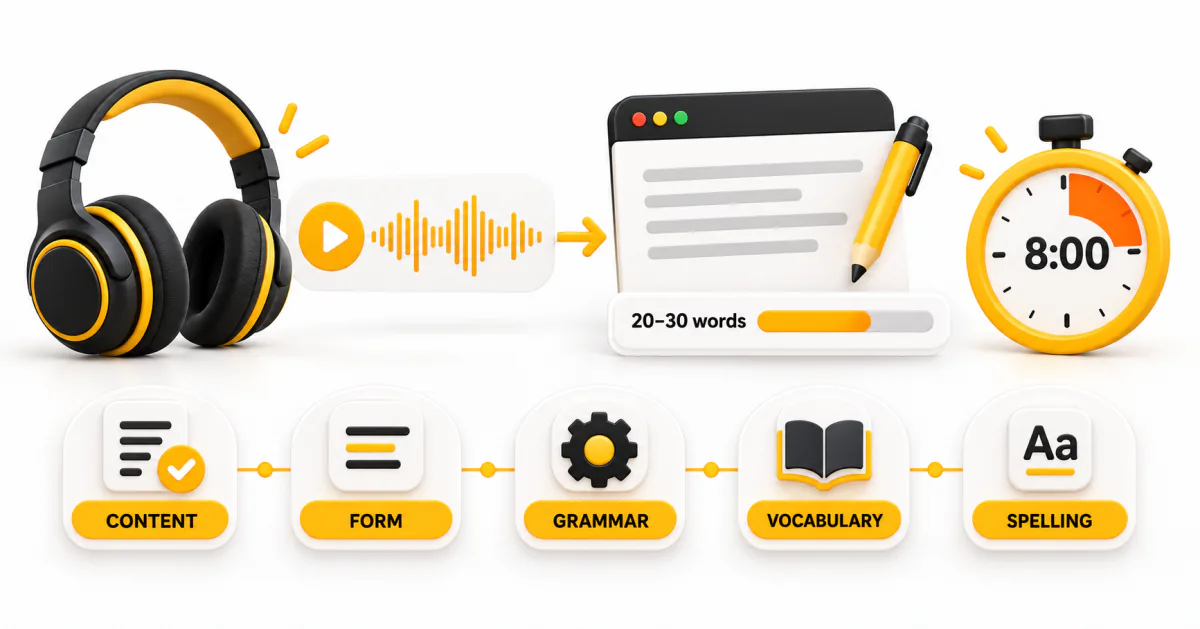
Summarize Spoken Text is a PTE Core Listening task. You hear a short recording. Then you write a brief account of its main points for someone who did not hear it.
The official Pearson task page gives these rules:
| Part of the task | What to expect |
|---|---|
| Recording | 45–75 seconds. |
| Number of plays | The audio plays once. |
| Your answer | 20–30 words. |
| Time | 8 minutes. |
| Skills scored | Listening and Writing. |
The answer box includes a word counter and Cut, Copy and Paste buttons. Check the counter before you move on.
The 2026 PTE Core Score Guide lists one or two Summarize Spoken Text questions. It uses partial credit, so several parts of your response are assessed.
What do the five scoring factors mean?
- Content: Did you keep the main idea and relevant support without changing the message?
- Form: Is your response a properly written summary in the required range?
- Grammar: Are your sentence structures correct and easy to understand?
- Vocabulary: Do your words fit the meaning and context?
- Spelling: Are your words spelled correctly?
Content comes first. Pearson warns that if a response misinterprets the topic or purpose, it receives no points on any of the five factors. A polished sentence cannot rescue the wrong message.
Form also matters. The score guide gives full Form credit to 20–30 words. It gives lower Form credit to 5–19 or 31–40 words. Fewer than 5 or more than 40 words receive zero for Form. A response written in capitals, without punctuation, or only as bullet points or a very short sentence also receives zero for Form.
Use one English spelling convention consistently. Pearson accepts US, UK, Australian and Canadian spelling conventions, but asks you to stay consistent within a response.
Is Core the same as Academic?
No. PTE Core requires 20–30 words and gives you 8 minutes. PTE Academic requires 50–70 words and gives you 10 minutes. If you have practised Academic before, reset these two numbers before a Core mock or test.
If you are still learning the test layout, read our PTE Core exam format guide after this lesson.
How can you plan, write and check in eight minutes?
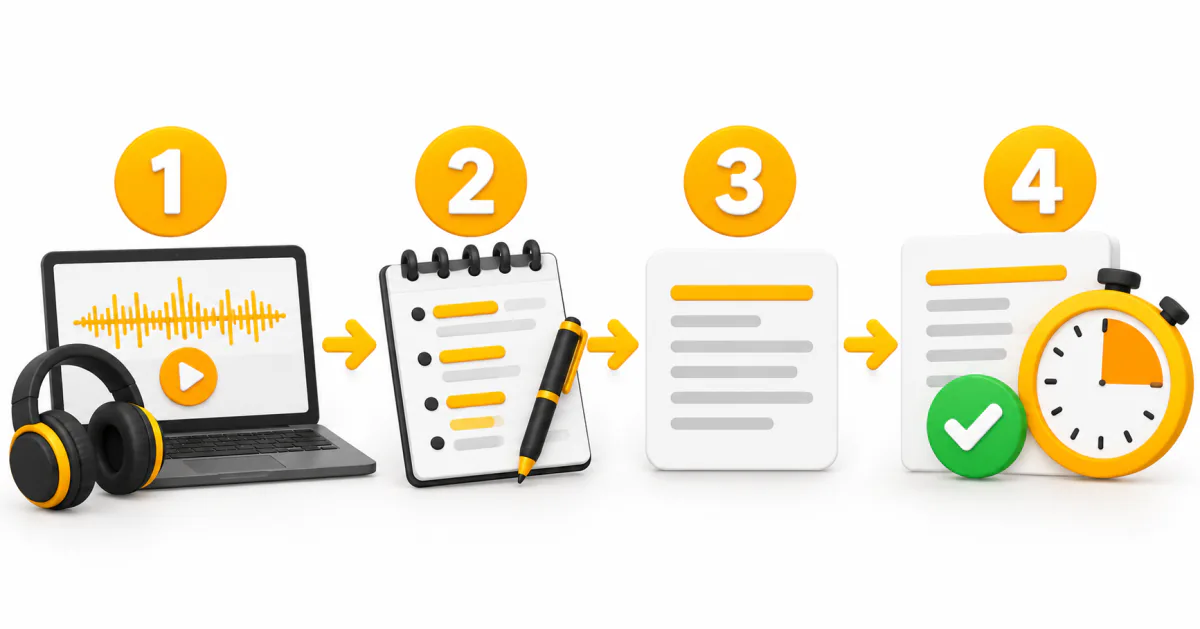
Use the same decision process each time. Let the recording decide your content. Do not force every topic into one memorised sentence.
Here is our suggested practice split. It is not an official Pearson timing rule, so adjust it after several timed attempts.
- Listen and note the message. During the recording, write the topic, the main point and two or three useful details. Pearson advises candidates to note main and supporting ideas rather than everything. Its Core Test Tips also suggests abbreviations, symbols and arrows to show links.
- Choose what earns space. Spend about 45 seconds reading your notes. Circle the main point. Keep only details that explain a cause, result, contrast, condition or next step.
- Write a 20–30 word summary. Spend about three to four minutes drafting. Begin with the central message. Add the best support using a clear link such as “because”, “but”, “while” or “so”. Use simple grammar you can control.
- Check in layers. Save the last two minutes. First compare your sentence with the notes. Then check the word count. Check grammar, spelling, capital letters and punctuation too. Pearson itself recommends leaving one or two minutes for this language check.
A small note map can help:
Topic → main message → strongest support → result or next step.
This is a note order, not a sentence template. Some recordings explain a problem and solution. Others compare two choices or announce a change. Follow the speaker’s logic.
For example, use these notes:
library / later hours → more evening users → higher staff cost → council reviewing.
You do not need to copy the speaker’s sentences. Turn the relationship into natural English: “A library attracted more evening users by staying open later, but higher staff costs mean the council will review whether to continue.”
That sample has 22 words. It keeps the change, the main result, the problem and the next step. It leaves out small details that do not change the message.
What do PTE Core Summarize Spoken Text practice examples look like?

The examples below were written for this guide. They are not Pearson questions. They have not been officially scored. Read each transcript as if it were the recording. During real practice, ask a partner or text-to-speech tool to read it once. Take notes as you listen.
Example 1: Free computer classes
Practice transcript
Our community centre will begin free computer classes for residents aged sixty and over next month. The Saturday sessions will cover useful tasks such as sending email, making video calls and finding reliable local services online. Learners can bring their own laptop or use one at the centre. Each class has only twelve places so that the tutor can give personal help. Anyone who wants to attend must register by phone or at the centre’s front desk. If the first four classes fill up, the centre will add more sessions later in the season.
Quick notes
community centre → free Saturday computer classes → older residents → basic online tasks → register / limited places.
Example answer — 25 words
The community centre will offer free Saturday computer classes for older residents, covering basic online tasks, with registration required because each class has limited places.
Why it works: The answer states who the classes are for. It also gives the topic and the key booking rule. It leaves out device choices and possible future sessions.
Try a second version without looking at the answer. You can change the wording, but keep the same message.
Example 2: Earlier bus services
Practice transcript
The city will run two earlier buses on Route 14 for a six-month trial. Hospital staff asked for the change because the current first bus arrives after many morning shifts begin. The extra services will operate from Monday to Friday, but the weekend schedule will stay the same. Transport officials will count passengers and compare fare income with operating costs throughout the trial. They will also collect comments from riders. After six months, the city will decide whether the earlier services should become part of the regular timetable.
Quick notes
six-month trial → earlier weekday Route 14 buses → help hospital workers → monitor use + costs → decide later.
Example answer — 25 words
A six-month bus trial adds earlier weekday services to help hospital workers, while officials will monitor passenger use and costs before deciding whether to continue.
Why it works: The answer keeps the reason and the weekday limit. It also keeps the later decision. It does not claim that the timetable change is permanent.
Compare your answer with three questions:
- Did you state the main change?
- Did you keep the key reason or result?
- Did you avoid adding a fact that the speaker never gave?
More than one answer can work. Judge the meaning, length and language instead of trying to match our sentence word for word.
Now cover both sample answers. Try one task again. Use one timer. Stop when time ends, even if the answer is not perfect. Check the main message first. Then count the words and fix one weak part.
Which mistakes reduce your score, and how can you fix them?
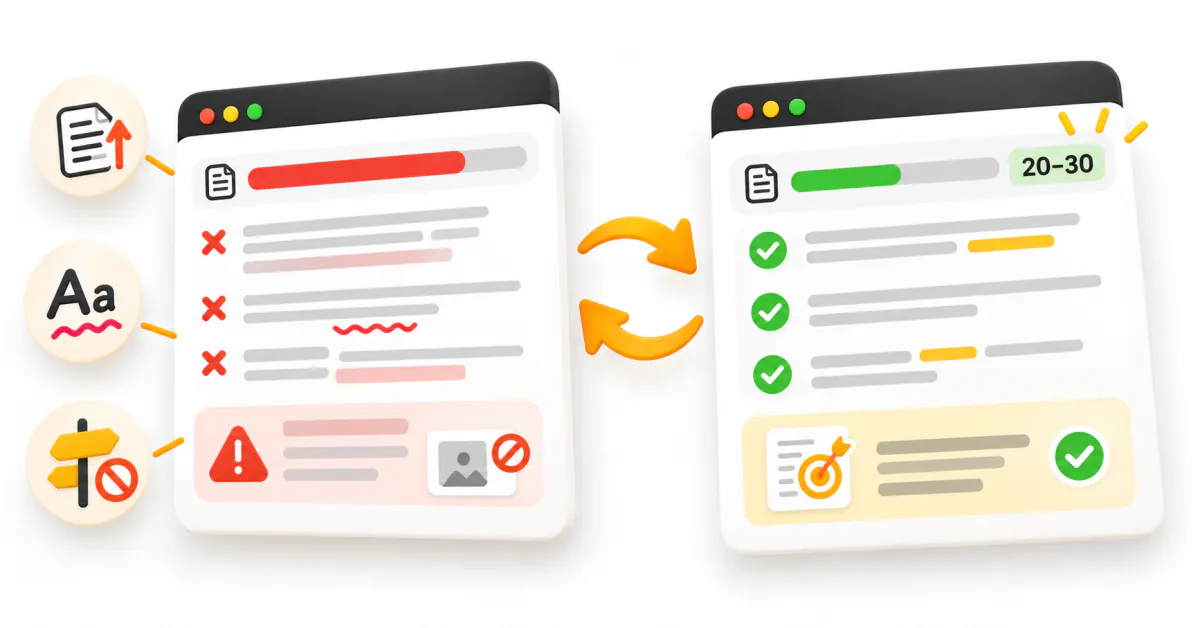
Writing every detail makes it harder to stay within 30 words. Rank your notes. Put the main message first, key support second and examples last. Most small examples will not fit.
Listing keywords as bullet points does not create a proper summary. Pearson’s score guide gives zero for Form when the response consists only of bullet points. Use your bullets as notes, then turn them into a complete sentence.
Missing the word range costs Form points. A 19-word or 31-word answer is close, but it does not earn full Form credit. Train yourself to finish near the middle of the 20–30 word range so that one last edit does not push you outside it.
Changing the relationship can damage Content. If the speaker says a trial is still under review, do not write that it will continue. If two events happen together, do not add “because” unless the speaker gives that cause.
Choosing a risky synonym can change the meaning. “Reduced” is not always the same as “removed”. Keep a familiar word from the recording when a replacement would be less accurate.
Checking only spelling leaves bigger errors untouched. Review in this order: message, length, sentence, words and spelling. Correct meaning before polishing a comma.
Try this short practice loop three or four times a week:
- Listen to one recording of about a minute and take notes.
- Write one timed 20–30 word summary.
- Mark the main point in the transcript and compare it with your answer.
- Record one specific error, such as “missed the final decision”.
- Rewrite once, then use a fresh recording for the next full attempt.
Do not copy the corrected answer into every future response. The value is in the decision you learnt: perhaps you need to hear contrasts, keep conditions or leave more checking time.
Keep your review note short. One line is enough. Read it before the next task, then focus on that one skill. Small, clear goals make each practice round easier to judge.
Frequently asked questions
How many words should I write?
Write 20–30 words. Pearson gives full Form credit in this range. We suggest aiming for about 24–27 words during practice so that small edits are easier. That narrower target is our suggestion, not an extra test rule.
How much time do I have?
You have 8 minutes for the whole task, including listening and writing. Practise with one timer from the start of the recording.
Can I hear the recording again?
No. The audio plays automatically, and you can hear it only once. Keep listening until the end. The final words can add a contrast, limit or decision.
Does Summarize Spoken Text affect Listening or Writing?
It contributes to both Listening and Writing. Your answer must show that you understood the recording and can express its main points clearly in writing.
Can I use a template?
Use a process, not a memorised answer. A short opening such as “The speaker explains…” fits some recordings, but it uses valuable words and cannot replace accurate content. Build each answer from that recording’s message.
Should I write one sentence or two?
Pearson asks for a written summary within 20–30 words and scores its grammar and form. One clear sentence is often practical at this length. If you write two, make sure both are complete and the total stays within the range.
Is PTE Core Summarize Spoken Text the same as PTE Academic?
No. Core uses 20–30 words and 8 minutes. Academic uses 50–70 words and 10 minutes. Check which test you are preparing for before using any online advice.
What should you do next?
Start with the first practice transcript and hide the example answer. Read it aloud once or ask someone else to read it. Write only the topic, main point and useful support while you listen.
Then write a 20–30 word summary and check it in layers. Do not chase a perfect template. Train yourself to hear the message, protect its meaning and use clear English under the timer.
For another Core writing task, continue with our PTE Core Summarize Written Text guide.
References and Useful Resources
- Pearson: PTE Core Listening format — official task rules, timing and scoring overview.
- Pearson: PTE Core Score Guide 2026 — question count and score bands.
- Pearson: PTE Core Test Tips — official note-taking and summary advice.
- Pearson: PTE Academic Listening format — official Academic rules used for the comparison.