Book PTE Exam
 PTE Voucher
 PTE Mock Tests
 Pricing
 About Us
 Blog
 Practice


Key Takeaway
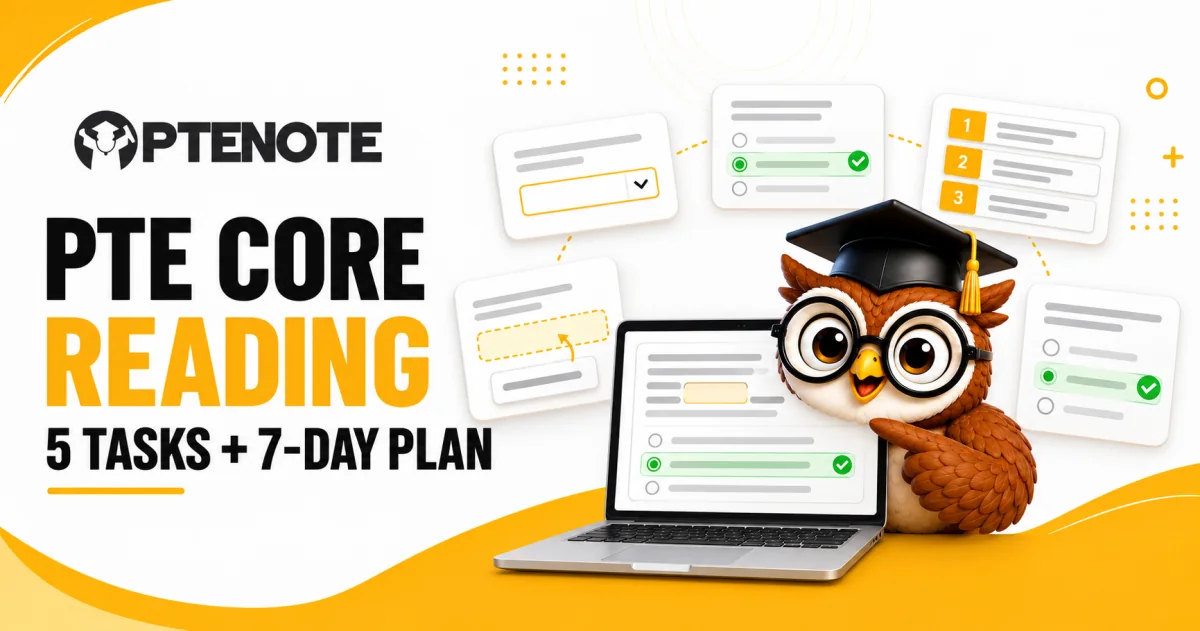
- PTE Core Reading lasts 27–37 minutes.
- PTE Core Reading has five question types.
- The first task, Reading & Writing: Fill in the Blanks, contributes to both Reading and Writing.
- Only Multiple Choice, Multiple Answers deducts a point for each wrong option you select.
- Reorder Paragraph gives partial credit for each correct pair of text boxes placed next to each other.
- Use PTE Core practice material. Pearson says PTE Core uses everyday English, while PTE Academic preparation uses academic English.
- Our seven-day plan covers all five tasks, timed practice and mistake review.
“I understand a passage when I read slowly. What happens when five Reading tasks share one clock?”
That is a fair worry. PTE Core Reading needs more than fast reading. You need to know what each task asks and how it is scored.
This guide gives you one original example for every task. You will also see why each answer fits. Then you can use our seven-day plan to organise your practice.
The examples below are teaching exercises made by us. They are not official Pearson questions or score predictions.
Pearson can change test guidance. Check its live PTE Core Reading page and current Score Guide before your test.
How Does PTE Core Reading Work?

Reading is Part 2 of PTE Core. Pearson lists five task types in a fixed order. The section lasts 27–37 minutes.
Pearson does not list a separate answer time for these Reading tasks. Keep an eye on the section clock as you work. You also cannot return to an earlier question after you move on.
The task table below gives the current official format.
| Order | Question type | Questions | Maximum text length | Scoring |
|---|---|---|---|---|
| 1 | Reading & Writing: Fill in the Blanks | 5–6 | 200 words | One point for each correct blank |
| 2 | Multiple Choice, Multiple Answers | 1–2 | 275 words | +1 for a correct option; −1 for a wrong option; minimum 0 |
| 3 | Reorder Paragraph | 2–3 | 110 words | One point for each correct adjacent pair |
| 4 | Fill in the Blanks | 4–5 | 80 words | One point for each correct blank |
| 5 | Multiple Choice, Single Answer | 1–2 | 110 words | Correct or incorrect |
Partial credit means you can earn some points without making the whole response perfect. The two blank tasks give credit for each correct blank. Reorder Paragraph gives credit for correct adjacent pairs.
The first blank task is an integrated task. That means one response contributes to two skills: Reading and Writing. The other four task types in this section contribute to Reading only.
Need the complete test order too? Read our PTE Core exam format guide before planning a full mock.
How Should You Practise the Five PTE Core Reading Tasks?
Use the same short cycle for every task: answer, check, explain and try again. Do not stop after seeing the answer key. Your explanation shows what you need to practise next.
1. How Do You Practise Reading & Writing: Fill in the Blanks?

You see a text with gaps. Each gap has its own dropdown list. The text can contain up to 200 words.
Pearson gives partial credit for each correct blank. This task contributes to both Reading and Writing.
Try this method:
- Skim the whole passage for its topic.
- Read the words before and after one gap.
- Decide which word form the sentence needs.
- Test each remaining choice in the full sentence.
- Read the completed sentence again.
Original practice example
The community centre has opened a quiet room for job seekers. Visitors can ______ a computer for one hour. Staff ask users to ______ their session if they cannot attend.
First gap: reserve / reserved / reservation
Second gap: cancel / cancellation / cancelled
Answer: reserve; cancel
After can and to, the sentence needs the base form of a verb. “Reserve a computer” and “cancel their session” also fit the meaning.
For your review, write the full phrase instead of one word. Record “reserve a computer”, not only “reserve”. This makes the grammar and word partnership visible.
2. How Do You Practise Multiple Choice, Multiple Answers?

You read a text of up to 275 words. Then you select every correct answer about its content or tone.
This task has negative marking. You receive one point for each correct option. Pearson deducts one point for each wrong option you select. The minimum score for one question is zero.
Read the question before you judge the options. Then match every chosen option to a clear part of the text.
Original practice example
A neighbourhood café will close at 4 p.m. on Friday for staff training. It will open at its normal time on Saturday. Customers with Friday evening orders will receive an email and can choose a refund or Saturday collection.
Which statements are correct? Select all that apply.
- A. The café will never open again.
- B. Staff training will affect Friday’s closing time.
- C. Saturday opening will follow the normal schedule.
- D. Every Friday order will move to Saturday automatically.
Answer: B and C
The first sentence supports B. The second supports C. A changes a short closure into a permanent one. D ignores the customer’s choice.
Do not choose an option because it uses words from the passage. Check whether the meaning is the same.
3. How Do You Practise Reorder Paragraph?

You see text boxes in a random order. You move them to restore the original text. The prompt can contain up to 110 words.
Pearson gives one point for each correct adjacent pair. An adjacent pair is two boxes placed next to each other in the correct order.
Start with a sentence that can stand alone. Then look for links such as repeated nouns, pronouns, time words and cause-and-effect language.
Original practice example
- A. She then checked the route on the city’s transport app.
- B. Ten minutes later, Maya boarded the next bus.
- C. Maya reached the bus stop and saw that her usual bus was delayed.
- D. The app suggested another service from the same stop.
Answer: C → A → D → B
C introduces Maya, the stop and the problem. A uses “She” to refer back to Maya. D names the result shown by the app. B finishes the sequence with “Ten minutes later”.
Review the links as pairs: C–A, A–D and D–B. If one pair feels weak, explain what connects it before rebuilding the full order.
4. How Do You Practise Reading: Fill in the Blanks?

This task shows a text with gaps and a word bank below it. You drag words into the gaps. The text can contain up to 80 words.
There are more words than gaps. Each word can be moved to a different gap or returned to the word bank. Pearson gives one point for each correct blank.
Complete the clearest gap first. Every word you place changes the choices left for the other gaps.
Original practice example
Please place glass bottles in the blue recycling bin. Remove each lid and ______ the bottle before disposal. Broken glass must be wrapped ______ to protect collection staff. Ask the building manager if you are ______ about an item.
Word bank: empty / carefully / unsure / weekly / bright
Answer: empty; carefully; unsure
“Empty the bottle” needs a verb. “Wrapped carefully” needs a word that describes how to wrap it. “Are unsure” describes the person’s state.
After checking, explain why the extra words fail. “Weekly” tells us when something happens. “Bright” does not fit the meaning or sentence structure here.
5. How Do You Practise Multiple Choice, Single Answer?

You read a text of up to 110 words. Then you select one answer about its content or tone.
Pearson marks the response as correct or incorrect. No credit is given for a wrong answer or no response.
Read the question first. Decide whether it asks for the main idea, one detail, the writer’s purpose or the tone.
Original practice example
The apartment manager plans to test the fire alarm on Tuesday morning. The sound will last for several minutes. Residents do not need to leave the building during this planned test. Anyone working at night can collect free earplugs from reception on Monday.
Why was this notice written?
- A. To announce a real fire
- B. To explain a planned alarm test
- C. To ask residents to repair the alarm
- D. To close the reception desk
Answer: B
The notice gives the date, expected sound and instructions for a planned test. The other choices add actions that the notice does not state.
If two options seem close, rewrite each one in simple words. Then compare those meanings with the passage.
What Seven-Day PTE Core Reading Practice Plan Can You Follow?

Use the plan below as our study suggestion. It is not an official Pearson timetable. Change the question count to suit your level and available time.
Aim for one complete practice cycle each day:
- Answer a small set without checking the key.
- Mark each answer.
- Explain the missed clue.
- Correct the answer in a different colour.
- Try one fresh question using the same lesson.
| Day | Main practice | Review question |
|---|---|---|
| Day 1 | Learn the five task formats and try a short sample of each. | Which instruction or scoring rule did I misunderstand? |
| Day 2 | Practise dropdown blanks with grammar and phrase checks. | Did the error come from grammar, meaning or a word partnership? |
| Day 3 | Practise drag-and-drop blanks. Explain unused words. | Did one early choice cause another gap to fail? |
| Day 4 | Build Reorder Paragraph answers one adjacent pair at a time. | What word or idea links each pair? |
| Day 5 | Practise both multiple-choice tasks. | Can I point to passage evidence for every selected option? |
| Day 6 | Complete a mixed set with a timer. | Where did I reread without making a decision? |
| Day 7 | Review the error log and repeat the hardest task with fresh questions. | Which error happened most often this week? |
Keep your error log simple. Record the task, your answer, the correct answer, the clue you missed and your next action.
For example: “I chose success after was very. The sentence needed an adjective. I will practise successful in two new sentences.”
For timed practice, note both accuracy and time. A faster set is not useful if you cannot explain your choices. Start with small sets, then practise a full Reading section when the task rules feel familiar.
Use PTE Core material for that timed practice. Pearson says PTE Academic preparation uses academic English, while PTE Core uses everyday English.
When you are ready for a complete practice attempt, explore our PTE Mock Tests. Treat any mock result as preparation feedback, not as an official Pearson score. A mock score does not guarantee your official PTE score.
Frequently Asked Questions
Is PTE Core Reading the Same as PTE Academic Reading?
No. Pearson says PTE Academic preparation uses academic English content. PTE Core preparation uses everyday English content. Always check the test name before using a practice set.
Which PTE Core Reading Task Has Negative Marking?
Multiple Choice, Multiple Answers has negative marking. You receive one point for a correct option, and one point is deducted for a wrong option you select. The minimum score for one question is zero.
Which Reading Task Also Contributes to Writing?
Reading & Writing: Fill in the Blanks contributes to Reading and Writing. The other four Reading task types in Part 2 contribute to Reading only.
Do You Lose Points for a Wrong Reorder Paragraph?
Pearson gives one point for each correct adjacent pair. The minimum score is zero. Focus on building strong pairs even when the full order is difficult.
How Should You Use the 27–37 Minute Reading Time?
There is no official fixed time for each Reading item. During practice, find a pace that lets you answer every task. Check one answer once, choose it and move on. Remember that you cannot return after moving to the next question.
Should You Memorise Reading Answers?
Use answer explanations to learn the clue, not only the final choice. A new passage will need the same reading skill, not the same remembered answer.
What Should You Practise Next?
Choose the task that caused your clearest mistake today. Try two or three fresh questions, then explain every answer in one sentence.
After one week, read your error log. Give more time to the error that repeats. Keep some practice for all five tasks so the full section still feels familiar.