



Key Takeaway
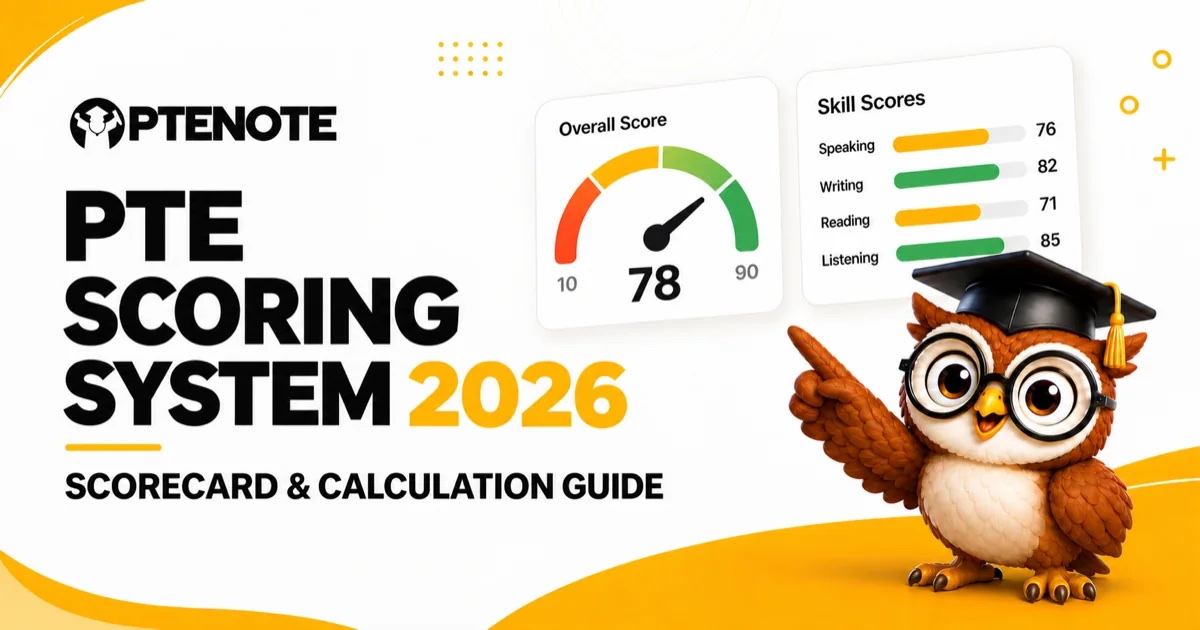
- PTE Academic reports one overall score and four communicative-skill scores: Listening, Reading, Speaking and Writing. Every score uses the 10–90 scale.
- Your overall score is based on performance across the whole test. It is not the average of the four skill scores.
- Some questions affect one skill, while integrated questions affect two skills.
- PTE uses AI scoring. Pearson also says human experts review selected parts of some open speaking and writing responses before the final score is set.
- The old six enabling-skill scores are no longer shown as separate numbers. Your private Skills Profile now gives feedback across eight broader areas.
- There is no universal PTE pass mark. Use the exact overall and skill requirements set by your university, visa programme or other receiving organisation.

A PTE scorecard can look simple at first. You see one large overall score and four smaller skill scores. Then a common question appears: “Why does my overall score not match the average of those four numbers?”
The answer is that PTE Academic does not calculate your result like a school percentage. It scores your responses across the whole test. Different question types use different scoring rules, and several tasks test two English skills together.
This guide explains the current PTE scoring system in simple English. You will learn what every part of the scorecard means, how scoring works, which tasks affect each skill and how to use the result to plan your next practice.
How Does the PTE Academic Scoring System Work?

PTE Academic uses a 10–90 reporting scale. A higher number shows stronger English ability. The same scale is used for the overall score and for Listening, Reading, Speaking and Writing.
Pearson uses an automated scoring system for all question types. It checks features that depend on the task. These can include correct words, correct options, content, form, grammar, vocabulary, pronunciation and oral fluency.
Since the PTE Academic update that took effect on 7 August 2025, selected parts of some open responses also receive human expert review. Pearson’s current Score Guide names these tasks:
- Describe Image
- Retell Lecture
- Respond to a Situation
- Summarize Group Discussion
- Summarize Written Text
- Write Essay
- Summarize Spoken Text
For these tasks, experts review content before the final task score is set. Write Essay also receives expert review for development, structure and coherence, and general linguistic range. Pearson says humans do not assess pronunciation or oral fluency.
This matters because some older PTE guides make two outdated claims: that scoring is completely automated with no human review, and that the scorecard still shows six enabling-skill scores. Neither statement describes the current PTE Academic result.
This article focuses on PTE Academic and PTE Academic UKVI. Their Score Reports use the same scoring information, although a UKVI report also contains a SELT Unique Reference Number. PTE Core has its own task set and score guide.
What Does Your PTE Scorecard Show?

Your result is easier to understand when you read it in three layers.
1. Overall score
The overall score is a broad measure of your English performance across the complete test. It ranges from 10 to 90. It is often the first number a university or another organisation checks, but some organisations also set a minimum for every communicative skill.
2. Four communicative-skill scores
You receive separate 10–90 scores for:
- Listening: how well you understand spoken English and use it in listening-based tasks
- Reading: how well you understand written English and organise information from text
- Speaking: how clearly and effectively you give spoken responses
- Writing: how clearly and accurately you produce written responses
These scores come from all questions that assess the relevant skill. A question does not have to appear inside a section with the same name. For example, Write from Dictation appears in Listening but affects both Listening and Writing.
3. Skills Profile
The Skills Profile is private feedback for you. It is visible in myPTE, but Pearson does not send it to institutions with your official Score Report. Its purpose is to show areas where your English is stronger or needs more work.
The current Skills Profile covers eight areas:
| Skills Profile area | Simple meaning |
|---|---|
| Open response speaking and writing | Giving your own spoken or written answer in your own words |
| Reproducing spoken and written language | Repeating or copying information accurately |
| Extended writing | Giving a longer written response |
| Short writing | Giving a short written response |
| Extended speaking | Giving a longer spoken response |
| Short speaking | Giving a short spoken response |
| Multiple-skills comprehension | Using more than one skill, such as listening and then speaking |
| Single-skill comprehension | Understanding information by using one skill, such as reading |
The performance bars are indicators, not extra 10–90 scores. Use them with the personalised recommendations in myPTE. Do not try to convert each bar into an exact number or assume that a full-looking bar guarantees a particular communicative-skill score.
Older reports showed separate enabling-skill scores for grammar, oral fluency, pronunciation, spelling, vocabulary and written discourse. Pearson replaced that section with the Skills Profile in November 2021. Those language features still matter when relevant tasks are scored, but they are not reported as six separate scorecard numbers.
How Is the PTE Overall Score Calculated?

The short answer is: your PTE overall score is not a simple average of Listening, Reading, Speaking and Writing.
Pearson says the overall score is calculated independently from the four communicative-skill scores. It is based on your performance across the whole test. Question scores, question difficulty and question weighting are part of the calculation.
Imagine that your four skill scores are 70, 66, 74 and 68. Their mathematical average is 69.5. Your reported overall score does not have to be 69 or 70. This does not mean that Pearson made an error. The overall score and the four skill scores are separate views of your performance.
Integrated tasks are another reason a home-made score calculator cannot reproduce the official result. One response may contribute to two communicative skills. The number of questions also varies within Pearson’s published ranges, and different tasks use different scoring criteria.
For this reason, be careful with websites that promise an exact official PTE score from a few raw marks. A practice platform can estimate performance, but only Pearson’s scoring system can issue an official PTE Academic result.
How Is Each PTE Question Scored?

PTE uses two main scoring methods. Some partial-credit questions can also deduct points for incorrect selections.
| Scoring method | How it works | Examples |
|---|---|---|
| Correct or incorrect | A correct answer earns credit. An incorrect answer earns no credit. | Multiple Choice, Single Answer; Select Missing Word |
| Partial credit | You can earn some credit even when the response is not completely correct. The exact criteria depend on the task. | Repeat Sentence; Reorder Paragraph; Write from Dictation |
| Partial credit with deductions | Correct choices earn points and incorrect choices deduct points. The minimum score for that question is zero. | Multiple Choice, Multiple Answers; Highlight Incorrect Words |
Open speaking and writing tasks may be judged on several traits. A spoken response can be checked for content, pronunciation and oral fluency. A written response can be checked for content, form, grammar, vocabulary, spelling and organisation, depending on the task.
Form can control whether the rest of an answer receives credit. For example, a task may require a specific word range, one complete sentence or connected prose. Read the current instructions for that task and meet the form rule before trying to add complex language.
There is no single public table that says one question always equals a fixed number of points on your final 10–90 score. The task score is one input to Pearson’s scoring model; it is not the same thing as a final scaled score.
Which Question Types Affect Each PTE Skill Score?

The table below follows Pearson’s current PTE Academic Score Guide. It is useful for understanding your scorecard, but it should not become a “high-weight tasks only” study plan. A low result can come from repeated small errors across many tasks.
| Test part | Question type | Skill score affected | Scoring method |
|---|---|---|---|
| Speaking & Writing | Read Aloud | Speaking | Partial credit |
| Speaking & Writing | Repeat Sentence | Listening + Speaking | Partial credit |
| Speaking & Writing | Describe Image | Speaking | Partial credit |
| Speaking & Writing | Retell Lecture | Listening + Speaking | Partial credit |
| Speaking & Writing | Answer Short Question | Listening | Correct or incorrect |
| Speaking & Writing | Summarize Group Discussion | Listening + Speaking | Partial credit |
| Speaking & Writing | Respond to a Situation | Speaking | Partial credit |
| Speaking & Writing | Summarize Written Text | Reading + Writing | Partial credit |
| Speaking & Writing | Write Essay | Writing | Partial credit |
| Reading | Fill in the Blanks (Dropdown) | Reading | Partial credit |
| Reading | Multiple Choice, Multiple Answers | Reading | Partial credit with deductions |
| Reading | Reorder Paragraph | Reading | Partial credit for correct adjacent pairs |
| Reading | Fill in the Blanks (Drag and Drop) | Reading | Partial credit |
| Reading | Multiple Choice, Single Answer | Reading | Correct or incorrect |
| Listening | Summarize Spoken Text | Listening + Writing | Partial credit |
| Listening | Multiple Choice, Multiple Answers | Listening | Partial credit with deductions |
| Listening | Fill in the Blanks (Type In) | Listening | Partial credit for correctly spelled words |
| Listening | Highlight Correct Summary | Listening + Reading | Correct or incorrect |
| Listening | Multiple Choice, Single Answer | Listening | Correct or incorrect |
| Listening | Select Missing Word | Listening | Correct or incorrect |
| Listening | Highlight Incorrect Words | Listening + Reading | Partial credit with deductions |
| Listening | Write from Dictation | Listening + Writing | Partial credit for correctly spelled words |
Notice two current details that many older task maps get wrong: Read Aloud now contributes to Speaking, and Answer Short Question contributes to Listening. Always use Pearson’s current Score Guide when an old chart disagrees.
What Does Each PTE Score Range Mean?

Pearson aligns PTE Academic scores with the Common European Framework of Reference for Languages, usually called CEFR. This gives a broad description of English ability.
| PTE Academic score | CEFR level | Plain-English meaning |
|---|---|---|
| 85–90 | C2 | Very advanced control of complex English |
| 76–84 | C1 | Advanced English for demanding study or work |
| 59–75 | B2 | Independent use of English in many study and work situations |
| 43–58 | B1 | Functional English for familiar situations, with limits in complex work |
| 30–42 | A2 | Basic communication about familiar needs and topics |
| 10–29 | A1 or below the A2 threshold | Early-stage English with a limited range |
Do not treat broad labels such as “good score” as an application rule. Pearson says institutions often use ranges such as 36–50 for foundation courses, 51–60 for undergraduate study and 57–67 for postgraduate study. These are only general examples. Your course can require a different overall score and separate minimum skill scores.
For a visa, university, employer or professional registration, check the official requirement for your exact route before you set a target. A score that works for one application can be too low—or higher than necessary—for another.
How Do PTE Scores Compare With IELTS Bands?

Pearson updated its PTE Academic and IELTS Academic concordance using research published in July 2025. The overall-score ranges are:
| IELTS Academic band | Approximate PTE Academic overall range |
|---|---|
| 4.5 | 24–30 |
| 5.0 | 31–38 |
| 5.5 | 39–46 |
| 6.0 | 47–54 |
| 6.5 | 55–62 |
| 7.0 | 63–70 |
| 7.5 | 71–78 |
| 8.0 | 79–85 |
| 8.5 | 86–89 |
| 9.0 | 90 |
This is an approximate research-based alignment, not a promise of equal results. PTE and IELTS do not measure every feature in exactly the same way. Pearson also publishes different PTE ranges for each IELTS Listening, Reading, Speaking and Writing band, so do not use the overall table to guess a per-skill requirement.
We have not repeated an old PTE-to-TOEFL chart here. Pearson’s current scoring page says updated relationships with other test providers will be published later. Use Pearson’s live scoring page when you need the latest comparison.
How Should You Use Your Scorecard to Improve?

Start with the requirement, not with a general label such as “65 is good.” Write down the exact overall score and every minimum skill score your application needs.
Then use this four-step method:
- Find the real gap. Compare your overall and four skill scores with the exact requirement. If the rule says 65 overall and 58 in every skill, a 64 in Writing needs attention even when your overall score is already high enough.
- Read the Skills Profile. Look for weaker areas and open Pearson’s personalised recommendations. Treat the bars as guidance, not exact hidden marks.
- Connect the weak skill to its tasks. Use the task map above. If Writing is low, do not practise only essays; integrated tasks such as Summarize Written Text, Summarize Spoken Text and Write from Dictation can also affect Writing.
- Practise, review and measure again. Complete task practice, review the scoring criteria, and then use a full mock test to check whether the whole score pattern is improving.
PTENOTE’s PTE mock tests online guide explains how to use mock results without overestimating what a practice score can prove. A mock score is an estimate for preparation. It is not an official Pearson result.
If pronunciation is your weak area, use our simple pronunciation practice guide. For a broader weekly routine, follow our PTE Academic study plan.
If you already have an official result, use this guide to understand what the numbers mean and where you need to improve. Then see how to send a PTE Academic score to universities or decide whether a PTE Academic rescore is worth requesting.
Frequently Asked Questions About PTE Scoring
Is the PTE overall score the average of four skills?
No. Pearson says the overall score is calculated independently and is based on performance across the whole test. Question scores, difficulty and weighting are part of the calculation.
What is the highest PTE Academic score?
The highest overall or communicative-skill score is 90. The reporting scale starts at 10.
Does PTE still show enabling-skill scores?
No. The old six enabling-skill numbers were replaced by the private Skills Profile in November 2021. Grammar, vocabulary, pronunciation, oral fluency and other traits can still affect relevant task scores.
Is PTE scored only by AI?
All question types use AI scoring. Pearson also says human experts review selected traits for seven open speaking or writing task types before the final task score is set.
Which PTE questions have negative marking?
Pearson’s current Score Guide deducts points for incorrect selections in Reading Multiple Choice, Multiple Answers; Listening Multiple Choice, Multiple Answers; and Highlight Incorrect Words. The minimum score for each of those questions is zero.
Can one PTE question affect two skill scores?
Yes. For example, Repeat Sentence affects Listening and Speaking, while Write from Dictation affects Listening and Writing.
Is 65 a good PTE score?
It can meet some requirements, but “good” depends on your exact application. Check the required overall score and every required skill score on the official university, visa or professional-body website.
Can an online PTE score calculator predict my official score exactly?
No. Practice tools can estimate performance, but Pearson’s full scoring model includes task scores, difficulty and weighting. Only Pearson can issue an official result.
Conclusion
The PTE scoring system becomes much clearer when you stop treating the result as five numbers that should match. Your overall score measures performance across the whole test. The four communicative-skill scores show Listening, Reading, Speaking and Writing. The Skills Profile gives private guidance for improvement.
Use the current task map and scoring methods to understand where each score comes from. Then compare the result with your exact requirement and practise the tasks connected to the gap. That gives you a useful plan instead of a guess.