 Book PTE Exam
 PTE Voucher
 PTE Mock Tests
 Pricing
 About Us
 Blog
 Practice


Key Takeaway
- Use a or an for one countable item when you do not identify which one.
- Choose a or an by the sound immediately after it, not just the first written letter.
- Use the when the reader can identify what you mean.
- For general statements with plural or uncountable nouns, leave out the article.
- Try the exercises before opening the answers. Explain your choice as well as checking it.
You write “an useful method”, then stop. The word starts with u, so why does the phrase sound wrong? Or you add the before a noun and wonder whether the sentence still means the same thing.
We’ll work through articles for PTE Academic using short explanations and original exercises. Keep a page for your answers. You’ll need to check what a sentence means, not only the word beside a gap.
What should you check before choosing an article?
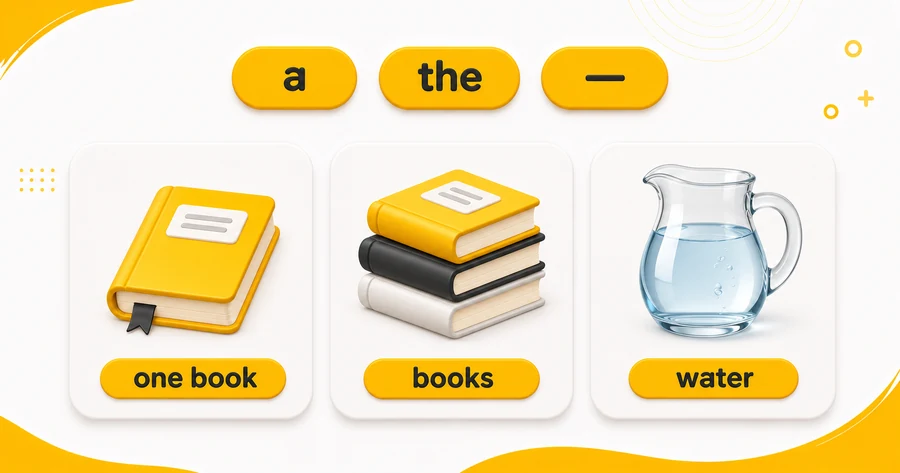
The English articles are a, an and the. They go with nouns: words such as book, room and water.
Singular means one; plural means more than one. Compare “one notebook” with “three notebooks”.
A countable noun names something you can count as separate items. An uncountable noun names something you do not count directly with a number in that meaning. Compare “two chairs” with “water”.
If that distinction is new, start with our lesson on countable and uncountable nouns. Here, we’ll use noun type to choose the small word before it.
A singular countable noun names one item. In an ordinary sentence, it needs an article or another determiner. This last term means a word such as my, this or that before a noun.
For example, write “I bought a notebook” or “I bought this notebook”. “I bought notebook” leaves the singular countable noun without that support.
Pearson’s guidance for Fill in the Blanks (Dropdown) tells you to check grammar and overall meaning when choosing missing words. This lesson practises article choice within that wider work.
Try these checks during study:
- Find the noun. Is the sentence about one item, several items or something uncountable?
- Ask what the reader knows. Can the reader identify the item or group?
- If your choice is a or an, say the next word aloud and listen to its first sound.
The British Council’s article lesson gives the basic rules. We’ll try them in whole sentences below.
How do you choose between a and an?
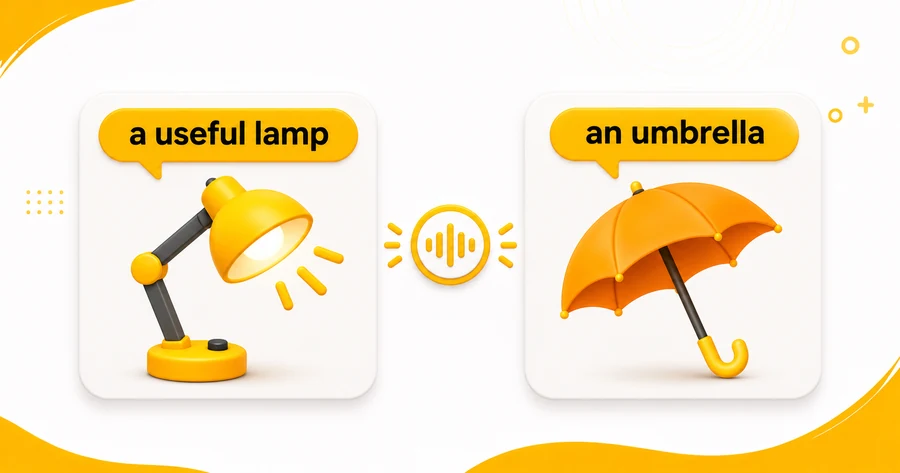
Use a or an for one countable item when you do not say which one. “Please bring a pen” asks for one pen. You have not named the pen you want.
Use a before a consonant sound: “a pen” and “a useful lamp”. The beginning of useful sounds like the beginning of “you”.
Use an before a vowel sound: “an umbrella” and “an hour”. In hour, the h is silent.
Listen to the word right after the article. A describing word counts too. Compare “a report” with “an annual report”. The noun stays report, but the next sound changes.
Try saying each whole phrase aloud. Then cover the article and say it again. Keep your attention on the sound, rather than making a list based only on the letters a, e, i, o and u.
Do not use a or an directly before a plural noun. For example, “a books” does not express one countable item.
Do not put a or an right before a noun used as uncountable. In “I need information”, information does not take an.
For more sound examples, see Purdue OWL’s guide to using articles. Keep the complete phrase in your notes so you can see the noun and hear the next sound together.
When does a sentence need the?
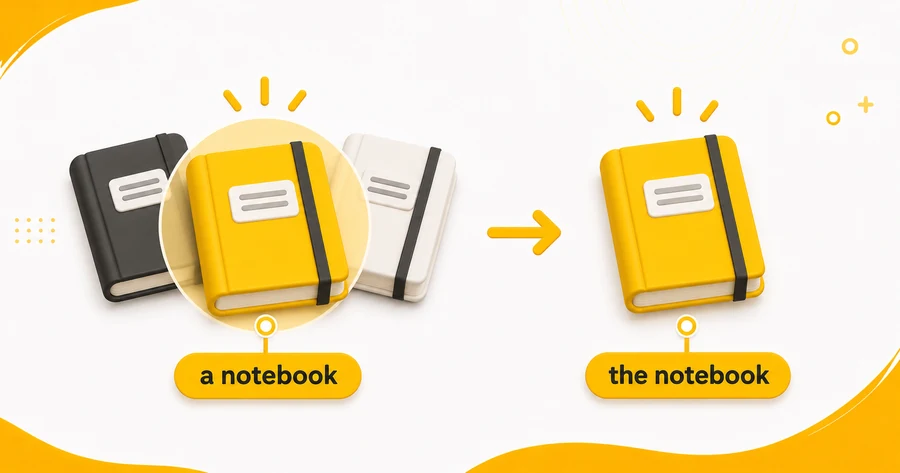
Use the when the reader knows which thing you mean. The words around the noun or the situation can make that clear.
Here is an original example: “Mina bought a notebook. The notebook has a green cover.” The first sentence introduces one notebook. The next sentence refers to that same notebook.
Draw a small arrow from “the notebook” back to “a notebook”. Then try a new pair of sentences about a different object. Make sure your second sentence refers to the same item.
The also works on a first mention. Picture a room with just one door. “Please close the door” is clear in that room, even if nobody has named the door before.
Words after a noun can show which one you mean. In “Please read the notice beside the lift”, the location tells the reader which notice to read.
The works before a particular plural group, too. “The notebooks on this shelf are mine” identifies the group by its location.
The also works before uncountable nouns. Use it when the reader knows which amount you mean. “The water in this jug is cold” points to the water in one jug.
Before adding the, ask “Which one?” or “Which group?” Find the words or clues that answer that question. Read the sentence again if you cannot tell.
The British Council’s guide to the explains references established by an earlier mention or by context.
When should you leave out the article?

Using no article is also called the zero article. In the exercises, we use a dash (—) to show that no word belongs in the gap.
Leave the article out when you mean things in general. Use this pattern with plural or uncountable nouns. You are talking about a type of thing, rather than a group you can point to.
Compare “Libraries need space” with “The libraries in this town need space”. The first talks about libraries in general. The second identifies the libraries in one town.
Compare “Water is useful” with “The water in this jug is cold”. The first is about water in general. The second points to the water in one jug.
Do not treat uncountable as a rule that bans the. Check the meaning too. “The water in this jug” is correct because the phrase tells us which water.
This lesson covers common article choices. Names and set phrases have more rules. For these exercises, focus on the everyday nouns and the meaning cues in each question.
Take a sentence from your own writing that begins with the. Underline the noun and describe the group or thing you mean. If you intend a general statement, compare your sentence with the two pairs above before editing it.
Can you choose the articles and explain your answers?
We wrote these exercises for this lesson. They are grammar practice, not real Pearson questions or a full PTE practice test. Work without a timer first. Choose only from the options given.
Set 1: choose the correct option. Read the meaning cue as part of each question.
- We need a / an online meeting to discuss the plan.
- She suggested a / an useful way to organise the notes.
- The walk took a / an hour.
- Please check A / The notes you sent me yesterday. Refer to those specific notes.
- — / The birds have wings. Make a general statement about birds.
- — / The advice in your last email helped me. Refer to that email’s advice.
Show Set 1 answers and explanations
- an. Online begins with a vowel sound.
- a. Useful begins with a consonant sound, like the beginning of “you”.
- an. Hour begins with a vowel sound; its h is silent.
- The. “You sent me yesterday” identifies the particular notes. A cannot introduce the plural noun notes.
- —. Birds is plural, and the cue asks for a general statement. The would point to an identified group.
- The. “In your last email” identifies the advice. Uncountable does not mean that the is forbidden.
Set 2: complete a connected passage. Assume the reader has not been told which museum or film the class visited or watched. Introduce each as a new, unspecified item. Use the options beside each gap.
Yesterday our class visited (1) ___ small museum. (a / an)
The guide welcomed us inside (2) ___ museum. (a / the)
She gave us (3) ___ information about its displays. (an / —)
We then watched (4) ___ short film. (a / an)
(5) ___ film explained how people travelled in the past. (A / The)
Before leaving, we filled in (6) ___ online form. (a / an)
Show Set 2 answers and explanations
- a. The passage introduces one museum. Small begins with a consonant sound.
- the. This is the same museum that the first sentence introduced.
- —. Information is uncountable in this use. Of the two choices, an is incorrect.
- a. One film is introduced without identifying it beforehand. Short begins with a consonant sound.
- The. The sentence refers back to that same film.
- an. Online begins with a vowel sound. Form does not decide the choice because online comes immediately after the article.
Set 3: fix the article error. Keep the meaning in brackets. Write the complete corrected sentence.
- This is an useful method. (One unspecified method.)
- I need an information about the course. (An amount of information, not a countable item.)
- I bought notebook yesterday. (Introduce one unspecified notebook.)
- The students need time to study. (Make a general statement about students.)
Show Set 3 corrections and explanations
- This is a useful method. Choose a before the consonant sound at the start of useful.
- I need information about the course. Remove an before information in this uncountable use.
- I bought a notebook yesterday. Add a to introduce the singular countable item as requested.
- Students need time to study. Remove the to express the requested general meaning with this plural noun.
Choose one mistake to record. Write your first answer, the correction and a short reason, such as “I checked the letter instead of the sound”. Tomorrow, try a fresh sentence with that pattern. Do not count a corrected answer as a new first attempt.
Next, use our worked essay proofreading lesson to check a longer piece of writing. Keep article choice as one check alongside meaning, spelling and sentence structure.
Frequently asked questions
Why is it a useful method rather than an useful method?
Useful starts with a consonant sound, like the start of “you”. Choose a by that sound, even though the written word begins with u.
Must the first mention always use a or an?
No. Use the on a first mention when the reader knows which thing you mean. Think of our room with just one door. You can name the door at once.
Can the come before information?
Yes. “The information in this email” identifies particular information. Its uncountable meaning does not prevent the.
Is no article always a mistake?
No. “Libraries need space” talks about libraries in general. Leave out the before libraries here. For one countable item in an ordinary sentence, use an article or a word such as my.
What can you try next?
Write two sentences about one object near you. Introduce it, then refer to the same object again. Explain both choices aloud. When you want to practise the wider Reading tasks, move to our PTE Reading practice guide.


