 Book PTE Exam
 PTE Voucher
 PTE Mock Tests
 Pricing
 About Us
 Blog
 Practice


Key Takeaway
- Pick a word form that fits both the sentence grammar and its meaning.
- Check the missing word’s job before you compare the options.
- Treat word endings as clues, not proof, and read the whole sentence.
- Try our 16 original practice questions and check each answer below.
You know what care means. Yet when a gap offers care, careful and carefully, it is still easy to pause. Meaning alone is only half the answer, because each form does a different job in a sentence.
Read the words around the gap first. They show which kind of word fits, and the meaning confirms your pick. Pearson runs PTE Academic. Its Reading task advice suggests the same two steps: use grammar clues to rule out unsuitable forms, then pick the word with the right meaning.
Below, we cover the four main word classes, key sentence patterns and one worked example. After that, you can try 16 original PTENOTE language exercises. We wrote them for grammar study; they are not real Pearson test questions or a full practice test.
What are word forms?
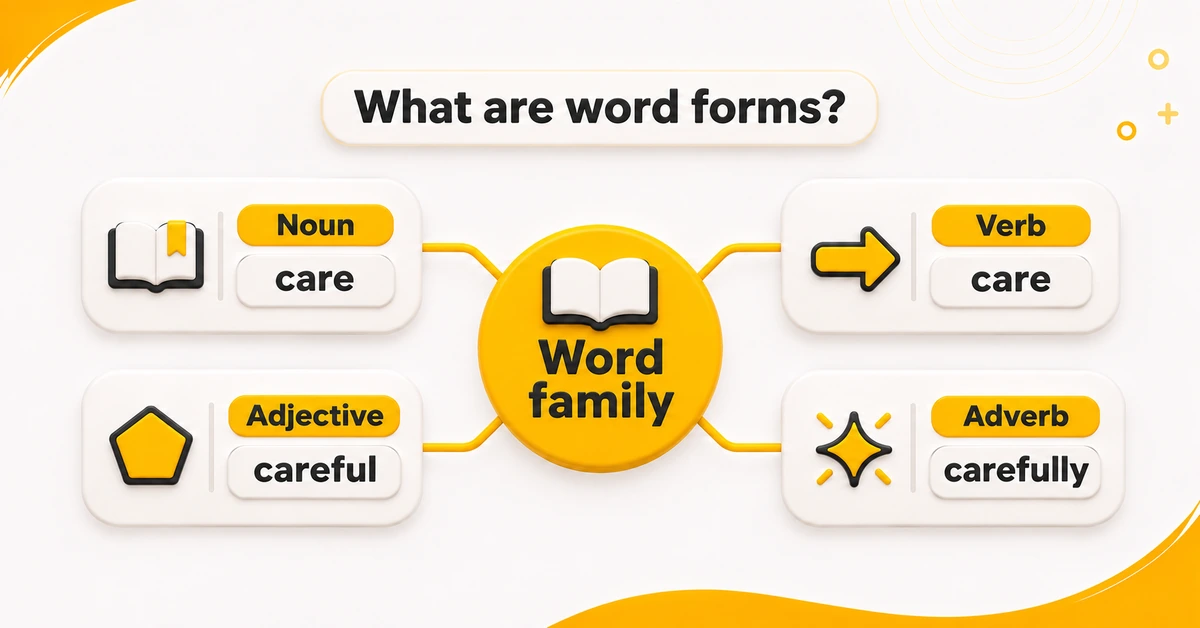
A word form is the shape a word takes for a specific job. Sometimes a word changes shape yet stays in the same group: help, helps and helped are all forms of the verb help. Other times, a new shape builds a related word with a new role. Helpful, for example, is an adjective describing someone or something that helps.
Start with four core word classes (also called parts of speech). A word class simply names what a word does.
| Word class | What it does | Example |
|---|---|---|
| Noun | Names a person, place, thing or idea | The student needs help. |
| Verb | Shows an action or state | We read. The answer is clear. |
| Adjective | Describes a noun, or describes the subject after a linking verb | This is a clear answer. The answer is clear. |
| Adverb | Tells more about a verb, an adjective or another adverb | She speaks clearly. Her answer is very clear. |
In that table, is works as a linking verb. It does not show an action like read. Instead, it joins the subject to a word that describes it. In “The answer is clear,” is links the answer to clear.
You do not need to learn long grammar terms before practising. Just ask what each word does. In “She reads carefully,” reads names the action, while carefully tells you how she reads.
One family, several jobs
A word family is a group of related words. Related words can take different roles, as the care family shows below.
| Form | Word class in this sentence | Example sentence |
|---|---|---|
| care | Noun | Check every answer with care. |
| care | Verb | We care about clear guidance. |
| careful | Adjective | A careful check caught the mistake. |
| carefully | Adverb | She checked every line carefully. |
Look at the first two rows. Care keeps the exact same spelling, yet it acts as a noun in the first sentence and a verb in the second. Spelling alone does not always tell you a word’s class; check the sentence around it.
Also separate two kinds of changes. Turning help into helpful creates a related adjective from the verb. Turning help into helped changes the verb form, and student to students makes a singular noun plural while keeping it a noun.
How do you choose the right form in a gap?
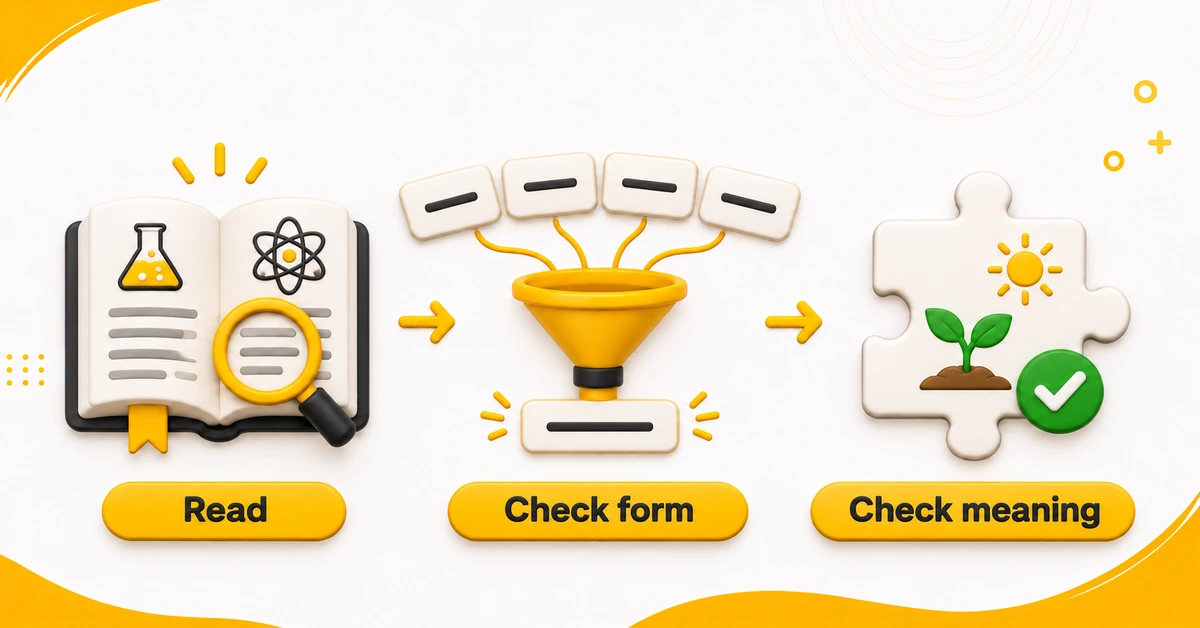
Do not look only at the gap and guess by sound. Read the full sentence first. The words on both sides show which forms fit.
Look for a sentence pattern
These five common patterns help you narrow the options.
| Sentence pattern | Example | Why this form fits |
|---|---|---|
| Adjective + noun | a careful reader | Describes the noun (reader) |
| Linking be + adjective | The instructions are clear. | Describes the subject (the instructions) |
| Verb + adverb of manner | Read carefully. | Shows how to do the action |
| Can + base verb | We can develop the idea. | Uses the verb in its base form |
| Plan + to + base verb | We plan to review the notes. | Uses the plain verb after plan to |
A base verb is the plain dictionary form before adding verb endings such as -s, -ed or -ing, like read, develop or review. Write “can develop,” not “can develops,” and “plan to review,” not “plan to reviewed.”
Treat these patterns as signposts, not rigid rules about two neighbouring words. A noun can follow be too: “She is a teacher.” An adverb can sit between can and the main verb: “We can carefully check it.” Always read the full structure.
The word to does not always take a base verb either. Compare “I plan to read” with “I look forward to reading.” The second sentence uses look forward to + -ing. Learn the whole expression instead of making a rule from to alone.
Use word endings as clues, not proof
Word endings give a useful first hint. You often see -ment in nouns like development, -ful in adjectives like careful and -ly in adverbs like carefully.
Even so, an ending does not always identify a word’s class. Friendly ends in -ly yet is an adjective: “She is a friendly teacher.” Fast works as an adverb without -ly: “She reads fast.” And developed can be a verb form in “They developed a plan,” or an adjective in a suitable sentence.
When you feel unsure, open a learner’s dictionary. Check the word-class label, meaning and an example sentence. No ending list replaces those checks.
Work through one example step by step
Let’s apply these steps to one sentence:
The tutor explained the rule ___, so everyone understood it.
clearly / clarity / clarify / clear
Start with the missing word’s job. We already have who acted (the tutor), the action (explained) and what the tutor explained (the rule). We now need to know how the tutor explained it, so an adverb fits.
That rules out three choices. Clarity is a noun naming clearness. Clarify is a verb meaning to make something easier to understand. Clear works as an adjective in “a clear explanation,” not to show how someone explained a rule.
Put clearly in the gap and read the whole sentence: “The tutor explained the rule clearly, so everyone understood it.” Both grammar and meaning fit. Always do that final meaning check, because two options can share a word class yet express different ideas.
For wider advice on the Reading section, our PTE Academic Reading guide explains how to approach each Reading task.
Can you choose the word forms yourself?
Write your answers first, before scrolling to the key. Beside each choice, note the job you looked for (such as “describes a noun” or “base verb after can”). Finish a full set before checking its answers.
Set 1: Choose one option for each sentence
- Please make a ___ check before you submit the form.
A. care · B. carefully · C. careful · D. cares - The tutor’s explanation is ___.
A. clarity · B. clear · C. clarify · D. clearly - She reads each instruction ___ before starting.
A. careful · B. care · C. carefully · D. cares - Our team can ___ a better plan.
A. development · B. develops · C. developed · D. develop - We plan to ___ the meaning of this sentence.
A. clarity · B. clearly · C. clarify · D. clarified - The new project was a ___.
A. success · B. succeed · C. successful · D. successfully - They completed the task ___.
A. success · B. succeed · C. successful · D. successfully - The editor praised the ___ of the instructions.
A. clear · B. clearly · C. clarify · D. clarity
Set 2: Complete a connected passage
Choose one option for each numbered gap.
Each group will (9) ___ a short guide for new students. Before writing, make a very (10) ___ plan. Read every line (11) ___ when the first version is ready. Comments from a test reader can improve the (12) ___ of your instructions.
- develop / development / developed / develops
- care / carefully / careful / cares
- careful / care / carefully / cares
- clarity / clarify / clearly / clear
Set 3: Replace the bold word
Replace only the bold word with the right form from the same word family. Keep all the other words unchanged.
- The trainer gave us a clearly explanation.
- We can improves the guide.
- They plan to reviewing the notes tonight.
- She answered the question careful.
Answers: Set 1
- C — careful. This gap needs an adjective to describe check. Care is a noun or verb, carefully is an adverb, and cares cannot describe check.
- B — clear. After linking is, clear describes the explanation. Clarity names a quality, clarify is a verb, and clearly is an adverb.
- C — carefully. We need an adverb showing how she reads. Careful describes a noun, while care and cares do not tell how an action happens.
- D — develop. Use the base verb after can. Develops and developed carry endings that do not fit with can, and development is a noun.
- C — clarify. Follow plan to + base verb. Clarified is the wrong verb form here, clarity is a noun, and clearly is an adverb.
- A — success. After was a, the sentence needs a noun (“a success”). Successful cannot stand alone after a here; removing a gives “The new project was successful.” Succeed is a verb; successfully is an adverb.
- D — successfully. This gap tells how they completed the task, so it takes an adverb. The noun success, verb succeed and adjective successful do not fit.
- D — clarity. The editor praised a quality of the instructions, so this slot takes a noun. Clear, clearly and clarify do other jobs.
Answers: Set 2
- Develop. Will takes the base verb, just like can. The noun development and the forms developed and develops do not fit here.
- Careful. Very modifies the adjective careful, which describes plan. The other options (care, carefully and cares) do not fit that structure.
- Carefully. Here an adverb tells you how to read every line. Careful describes a noun, and care or cares cannot show how to read.
- Clarity. Comments improve a quality of your instructions, so we need a noun. Clarify, clearly and clear cannot fill that noun spot.
Answers: Set 3
- The trainer gave us a clear explanation. Explanation is a noun, so it takes the adjective clear rather than the adverb clearly.
- We can improve the guide. Drop -s and use the base verb improve after can.
- They plan to review the notes tonight. Replacing only the bold word gives review, because plan to takes to + base verb, not to + -ing.
- She answered the question carefully. The sentence shows how she answered, so it needs the adverb carefully instead of the adjective careful.
What to practise next
Pick two questions you missed. Copy each correct sentence into a notebook, underline the clue that decided the form, and write one new sentence with the same pattern. If verb endings caused most of your slips, our subject–verb agreement guide is a helpful next read.
References and Useful Resources
- Pearson: PTE Academic Reading — official fill-in-the-blank task advice.
- Douglas College: Parts of speech and word forms — word classes, examples and shared endings.
- British Council: Link verbs — nouns and adjectives after linking verbs.
- British Council: Adverbials of manner — -ly forms and common exceptions.
- Collins English Dictionary — a learner’s dictionary entry showing word class, meaning and verb forms.


