Book PTE Exam
 PTE Voucher
 PTE Mock Tests
 Pricing
 About Us
 Blog
 Practice


Key Takeaway
- Find the subject before choosing or changing a verb.
- A phrase between the subject and verb does not change their agreement.
- Check forms such as is/are, has/have and helps/help.
- Try the exercises before opening the answers.
You write “The results shows a clear change”, then pause. Is it shows or show? Rather than changing the word by feel, look for the subject: the results. Write “The results show a clear change”.
We’ll work through subject–verb agreement for PTE Academic with short rules and original practice. Start with simple sentences, then try longer ones. Keep your first answers so you can see exactly what you changed.
What does subject–verb agreement mean?
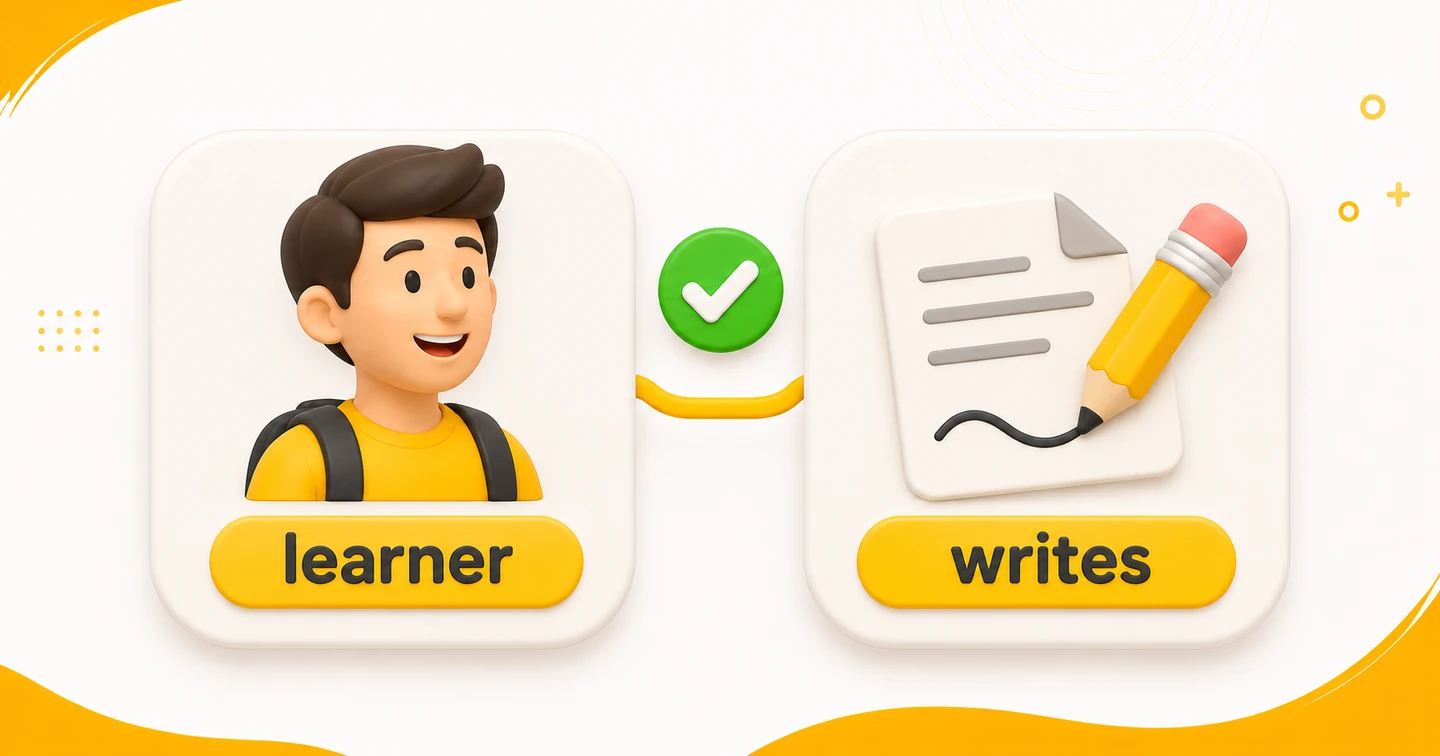
The subject names who or what does the action or is in the state described.
A verb expresses an action or a state of being.
Look at “The learner writes”. The learner is the subject; writes is the verb. In “The learner is ready”, is links the learner to the state of being ready. You are still checking a subject and a verb.
Subject–verb agreement means choosing a verb form that matches its subject.
Compare our original examples:
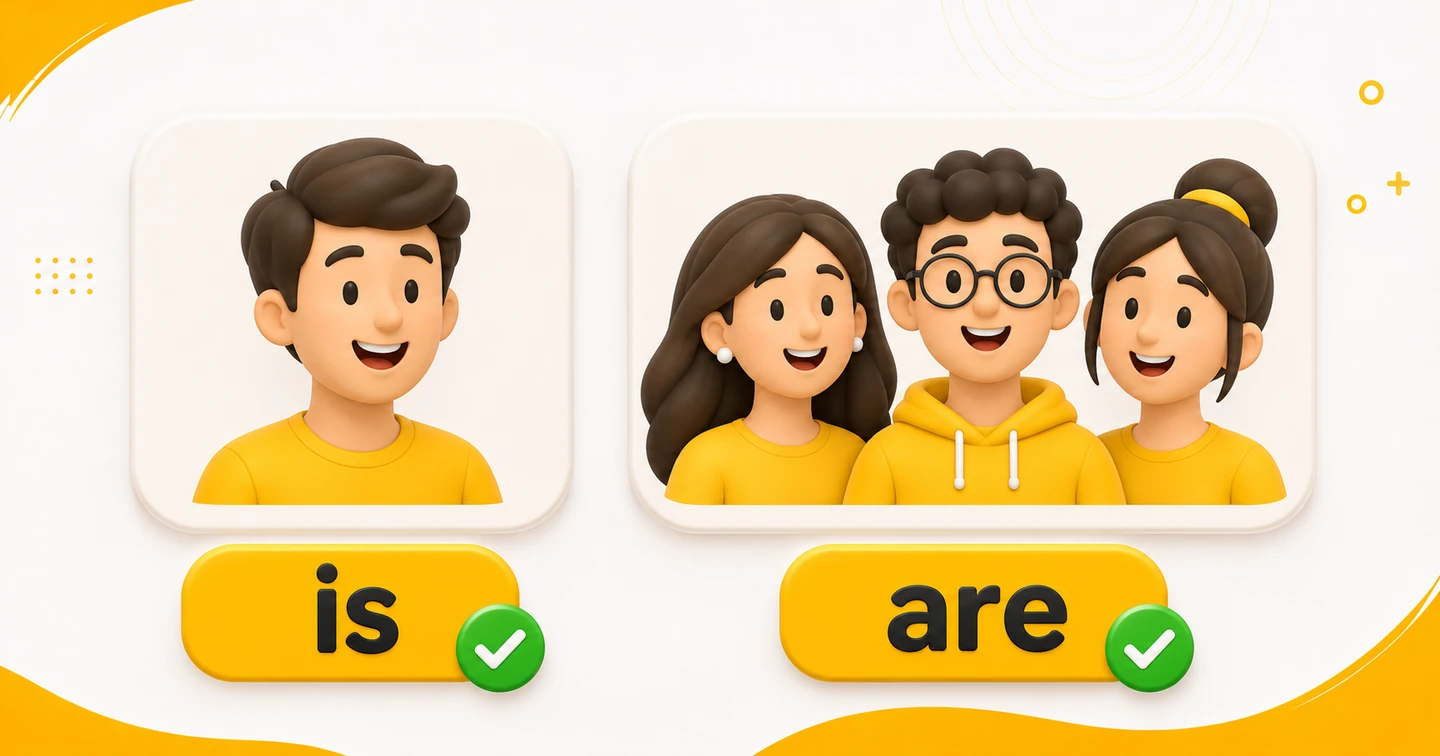
- One learner writes a short answer.
- Two learners write short answers.
One learner is singular; two learners are plural. Notice the difference between writes and write. Do not decide that adding an s makes both a noun and a verb plural.
This lesson focuses on present-simple forms, such as “writes”, “is” and “has”. Work through those forms first rather than trying to study every tense at once.
Pearson’s PTE Academic Reading guidance tells you to check grammar and meaning when choosing words for Fill in the Blanks.
Use this lesson to practise one grammar check. Then return to our PTE Reading practice guide for broader question practice.
Which verb forms match in the present simple?
Start with the subject in the first column. Read across the row, then say one complete example aloud. The table shows positive statements, not questions or negative sentences.
| Subject | Be | Have | Example with write |
|---|---|---|---|
| I | am | have | I write. |
| You / we / they | are | have | You write. We write. They write. |
| He / she / it | is | has | He writes. She writes. It writes. |
In positive present-simple statements, most verbs add s or es with he, she or it.
For example: “She reads”, “He checks” and “It works”. The subject can also be a name: “Mina reads”. Try replacing Mina with she while you check.
Use the base form with I, you, we and they in positive present-simple statements with ordinary verbs.
Base form means the form such as read, before adding an ending. Compare “I read” with “She reads”. “You read” stays the same whether you means one person or several.
Be has its own forms: I am; you, we and they are; he, she and it is.
So “I is ready” is incorrect. Write “I am ready”. Do not add an s to am or are. Use the form that belongs with the subject.
Use has with he, she and it; use have with I, you, we and they.
Try “The course has two parts” and “The courses have two parts”. In the first example, the course matches it. In the second, the courses matches they.
These patterns follow the British Council’s present-simple lesson and the University of California, Davis, agreement table.
How do you find the subject in a longer sentence?
Read the whole sentence, then find the words that belong together. Use the comparisons below to practise. They show selected patterns, not every agreement rule.
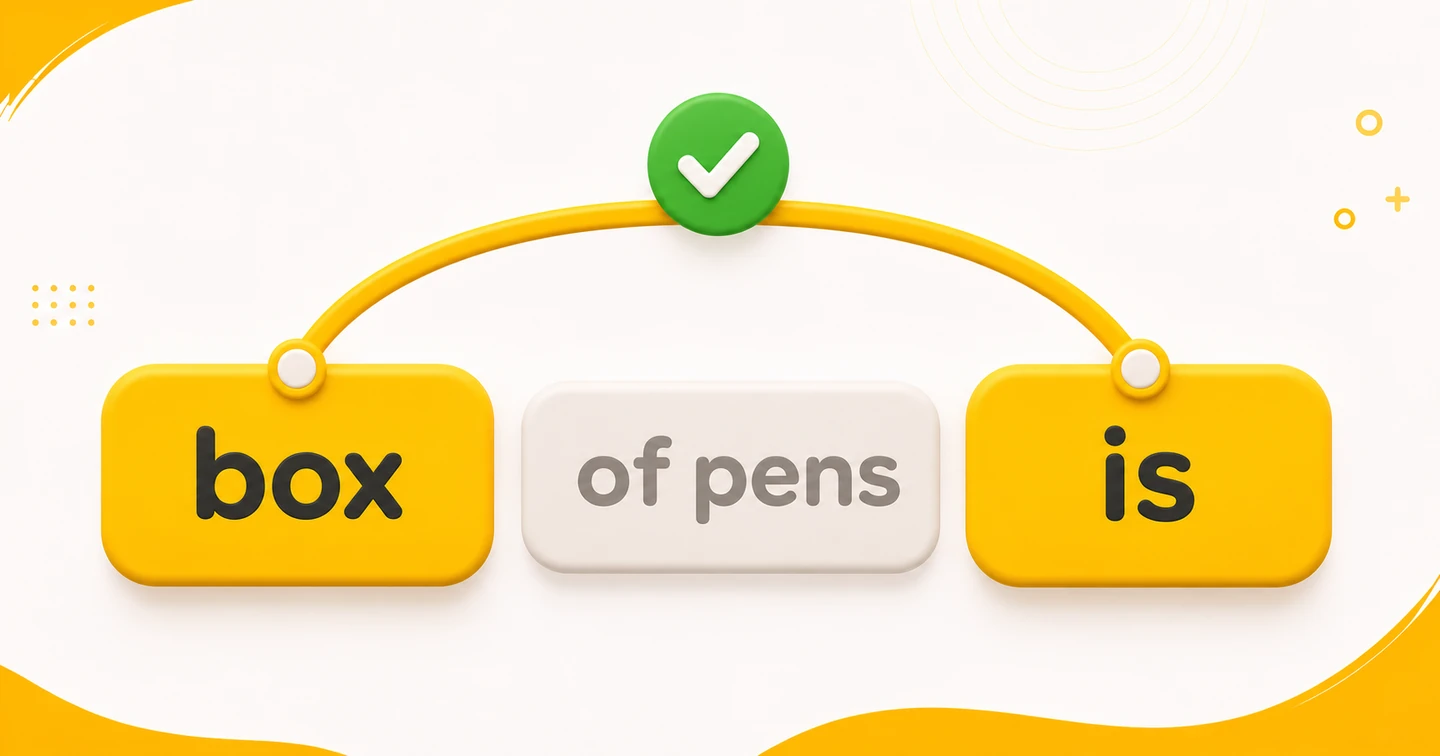
Extra words between the subject and verb. Compare “The box is open” with “The box of pens is open”.
A phrase between the subject and verb does not change their agreement.
In the longer example, of pens describes the box. Match is with box, not with pens. Now reverse the number: “The boxes beside the door are open”. Door is closer to the verb, but boxes is the word to check.
During study, put brackets around the extra phrase: “The box [of pens] is open”. Read “The box is open” before restoring the full sentence. Keep the extra words in your final answer.
Each and every before a noun.
When each or every comes before a singular noun that is the subject, use a singular verb.
Compare “The visitors have a ticket” with “Each visitor has a ticket”. “Every visitor has a ticket” uses the same singular pattern.
When each is the subject in a phrase such as “each of the visitors”, it takes a singular verb.
Write “Each of the visitors has a ticket”. The plural word visitors inside the of phrase does not make have correct. Check what each is doing rather than changing a verb whenever you see that word anywhere.
Two separate people joined by and.
When two separate people are joined by and as the subject, use a plural verb.
“Mina and Ravi are ready” refers to two people. “Mina is ready” refers to one. Read the pair of names as they while you check the verb.
There is and there are.
Use there is with a singular noun and there are with a plural noun.
Compare “There is a desk by the window” with “There are three desks by the window”. Read the noun after the verb before choosing. These examples describe one item or several items of the same kind, rather than a mixed list.
Need help deciding whether a noun is countable? Our countable and uncountable noun lesson covers that separate step. For longer-sentence agreement, Purdue OWL’s guide gives further examples.
Can you choose and correct the verbs yourself?
We wrote these exercises for this lesson. They are grammar practice, not real Pearson questions or a full PTE practice test. Work without a timer first. Write your answers before opening each answer panel.
Set 1: choose one verb. Read each complete sentence. Circle the word you choose and underline its subject.
- The speaker explain / explains the main idea clearly.
- Two speakers explain / explains the same chart.
- I am / is ready to begin.
- You has / have enough space for your notes.
- The list of topics is / are on the desk.
- Each learner check / checks one answer.
- Every room has / have a window.
- Mina and Ravi is / are in the reading room.
- There is / are two notices by the entrance.
- Each of the folders contain / contains a short report.
Show Set 1 answers and explanations
- explains. The speaker is one person, so match the verb with he or she.
- explain. The subject is two speakers, so use the same form as they.
- am. The matching pair is I am.
- have. Use have with you, including when it refers to one person.
- is. List is the word to match. Of topics adds detail.
- checks. Each learner is the singular subject.
- has. Every room is singular; the pair matches it has.
- are. Mina and Ravi are two separate people joined by and.
- are. The noun phrase after the verb is two notices, which is plural.
- contains. Each is the subject. Of the folders does not change its singular agreement.
Set 2: correct one verb error. Keep the subject and the rest of the meaning. Write the complete corrected sentence.
- The instructions on the page is clear.
- Each of the notebooks have a coloured cover.
- The tutor and the learner checks the answer together.
- There are one spare chair near the door.
Show Set 2 corrections and explanations
- The instructions on the page are clear. The word instructions is plural. Page is part of the extra phrase.
- Each of the notebooks has a coloured cover. Each takes singular agreement here. Match it with has.
- The tutor and the learner check the answer together. Two separate people form the subject. Use check.
- There is one spare chair near the door. One spare chair is singular, so choose there is.
Set 3: complete a connected passage. Choose from the pair beside each gap. Check each subject separately.
A student club organises a weekly book exchange. The box of returned books (1) ___ near the entrance. (is / are) Each member (2) ___ a card before borrowing a book. (show / shows) Mina and Ravi (3) ___ the cards together. (check / checks) There (4) ___ three shelves for books ready to borrow. (is / are)
Show Set 3 answers and explanations
- is. The word box is singular. The words returned books are inside the extra phrase.
- shows. Each member is a singular subject.
- check. Mina and Ravi are two separate people, so use the plural pattern.
- are. The phrase three shelves is plural.
After checking, choose one mistake to work on. Write the full correct sentence and underline the subject. Then make a new example with different words. For instance, change “The list of topics is…” to “The list of rooms is…”. Check your new sentence without looking at the answer panel.
When you return to a complete essay, use our worked essay proofreading lesson to check the answer’s meaning as well as its grammar. Keep this agreement check as one part of that wider review.
Frequently asked questions
Why is “I writes” wrong if I means one person?
Use the base form with I in a positive present-simple statement with an ordinary verb: “I write”, not “I writes”.
Learn the full subject pattern rather than treating every reference to one person as he, she or it.
Do I match the verb with the nearest noun?
A noun inside a phrase between the subject and verb does not control their agreement.
In “The box of pens is open”, check box, not pens. Find the subject before choosing the form.
What can I do if I keep missing the same pattern?
Try a short review with one pattern only. Cover its answers, attempt fresh sentences and explain each choice. Ask a teacher to check any correction you cannot explain. Add another pattern after reviewing that work.
What can you try next?
Take one paragraph you wrote today. Mark its subjects and verbs, then read each pair on its own. Keep one correction in your notes and write a fresh sentence using that pattern tomorrow.
References and Useful Resources
- University of Melbourne: forming subject–verb agreement.
- British Council: present-simple forms.
- British Council: am, is and are.
- British Council: there is and there are.
- University of California, Davis: agreement forms and subject patterns.
- University of California, Davis: subject and verb definitions.
- Purdue OWL: subjects separated from their verbs.
- University of Wisconsin–Madison: subjects joined by and.
- Pearson: PTE Academic Reading guidance.